

Abelam
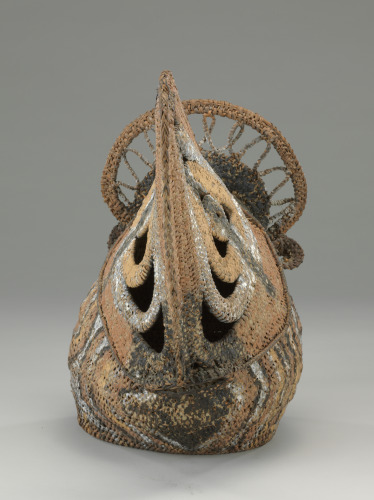
Helmet Mask and Skirt for Yam Ceremony
Abelam, 1933-1966
Scroll

Abelam
Helmet Mask and Skirt for Yam Ceremony
Abelam, 1933-1966
Physical Qualities
Fiber, wood, bamboo, pigments, 66 9/16 x 15 3/4 x 17 11/16 in. (169 x 40 x 45 cm.)
Credit Line
Gift of A. Harvey and Phyllis K. Schreter, Baltimore
Object Number
1991.416
For yam ceremony Yam helmet and skirt attached together with stick frame at base of helmet. Helmet is made of plaited bamboo with red, black and white vertical stripes. Beak-shaped front of helmet is openwork: roughlysquare-shaped - 2 nested squares with central circle. Openwork 'diadem' across the top of the helmet. Helmet comes to a point behind diadem. Skirt composed of lengths of fibers folded over a fiber thong and held in place by fiber in 'whipstitch' pattern.
Black, red, white and yellow pigments
The Baltimore Museum of Art by gift 1991; Harvey and Phyllis K. Schreter
Coupaye, Ludovic. Growing artefacts, displaying relationships: yams, art and technology amongst the Nyamikum Abelam of Papua New Guinea. Vol. 2. Berghahn Books, 2013.
Losche, Diane. "What Do Abelam Images Want from Us?: Plato's Cave and Kwatbi's Belly." The Australian journal of anthropology 8, no. 2 (1997): 35-49.
Losche, Diane. "The Sepik gaze: Iconographic interpretation of Abelam form." Social Analysis: The International Journal of Social and Cultural Practice 38 (1995): 47-60.
Forge, Anthony. “Style and Meaning in Sepik Art,” in Primitive Art and Society, ed. Anthony Forge, 169-192. London: Oxford Univ. Press.1973.
Forge, Anthony.“Art and Environment in the Sepik,” in Art and Aesthetics in Primitive Societies , ed. C. Jopling, 290-314. NY: E. P. Dutton. 1971
Losche, Diane. "What Do Abelam Images Want from Us?: Plato's Cave and Kwatbi's Belly." The Australian journal of anthropology 8, no. 2 (1997): 35-49.
Losche, Diane. "The Sepik gaze: Iconographic interpretation of Abelam form." Social Analysis: The International Journal of Social and Cultural Practice 38 (1995): 47-60.
Forge, Anthony. “Style and Meaning in Sepik Art,” in Primitive Art and Society, ed. Anthony Forge, 169-192. London: Oxford Univ. Press.1973.
Forge, Anthony.“Art and Environment in the Sepik,” in Art and Aesthetics in Primitive Societies , ed. C. Jopling, 290-314. NY: E. P. Dutton. 1971