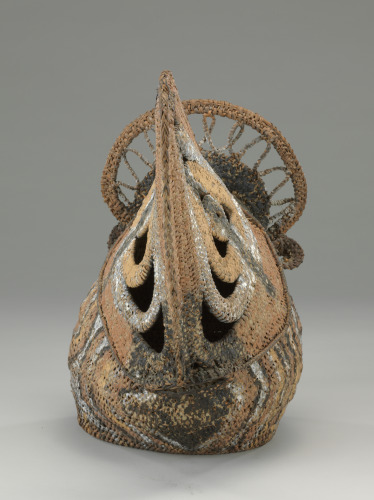

Abelam
Helmet Mask (Baba Tagwa)
Abelam, 1929-1963
Scroll

Abelam
Helmet Mask (Baba Tagwa)
Abelam, 1929-1963
Physical Qualities
Cane, raffia, feathers, pigments, possibly vegetable paste, 14 x 15 in. (35.6 x 38.1 cm.)
Credit Line
Gift of The Hecht Company
Object Number
1964.2.13
White and red pigments
The Baltimore Museum of Art by gift 1964; the Hecht Company
Coupaye, Ludovic. Growing artefacts, displaying relationships: yams, art and technology amongst the Nyamikum Abelam of Papua New Guinea. Vol. 2. Berghahn Books, 2013.
Losche, Diane. "What Do Abelam Images Want from Us?: Plato's Cave and Kwatbi's Belly." The Australian journal of anthropology 8, no. 2 (1997): 35-49.
Losche, Diane. "The Sepik gaze: Iconographic interpretation of Abelam form." Social Analysis: The International Journal of Social and Cultural Practice 38 (1995): 47-60.
Forge, Anthony. “Style and Meaning in Sepik Art,” in Primitive Art and Society, ed. Anthony Forge, 169-192. London: Oxford Univ. Press.1973.
Forge, Anthony. “Art and Environment in the Sepik,” in Art and Aesthetics in Primitive Societies , ed. C. Jopling, 290-314. NY: E. P. Dutton.1971.
Losche, Diane. "What Do Abelam Images Want from Us?: Plato's Cave and Kwatbi's Belly." The Australian journal of anthropology 8, no. 2 (1997): 35-49.
Losche, Diane. "The Sepik gaze: Iconographic interpretation of Abelam form." Social Analysis: The International Journal of Social and Cultural Practice 38 (1995): 47-60.
Forge, Anthony. “Style and Meaning in Sepik Art,” in Primitive Art and Society, ed. Anthony Forge, 169-192. London: Oxford Univ. Press.1973.
Forge, Anthony. “Art and Environment in the Sepik,” in Art and Aesthetics in Primitive Societies , ed. C. Jopling, 290-314. NY: E. P. Dutton.1971.