Thomas Moran
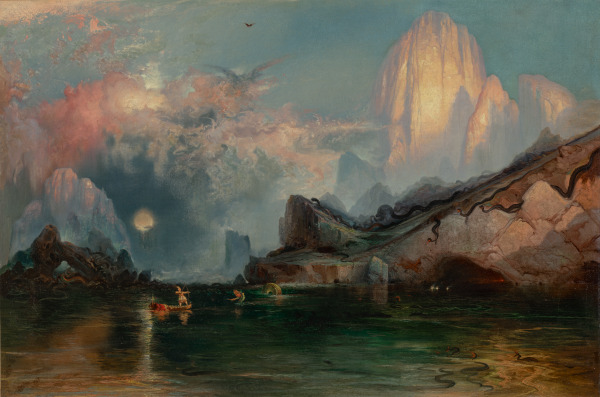
Hiawatha and the Great Serpent, the Kenabeek
1866
Scroll
Thomas Moran
Hiawatha and the Great Serpent, the Kenabeek
1866
Physical Qualities
Oil on canvas, Framed: 27 3/8 x 37 1/8 x 4 1/8 in. (69.5 x 94.3 x 10.5 cm) Sight: 19 1/2 x 29 1/2 in. (49.5 x 74.9 cm)
Credit Line
Friends of Art Fund
Object Number
1967.17
Thomas Moran drew inspiration for this painting from the 1855 epic poem “The Song of Hiawatha” by Henry Wadsworth Longfellow (1807–1882). The popular poem, set on the southern shores of Lake Superior in the Pictured Rocks area of what is now Michigan, details the adventures of a mythical Ojibwe warrior, not related to the 16th-century historical Haudenosaunee (Iroquois) leader of the same name. In the mid-19th century, artists and writers depicted idealized Native Americans within the narrative of a “vanished” past, which conveniently aligned with American expansionist goals: by the 1860s, white settlers had forced countless thousands of Native Americans off of their traditional homelands.
Frederick Judd Waugh, Philadelphia; Jules Brassner, Palm Beach, Florida; Gallery Gertrude Stein, New York; Stephen Mazoh, New York
I Like America
American Wing Rotations 2023
American Wing Rotations 2024
American Wing Rotations 2025
"American Sublime: Landscape Painting in the United States 1820-1880"; Andrew Wilton and Tim Barringer; Tate Publishing, London, 2002; p. 245, cat. 96.
Pamela Kort and Max Hollein, eds., "I Like America: Fictions of the Wild West," Prestel, Munich, 2006, p. 174, cat. 127.
Sona K. Johnston, "American Painting 1750-1900 from the Collection of The Baltimore Museum of Art," 1983, pp. 108-100, ill. p. 109.
BMA News, vol.30, nos. 1&2, 1968, ill. p. 20
"Accessions of American and Canadian Museums, January-March, 1967," The Art Quarterly, Summer 1967, p. 154, ill. p. 167
"Accessions of American and Canadian Museums, January-March, 1967," The Art Quarterly, Summer 1967, p. 154, ill. p. 167
Inscribed: l.l., T. Moran 1867/Op 34
 On View at the BMA