William Randle and Robert Davis
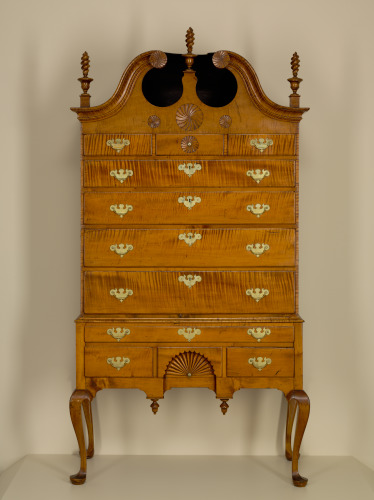
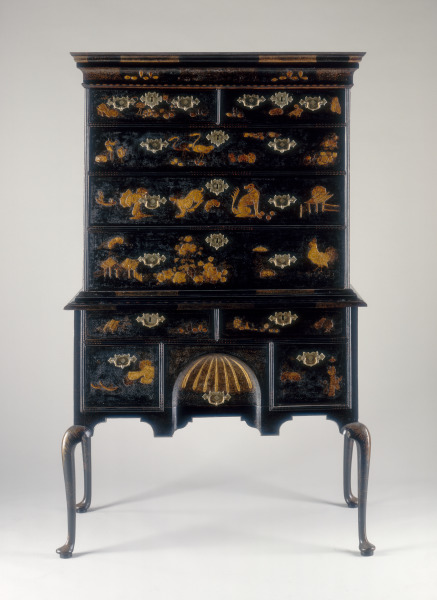
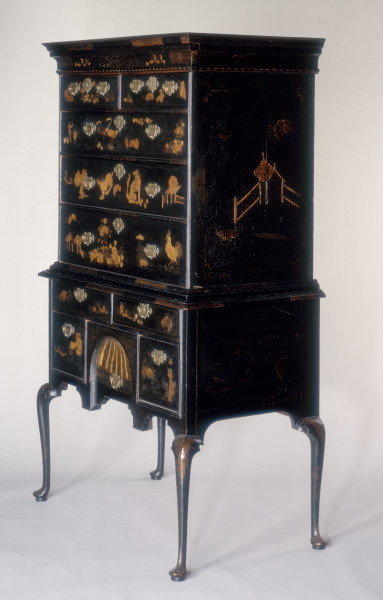
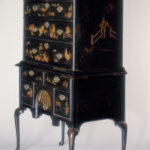
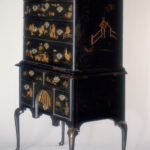
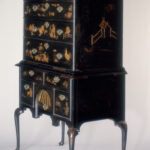
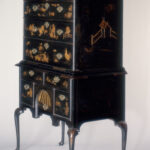
High Chest of Drawers
1727-1737
Scroll
Physical Qualities
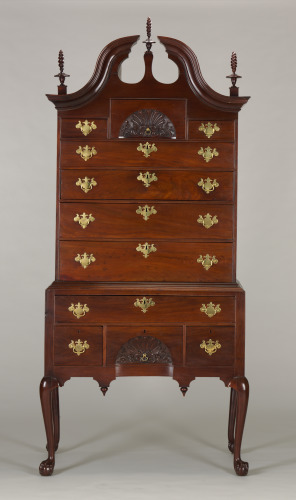
Maple, white pine, paint, gilt, gold leaf, gesso, brass; three replaced bails, 68 1/16 x 43 3/4 x 24 1/2 in. (172.9 x 111.1 x 62.2 cm.)
Credit Line
Purchased as the gift of Mr. and Mrs. Francis C. Taliaferro in Memory of Mr. and Mrs. Austin McLanahan
Object Number
1970.37.4
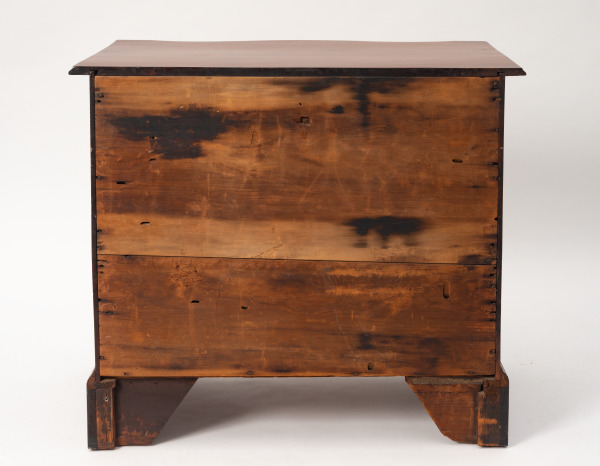
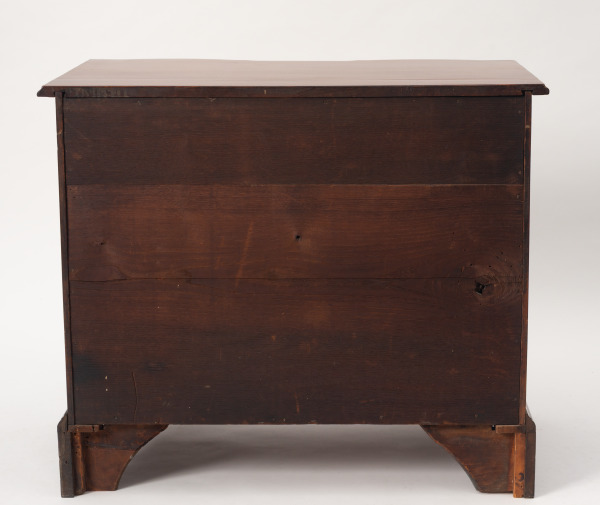
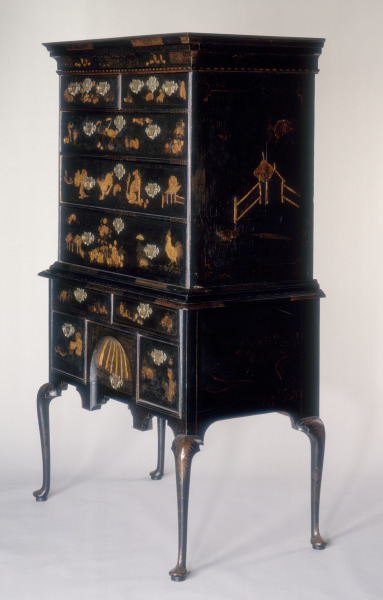
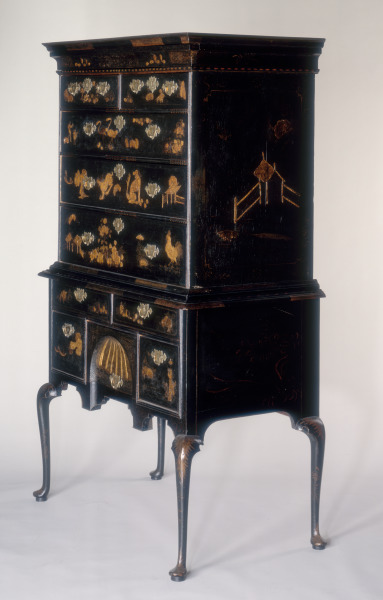
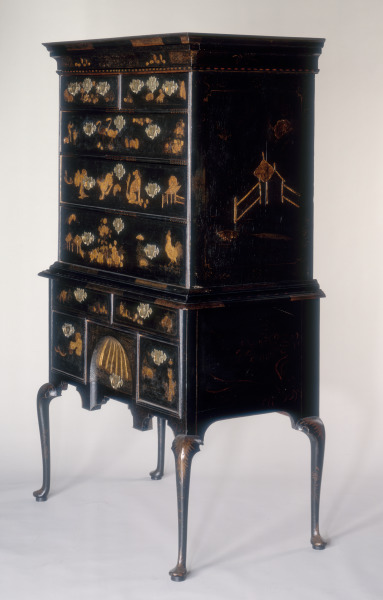
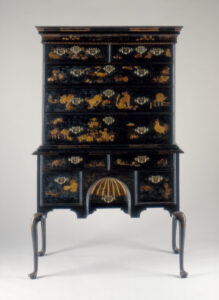
With its powerful stance and fanciful ornamentation, this capacious chest, lifted high above the floor on elegant serpentine legs, is a remarkable survivor. Inspired by Asian lacquers, the delicate surfaces of japanned case pieces made them the most perishable high-style furniture produced in 18th-century America. Only about 40 examples are known. Such furniture first appeared in Holland and England during the reign of Charles II (ruled 1660–1685). As demand for Chinese and Japanese imports exceeded supply, Western craftsmen quickly discovered that imitation was a profitable form of flattery. They combined whimsical surface ornament with practical Western furniture forms. Closely linked to London, Boston became colonial America’s leading center for japanning. The BMA chest underscores the collaborative nature of American furniture making. Robert Davis probably emigrated from England after completing his London apprenticeship at Worshipful Company of Painter-Stainers in 1717. In Boston, he met William Randle, eventually working in partnership with him. By 1735, Davis had married into the family and taken over his father-in-law’s japanning business. Both Randle’s initials and Davis’ signature are on the chest, suggesting that the piece dates from around the time of this union.
The Baltimore Museum of Art, by purchase, 1970; Roland Hammond, Antiques, North Andover, Massachusetts, by 1970; by descent to John Harkness, Hamilton, Massachusetts; Harkness family of Marblehead, Massachusetts.
PAINT! Japanned, Ebonised, Grained, and Polychromed Furniture in the Baltimore Museum of Art
2007-12-31 19:00:00
2007-12-31 19:00:00
AMW Reinstallation 2014
American Wing Rotations 2020
American Wing Rotations 2021
American Wing Rotations 2022
American Wing Rotations 2023
American Wing Rotations 2024
American Wing Rotations 2025
Elder III, William Voss. Japanned High Chest Restored Successfully. 'The Baltimore Museum of Art Record,' Vol. 3, No. 3, Nov. 1972
Museum Accessions, 'Antiques,' June 3, 1973, p. 1070
Elder III, William Voss and Jayne E. Stokes. American Furniture 1680-1880: From the Collection of the Baltimore Museum of Art. Baltimore: Museum of Art, 1987, p. 72-73, ill. 49.
"Important American Furniture, Folk Art and Decorative Arts", New York: Christies, 2012, p. 26, fig. 3.
Christie's. "Christie's Sale 2584/Lot 20-Notes." . http://m.christies.com/sale/lot/sale/23562/lot/5598247/p/1/?KSID=a96af6fbdb7b28b48f9bb8026ba05014 (accessed May 5, 2014).
Inscribed: Inscribed: "WR" [cipher]; "Robert Davis"
Japanner
Robert Davis
1709–1738
American, born England before 1710-1739; active in Boston, 1733-1739
Meet Robert →
 On View at the BMA
Explore the Collection Further