
Unidentified
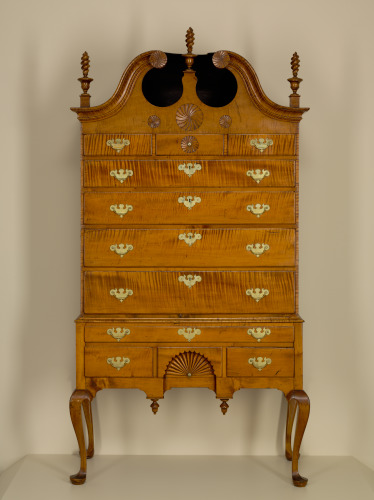
High Chest of Drawers
1759-1779
Scroll
Unidentified
High Chest of Drawers
1759-1779
Physical Qualities
Mahogany; yellow pine, tulip poplar, and sweet gum secondary woods; some replaced brasses, 96 3/8 x 44 1/2 x 24 3/4 in. (244.8 x 113 x 62.9 cm.)
Credit Line
Gift of a Group of Friends in Memory of Howard Sill
Object Number
1929.13.1
This high chest of drawers in the Chippendale style was probably made in Annapolis, Maryland. It entered the BMA collection in 1929, near the end of the Colonial Revival. At that time, such a chest was still considered the quintessential piece of Americana. Nearby objects in the gallery reveal how decades of scholarship have since expanded the canon, embracing other forms and later styles. John Inch, a silversmith, watchmaker, and tavern proprietor who worked in Annapolis, made the oldest recorded piece of Maryland silver to survive. Evidence of a long sporting tradition, the bowl is inscribed as a trophy commemorating the first recorded formal horse race in Maryland. Dungannon, a high-mettled horse imported from England by Dr. George Steuart (1700–1784), won the three- mile head-to-head contest. An English porcelain bowl underscores the stylistic impact of metal forms on ceramics. It is decorated with scenes from a fox hunt. During the “First (Dr. Wall) Period,” from 1751 to 1783, the Worcester Tonquin Manufactory pioneered large-scale production of porcelains decorated with sophisticated transfer prints, a process introduced by English artist Robert Hancock. Hancock based these hunting images on a 1755 engraving by Thomas Burford, which was taken from James Seymour’s painting The Chase. Also depicting a hunt, a Chinese punch bowl made at the Jingdezhen Kilns for export to the West drew on European print sources for its imagery. China’s enormous workforce obviated pressure for time-saving technological advances such as those seen in England, but Western prints and drawings were often provided to show Chinese craftsmen what foreign customers wanted.
The Baltimore Museum of Art by purchase, 1929; Mary Frances DuVal Sill (Mrs. Howard Sill), Prince George's County, Maryland, by 1929; Howard Sill, Prince George's County, Maryland, after 1900.
AMW Reinstallation 2014
American Wing Rotations 2020
American Wing Rotations 2021
American Wing Rotations 2022
American Wing Rotations 2023
American Wing Rotations 2024
American Wing Rotations 2025
Miller, Edgar G. 'American Antique Furniture...,' Vol. 1, Baltimore: Lord Baltimore Press, 1937, pp. 377-378, fig. 662
In the Museums, 'Antiques,' October 1959, p.352
Greenfield, K.R. The Museum: Its First Half Century, 'Anual I,' BMA 1966, repro. p. 68 William Voss Elder III, "Maryland Furniture 1760-1840," 'Antiques', February 1977, pp. 356, 358, illus. pl. 1
Elder III, William Voss and Jayne E. Stokes. American Furniture 1680-1880: From the Collection of the Baltimore Museum of Art. Baltimore: Museum of Art, 1987, p.74-76, ill. 50.
'American Antiques From Israel Sack Collection,' Highland House Publishers, Inc. Vol. IX, 1989. Pl XVII
Maker
Unidentified
2000-01-01 00:00:00–2000-01-01 00:00:00
 On View at the BMA