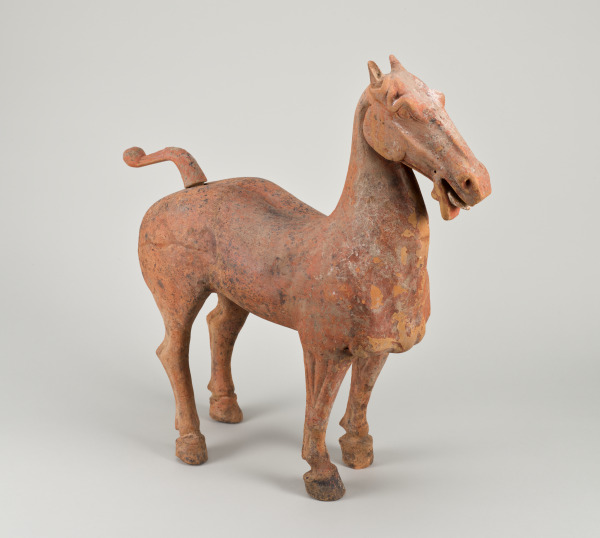
Horse-Headed Figure
701-907
Scroll
Horse-Headed Figure
701-907
Physical Qualities
Earthenware with traces of white slip, 7 1/8 x 2 x 2 3/8 in. (18.1 x 5.1 x 6 cm.)
Credit Line
Gift of Terri and Erwin Harris, Baltimore
Object Number
1986.192.1
The horse and monkey are two of the twelve animals of the Chinese calendrical system. Based on the combination of the Ten Heavenly Stems and Twelve Earthly Branches, the Chinese sixty-year calendar is attributed to the legendary Yellow Emperor and its origin to 2697 B.C. The elements of the Stems alternate the yang and yin aspects of wood, fire, earth, metal, and water. The twelve animals representing the Branches are the rat, bull, tiger, rabbit, dragon, snake, horse, ram, monkey, rooster, dog, and pig.
The Baltimore Museum of Art by gift, 1986; Terri and Erwin Harris, Baltimore