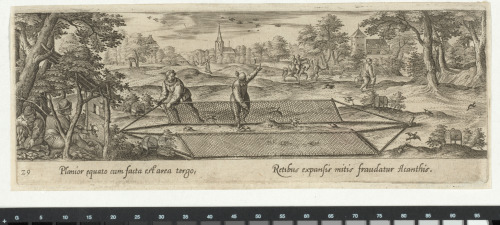
Raoul Dufy and Éditions de La Sirène
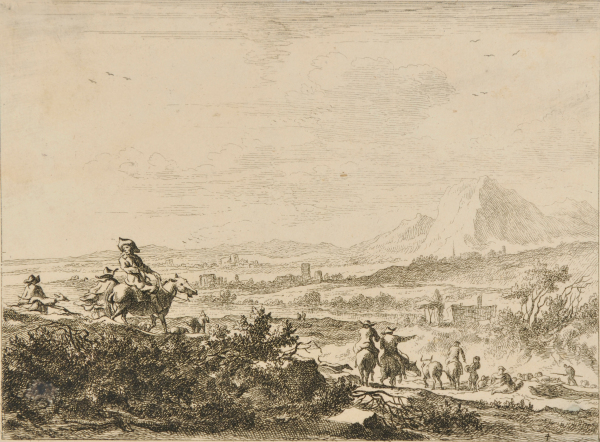
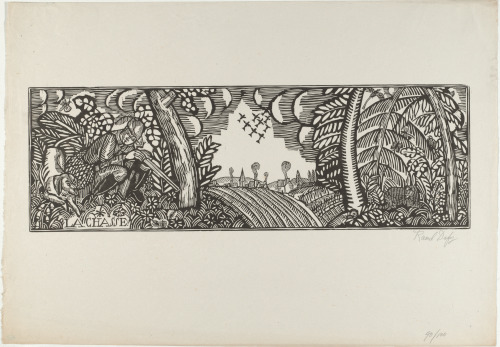
Hunting
1904-1914
Scroll
Physical Qualities
Woodcut, Sheet: 501 x 718 mm. (19 3/4 x 28 1/4 in.)
Image: 210 x 642 mm. (8 1/4 x 25 1/4 in.)
Credit Line
Nelson and Juanita Greif Gutman Fund
Object Number
2006.62
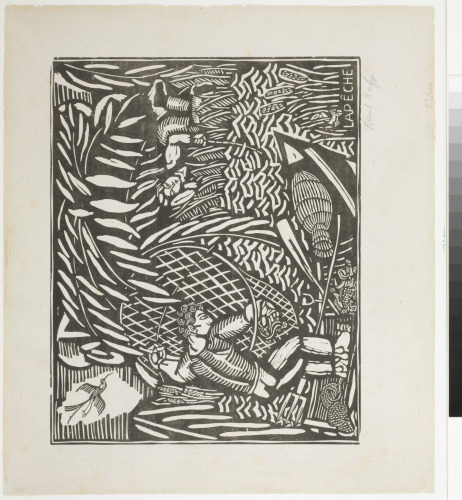
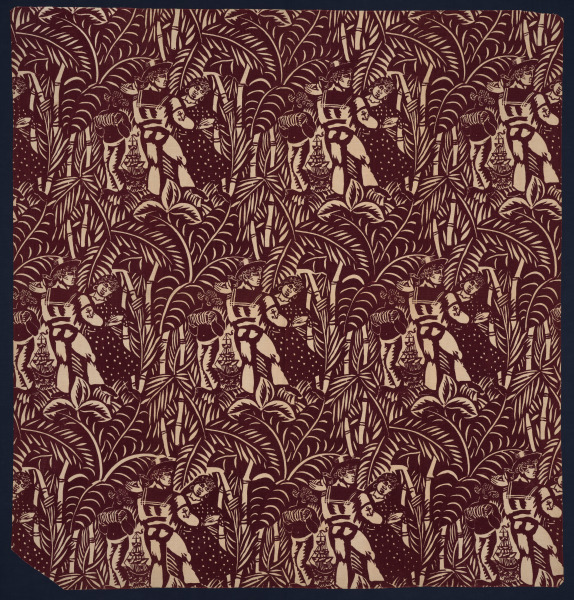
Unlike his Fauve colleagues, who were inspired by Paul Gauguin’s prints of the late 1890s among other influences, Raoul Dufy turned to woodcuts because of his interest in popular prints, such as those seen in almanacs and calendars. He strove to produce images that provided a perfect balance between light and dark throughout the composition. In both Fishing and Hunting, Dufy created crisply rendered figures in landscape settings in a playful and decorative style that were so appealing they
were later printed on fabric.
The Baltimore Museum of Art by purchase, 2006; Carolyn Bullard, Dallas, Texas; Henry M. Petiet
Wild Forms: Fauve Woodcuts
S. Coppel, "The Fauve Woodcut," Print Quarterly, vol. XVI, no, 1 (March 1999), pp. 22-27;
S. Coppel, "Picasso and his Contemporaries," British Museum, 1997, no. 21;
Emmanuel Pernoud, "L'estampe des fauves: Une esthetique du contraste" (Paris: Hermann Editeurs des sciences et des arts, 1994) pp. 88-89, fig. 27;
Dora Perez-Tibi, "Dufy" (NY: Abrams, 1989) 54-57
S. Coppel, "Picasso and his Contemporaries," British Museum, 1997, no. 21;
Emmanuel Pernoud, "L'estampe des fauves: Une esthetique du contraste" (Paris: Hermann Editeurs des sciences et des arts, 1994) pp. 88-89, fig. 27;
Dora Perez-Tibi, "Dufy" (NY: Abrams, 1989) 54-57
Signed: 1
Inscribed: lower left in block: "LA CHASSE"; lower right in graphite: "Raoul Dufy / 90/100"
Markings: CM: verso: at lower right: H.M.P. (Henry M. Petiet, Lugt undesc)