
Arita kilns
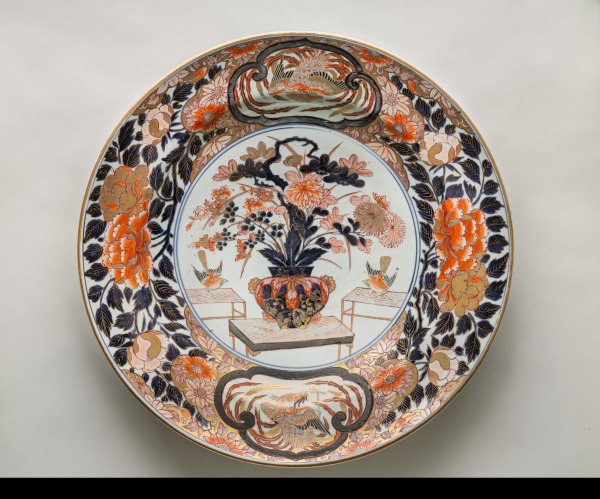
Imari-style Dish Decorated with a Vase of Flowers on a Table
1689-1709
Scroll
Arita kilns
Imari-style Dish Decorated with a Vase of Flowers on a Table
1689-1709
Physical Qualities
Porcelain with underglaze cobalt and overglaze enamel and gold decoration, 3 1/2 H x 21 3/4 Diam. in. (8.9 x 55.3 cm.)
Credit Line
Gift of Minna Lürman
Object Number
1923.4.3
At center is a large Chinese-style bronze vase or basket containing a formal arrangement of flowers which derives from designs on Chinese export porcelain and ultimately, perhaps, from Persian designs. The vase rests on a Chinese-style table shown isometrically flanked by two other tables on which birds have alighted. The wide rim is decorated with pairs of large blossoms and leaves on each side, and with shaped reserves at top and bottom, each framing a phoenix.
This decorative dish reflects a formal and highly disciplined style of flower arranging called 'rikka.' Each flower and bird was specifically chosen to remind the viewer of the passage of time and the beauty of the four seasons. The chrysanthemums, bush-clover, and chokeberry arranged right to left in the vase represent autumn; the peonies and clematis on the rim, spring; the plump sparrows on the tables, winter; and the red-feathered phoenixes, also on the rim, summer. The dish represents a very specific moment in the Genroku era (1688-1704) when 'rikka' was the height of fashion, and flourishing Arita kilns shipped their distinctive porcelain from the port of Imari to markets across Japan and beyond.
The Baltimore Museum of Art by gift 1923; Minna Lürman, Baltimore
John Dorsey, "Imari Porcelain: History beneath the Glaze," "The Sun," November 1985, Maryland Living section, 1L, 10L, 11L, ill. 1L.
Baltimore Museum of Art. The Baltimore Museum of Art: Celebrating a Museum. Baltimore: The Baltimore Museum of Art, 2014.