Henri Matisse, Antoine-Louis Barye, and others
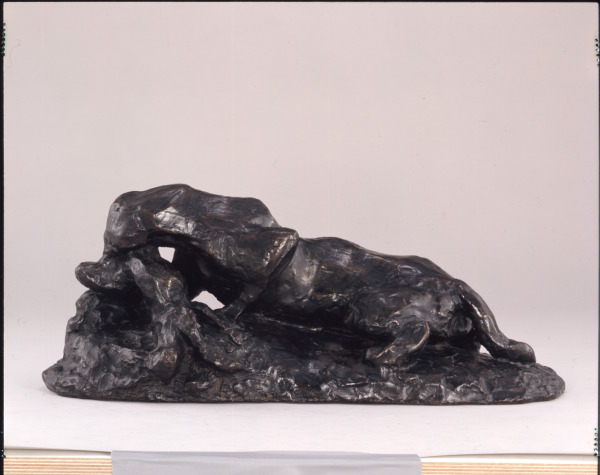
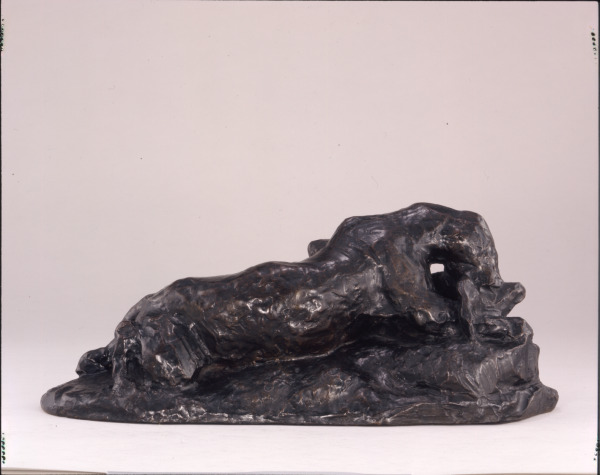
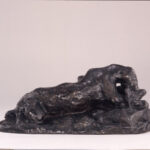
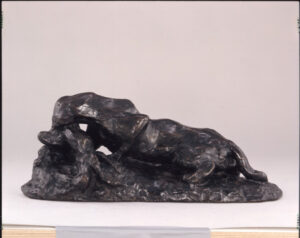
Jaguar dévorant un lièvre
1898-1900
Scroll
- Artist: Henri Matisse
- Artist: Antoine-Louis Barye
- Foundry: Valsuani
Jaguar dévorant un lièvre
1898-1900
Physical Qualities
Bronze, 8 1/2 x 23 x 8 in. (21.6 x 58.4 x 20.3 cm.)
Credit Line
Purchase with exchange funds from the Nelson and Juanita Greif Gutman Collection
Object Number
1999.3
In an attempt to learn as much as possible about depicting all aspects of the figure in his art, Matisse turned to sculpture in 1899. He enrolled in a free municipal art class and, as an exercise, began copying a bronze from the Louvre, Antoine-Louis Barye's Jaguar Devouring a Hare. For the next two years Matisse devoted himself to the investigation of Barye's example, as evidenced in his drawings. He worked on his sculpture while blindfolded to gain a tactile understanding of its twisting masses and he even studied a dissected cat, as Barye was known to do. Ultimately, Matisse translated Barye's dynamic realism into a highly personal idiom comprised of additive modeling and subtractive editing with the knife. The abstract marks of this process remain visible on the surface, while the structural principles underlying Barye's jaguar are retained as a unified gesture that concentrates all the power of the animal into a sinuous arabesque. This serpentine form, recurrent throughout Matisse's career, became the point of departure for his celebrated series of backs.
A close comparison of the two jaguars by Matisse and Barye
reveals the innovative character of Matisse’s sculpture. Both
works suggest enormous muscle power in the long stretchedout
body of the beast. However, unlike Barye who describes
every detail of the jaguar’s fur, Matisse leaves the marks of
his own hands and sculptor’s knife on the jaguar’s body as
evidence of his personal interaction with the clay. By
manipulating the material and reworking the surface, Matisse
produced an entirely new sense of energy unrelated to any
particular set of muscles or bones.
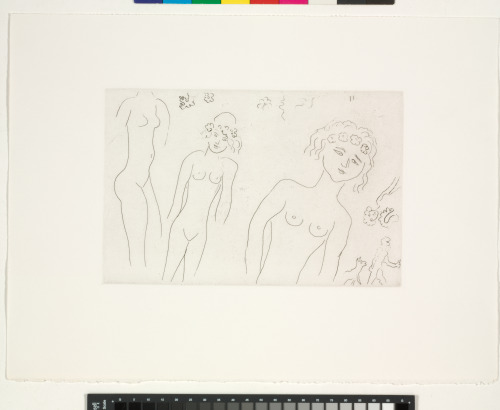
Matisse made several drawings to help him analyze the
interior structural principles and gesture that give Barye’s
jaguar its visceral force. The drawings call attention to the
sinuous line that starts at the jaguar’s tail and spirals through
the rib cage and shoulders to animate the beast. This type
of serpentine line recurs in Matisse’s sculptures throughout
his career. ("Matisse," 2007)
The Baltimore Museum of Art by purchase, 1999; C&M Arts, New York; Private Collection,? ; Arthur Tooth & Sons, Ltd., London; Sotheby's London, December 7, 1966 (#78); Reyntiens; Sotheby's, London, July 7, 1960 (#1); Theodor Ahrenberg, Stockholm; Galerie Samlaren, Agnes Widlund, Stockholm; from the artist
Matisse: Painter as Sculptor
Cone Refresh
Matisse, Life in Color: Masterworks From The Baltimore Museum of Art
Alfred H. Barr, Jr., "Matisse: His Art and His Public," (New York: Museum of Modern Art, 1951) 52, 303.
Raymond Escholier, "Matisse," (New York: Praeger, 1960) 46.
Albert Elsen, "The Sculpture of Matisse," (New York: Harry N. Abrams, 1972) 15-21.
Isabelle Monod-Fontaine, "The Sculpture of Henri Matisse," (London: The Arts Council of Great Britain, 1984) cat. # 2.
Jack Flam, "Matisse: The Man and His Art, 1869-1918," (Ithaca & London: Cornell University Press, 1986) 75-76.
Jack Flam,"Henri Matisse: Sculpture," (New York: C&M Arts, Date?) No. 6 (illustrated).
Hilary Spurling, "The Unknown Matisse," (New York: Alfred A. Knopf, 1998) 200, 212-13.
The Baltimore Museum of Art, "BMA Today," January - February 2004, p.15, ill.
Kosinski, Dorothy, Jay McKean Fisher, and Steven Nash. Matisse: Painter as Sculptor. Baltimore, MD: Baltimore Museum of Art; Dallas, TX: Dallas Museum of Art: Nasher Sculpture Center; New Haven: Yale University Press, 2007, pages 19, fig. 16, 100-102, 105, cat no. 1.
Claude Duthuit and Wanda de Guébriant, "Henri Matisse: Catalgoue raisonné de l'oeuvre sculpté," Paris, Claude Duthuit (publisher), 1997, p. 6, cat. #4 (edition 4).
Inscribed: Signed and numbered beneath tiger's tail: "HM 4/10". Underside: "14" in red paint (twice); three stamps (Sweden) "Zoll 1-10+"; three stickers, "Made in France," and glued to base, page cut from catalogue describing sculpture.
Markings: Foundry stamp behind the Jaguar's proper right rear paw: "Cire - C. Valsuani - perdue"