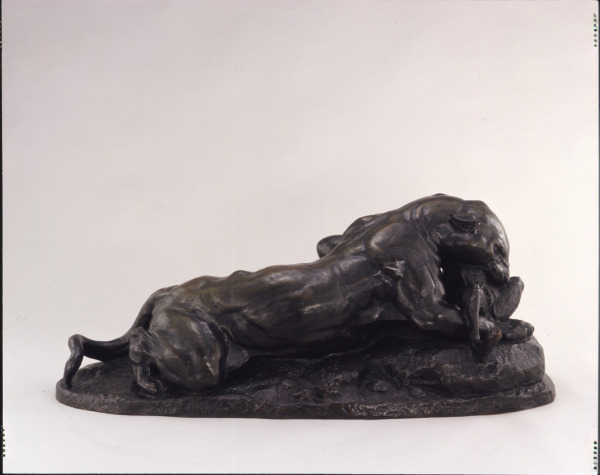
Antoine-Louis Barye
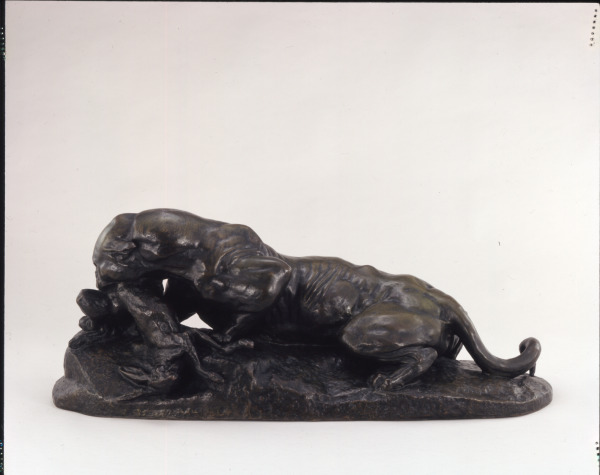
Jaguar Devouring a Hare
1849
Scroll
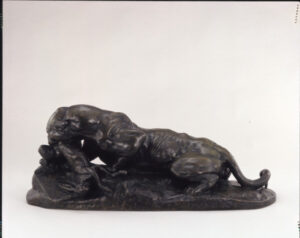
Antoine-Louis Barye
Jaguar Devouring a Hare
1849
Physical Qualities
Bronze, 16 x 40 x 18 in. (40.6 x 101.6 x 45.7 cm.)
Credit Line
Purchased in Honor of Stiles Tuttle Colwill on his 50th Birthday with funds contributed by his Friends and Colleagues
Object Number
2003.199
Antoine-Louis Barye trained initially as a goldsmith and later studied sculpture and
painting, entering the École des Beaux-Arts in 1818. Together with painter, Eugène
Delacroix, he studied animals in the Paris zoo, and like his companion, was drawn
to the Romanticism inherent in their exoticism and often violent behavior.
Shown in plaster at the Salon of 1850, Jaguar Devouring a Hare, an unusually large
work for the artist, was praised by the well-known critic, Théophile Gautier:
“. . .Mr. Barye does not treat these beasts from a purely zoological
point of view. . .He exaggerates, he simplifies, he idealizes the animals . . . ;
he has a fiery fashion, energetic and bold, in fact like a Michelangelo
of the Menagerie.”
Several proofs were made prior to the first bronze edition of 1857, and it is
possible that this work, recently acquired by the Museum, was among these rare,
early examples. Other editions appeared during Barye’s lifetime followed by several posthumous versions cast by Barbedienne, one of which is in the collection of the Walters Art Museum.
In 1850, the renowned French animalier (animal sculptor)
Antoine Barye exhibited a large plaster sculpture of a jaguar
devouring a hare. Its astonishing realism was based on
Barye’s thorough knowledge of the animal’s musculature and
bone structure, an understanding that he developed through
his anatomical studies of recently deceased animals at the
Paris Zoo. Barye’s skill in depicting wild animals was
so impressive that he became known as the “Michelangelo
of the menagerie.”
Scenes of animal conflict became popular in the 19th century
as the population of cities increased and European nations
began to colonize the wilderness areas of the world.
Influenced by 19th-century romanticism, Barye used raw
animal passion as an emblem of the awe-inspiring forces
of sublime nature.
The Baltimore Museum of Art by purchase, 2003; Christie's, New York, October 28, 2003; Private Collection, New Jersey
Matisse: Painter as Sculptor
Cone Refresh
The Baltimore Museum of Art, BMA Today, January - February 2004, p.15, ill.
Christie's New York: "19th Century Furniture, Sculpture, Works of Art and Ceramics," Sale 1291, October 28, 2003, lot 224, p. 207.
Kosinski, Dorothy, Jay McKean Fisher, and Steven Nash. Matisse: Painter as Sculptor. Baltimore, MD: Baltimore Museum of Art; Dallas, TX: Dallas Museum of Art: Nasher Sculpture Center; New Haven: Yale University Press, 2007, pages 103-104, cat. no. 146.
Stuart Pivar, "Barye Bronzes," London: Antique Collectors' Club Ltd., 1974, A 82, p. 154.
Lemaistre, Isabelle Leroy-Jay: "La griffe et la dent. Antoine Louis Barye (1795-1875) sculpteur animalier," 1997; Les dossiers du musée du Louvre; cat. 43, pp. 24, 97.
Duthuit, Claude: "Henri Matisse. Catalogue raisonneé de l'oeuvre sculpté," Paris, 1997; p. 6, Épreuve #4.
Michel Poletti and Alain Richarme, "Barye Catalogue raisonné des sculptures," Gallimard, 2000; nos. A96, p. 236 and CS44-5, pp. 411-2.
Lillian M. Burgunder, "Antoine-Louis Barye Sculptures and Decorative Objects in the Collection of The Baltimore Museum of Art," September 2006, p. 56.
Lemaistre, Isabelle Leroy-Jay: "La griffe et la dent. Antoine Louis Barye (1795-1875) sculpteur animalier," 1997; Les dossiers du musée du Louvre; cat. 43, pp. 24, 97.
Duthuit, Claude: "Henri Matisse. Catalogue raisonneé de l'oeuvre sculpté," Paris, 1997; p. 6, Épreuve #4.
Michel Poletti and Alain Richarme, "Barye Catalogue raisonné des sculptures," Gallimard, 2000; nos. A96, p. 236 and CS44-5, pp. 411-2.
Lillian M. Burgunder, "Antoine-Louis Barye Sculptures and Decorative Objects in the Collection of The Baltimore Museum of Art," September 2006, p. 56.
Inscribed: Signed: BARYE