Tswana and Southern Sotho
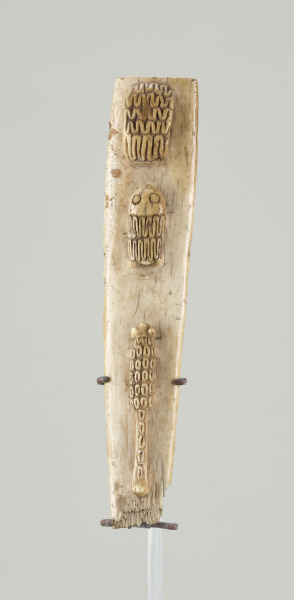
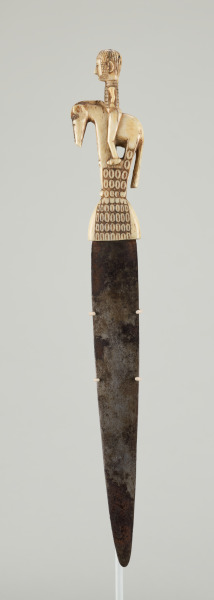
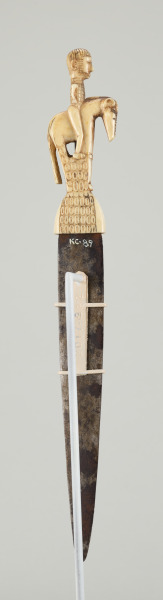
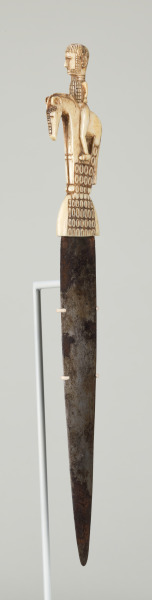
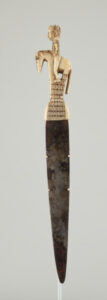
Knife with European Horse Rider
1800-1832
Scroll
Physical Qualities
Bone, metal, 10 3/8 × 1 5/8 in. (26.4 × 4.1 cm.)
Credit Line
Purchased as the gift of Amy Gould and Matthew Polk, Gibson Island, Maryland
Object Number
2017.221
In the 18th and 19th centuries, artists across southeastern Africa began to experiment with figuration. Bowls sprouted horn-shaped legs. Animals appeared on knives. And once-simple containers morphed into cows. Christian missionaries - who saw figurative art as superior to indegenous forms of abstraction - commissioned African artists to make many of these pieces. The knife featuring a European rider on a non-native horse was undoubtedly one such commission. The cow-shaped snuff container and four-legged bowl, however, were made for a southern African clientele. This shift in southern African taste can be attributed both to the growing fliency of local artists with figuration as well as the spread of photographic technology, which made figurative images more accessible to African artists.
The Baltimore Museum of Art by purchase, 2017; Jacaranda Tribal, New York; Michael Graham-Stewart, London; Alain Guisson, Brussels, Belgium
African Mini-Installation
African Gallery Rotations 2021
African Gallery Rotations 2022
African Gallery Rotations 2023
African Wing Rotations 2024
African Wing Rotations 2025
Jack, Anthony. "Africa: Relics of the Colonial Era." London: Michael Graham-Stewart, 1991, p. 43.
Klopper, Sandra, "The Art of Southeast Africa from the Conru Collection." 5 Continents, 2002.
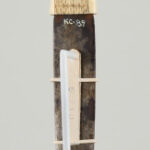
"The handle of this rare knife is presented as a European mounted on a horse or mule. He is bearded and wearing a jacket, while the horse is decorated with a halter. The base of the handle is decorated with seven registers of repeated oval shapes. The sheaht, which is perhaps older and belonged originally to anothe knife, has a leopard, a frog, and another abstracted animal carved in high relief." - The Art of Southeast Africa p.188
 On View at the BMA
Explore the Collection Further