

Hippolyte Lebas and Oberkampf les héritiers
La Marchande d’amour (The Love Merchant or The Cupid Seller)
1816
Scroll
- Designer: Hippolyte Lebas
- Manufacturer: Oberkampf les héritiers
La Marchande d’amour (The Love Merchant or The Cupid Seller)
1816
Physical Qualities
Cotton, 27 1/2 x 39 in. (69.9 x 99.1 cm.)
Credit Line
Gift of Dena S. Katzenberg, Baltimore
Object Number
1984.171
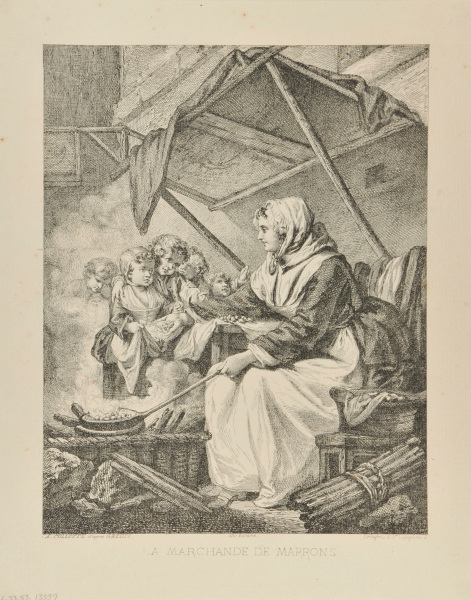
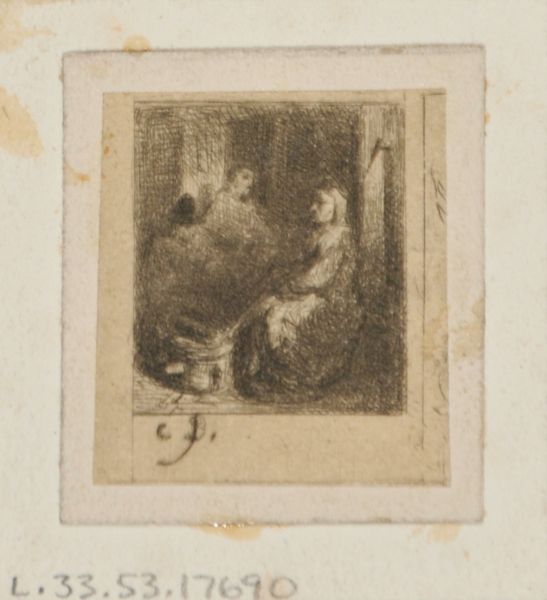
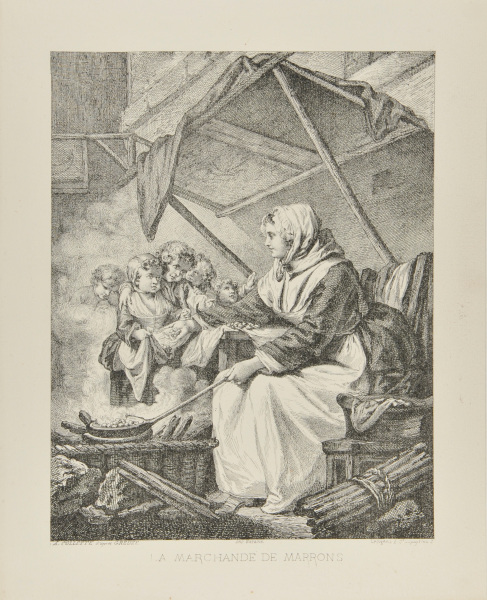
A rectangular panel of cotton fabric roller-printed in brown with an engraved neoclassical design and over-printed with woodblocks in yellow to give a colored background. The design consists of a series of medallions and cartouches featuring classical themes. The title design of the piece, shown in an octagonal medallion, depicts a woman selling caged cupid figures.++ In an oval medallion beneath this design a young man with a lyre is shown riding a lion. This is possibly a representation of Hercules, who is often depicted riding a lion. The attributes associated with Hercules, a bow, a club, and a distaff, are displayed above the medallion. In another row, another vignette situated within a hexagonal frame shows Venus consoling Cupid as Time breaks Cupid bow's. In another shell- or spade-shaped medallion Cupid sails on a boat fashioned from his quiver and bow using an arrow as an oar and a torch as a mast. Between these two rows of major medallions are rows of smaller cartouches. The row to the left includes a small roundel with a butterfly motif alternating with square medallions set on point containing lovebirds and surmounted with embracing cupids. Another row of small cartouches features a roundel with Cupid sharpening and annointing his arrow with a love potion, and an oval cartouche depicting Cupid embracing a winged figure--probably Psyche. These large and small medallions are joined with trophies consisting of dolphins, palmettes, tridents, plinths, dogs, pitchers or urns, swans, etc. The figures are printed in brown on a white ground which is blocked in with yellow or gold. This gives a very three-dimensional effect to the design. The background consists of a printed diaper pattern with rosette centers. The registration of the background color is imperfect. The vertical repeat is approximately 20'; the horizontal repeat involves the width of the textile. This panel includes less than one-and-a-half vertical repeats. The ground is a balanced plain-woven cotton, far more even and fine than that used for earlier toiles. This rectangular panel has narrow unprinted selvages. The top and bottom edges are cut and unfinished. The presence of lines of very small holes suggests that the fabric was once sewn on all four sides and that this piece was once quilted in a double diamond pattern. ++This design comes from a Roman painting discovered in 1759 at Gragnano near Naples. In 1776 during a trip to Rome, Jacques-Louis David copied an engraving by Vien after the Gragnano painting. This engraving, entitled 'Marchande à la Toilette, was originally published in Le Antichità de Ercolano in 1762. (Gilfoy, p. 292)
Baltimore Museum of Art by gift, 1984; Dena S. Katzenberg by purchase, Baltimore, MD; Elinor Merrill, New York, NY.
Henri Clouzot and Frances Morris, Painted and Printed Fabrics: The History of the Manufactory at Jouy and Other Ateliers in France, 1760-1815, New York: The Metropolitan Museum of Art, 1927, pl. XXXVIII.
Henri Clouzot, Histoire de la manufacture de Jouy et de la toile imprimée en France, Paris G. van Oest, 1928, pp. 38-39. Peggy Stoltz Gilfoy, Fabrics in Celebration of the Collection, Indianapolis: Indianapolis Museum of Art, 1983, pp. 192-193, illus. Stuart Robinson, A History of Printed Textiles, Cambridge, Mass.: The MIT Press, 1969, p. 105. Gillian Moss, Printed Textiles 1760-1850, New York: Cooper-Hewitt Museum, Smithsonian Institution, 1987, pp. 25-26. Josette Brédif, Printed French Fabrics: Toiles de Jouy, New York: Rizzoli, 1989, p. 142; illus. p. 180.
Henri Clouzot, Histoire de la manufacture de Jouy et de la toile imprimée en France, Paris G. van Oest, 1928, pp. 38-39. Peggy Stoltz Gilfoy, Fabrics in Celebration of the Collection, Indianapolis: Indianapolis Museum of Art, 1983, pp. 192-193, illus. Stuart Robinson, A History of Printed Textiles, Cambridge, Mass.: The MIT Press, 1969, p. 105. Gillian Moss, Printed Textiles 1760-1850, New York: Cooper-Hewitt Museum, Smithsonian Institution, 1987, pp. 25-26. Josette Brédif, Printed French Fabrics: Toiles de Jouy, New York: Rizzoli, 1989, p. 142; illus. p. 180.
Inscribed: On paper tag formerly attached to piece: Obverse: [stamped] 'J. H. INC.'/[written in ink] '1798/ La Marchande/ d'Amour'/ [added in pencil] 'H.' [in ink] 'Lebas' [added in pencil '(Hippo)'/ Clouzot/ Plate XXXVIII'; Reverse: [written] 'L 76.5.15'/ [printed] 'No. 8H/ Tag made by/ Waterbury/ Tag Co./ Waterbury, Conn.'