Henri Matisse
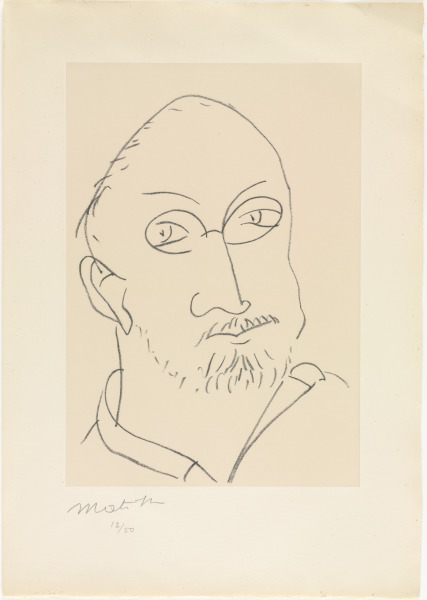
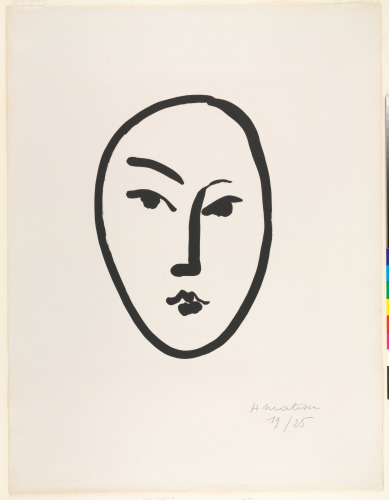
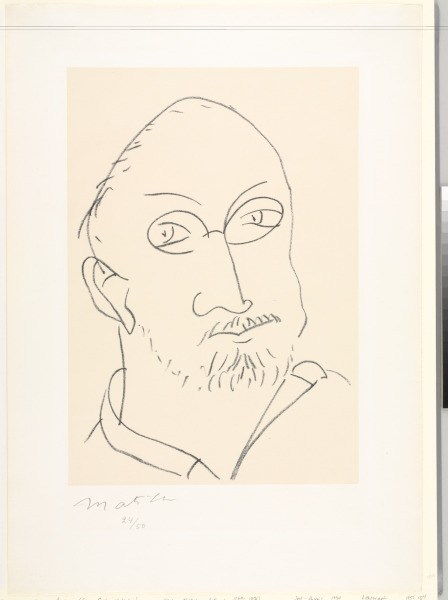
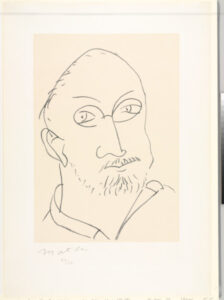
Large Mask
1943
Scroll
Henri Matisse
Large Mask
1943
Physical Qualities
Crayon transfer lithograph on chine collé, Sheet: 541 x 381 mm. (21 5/16 x 15 in.)
Image: 384 x 266 mm. (15 1/8 x 10 1/2 in.)
Credit Line
Board of Trustees Fund
Object Number
1955.104
This portrait explore a range of characters, from stern to sly, to a revealing self-caricature. Just as Rembrandt inspired Matisse’s first self-portrait print made between 1900 and 1903, the Dutch artist’s life-long practice of making self-portraits may have been the catalyst for Matisse’s evolving series that began in the mid-1930s and continued until his death in 1954. His self portraits may be a reflection of periods of re-examination of the direction of his art. In 1945 he illustrated his essay Exactitude is not Truth, (a defense of a claim his art was too facile), with a series of drawings reproduced with the text. In a “word portrait” written in the third person he portrayed “the reserve with which he faces [life] and which keeps him from an uncontrolled surrender to it,” and concluded, “It is indeed the same man, one who remains an attentive spectator of life and of himself.” The photographer Brassai (1899–1994) made a number of portraits of Matisse and noted his anxiety about being photographed: “He searched for himself in his portrait and had difficulty finding himself—if he appeared austere, he was belying his nature; if shown laughing it looked like caricature.” While a few of his self-portraits are painted, Matisse preferred to capture his likeness in prints and drawings.
Matisse, Picasso, and the School of Paris
Matisse: Painter as Sculptor
Matisse, Life in Color: Masterworks From The Baltimore Museum of Art
Inscribed: Recto: "Matisse 24/50" in graphite at bottom left corner.
Markings: Watermark: -ARC (ARCHES) at bottom left.