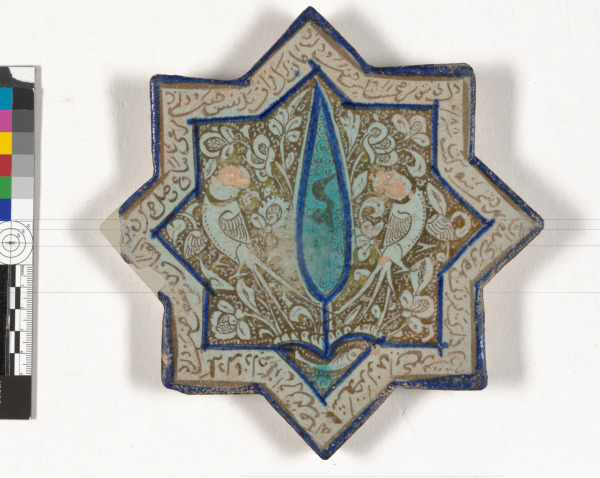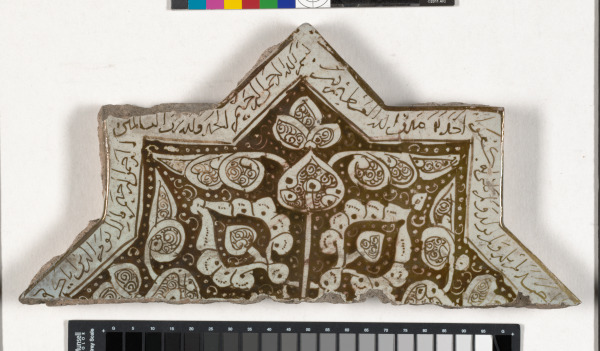
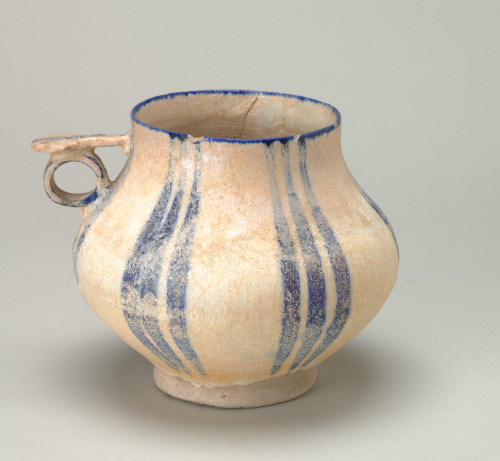
Kashan kilns
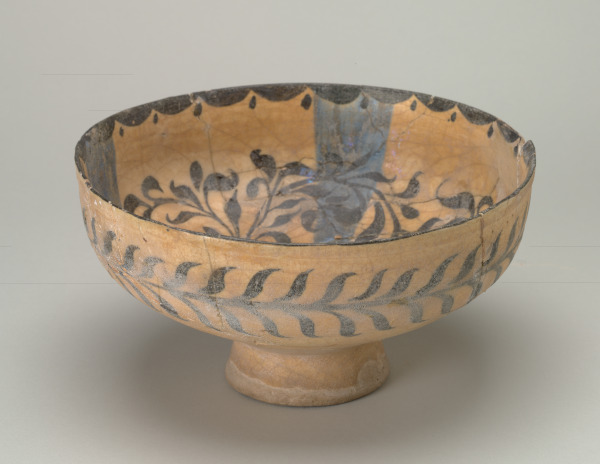
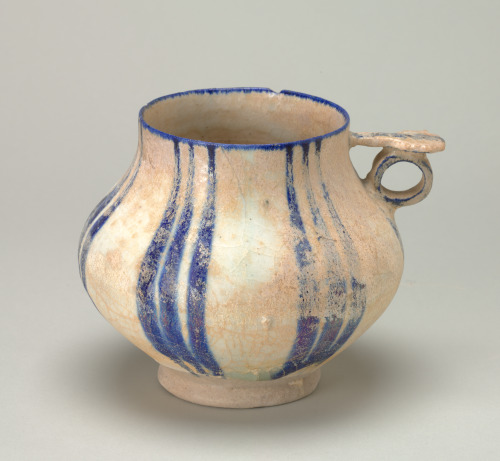
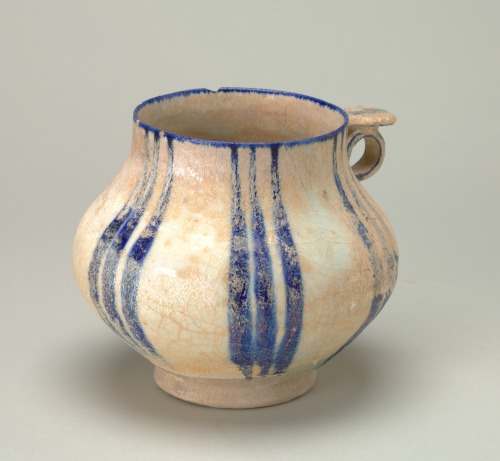
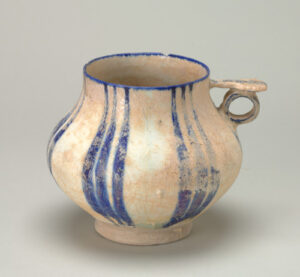
Large One-Handled Cup
1200-1232
Scroll
Kashan kilns
Large One-Handled Cup
1200-1232
Physical Qualities
Fritware with underglaze blue decoration, 5 H x 3 5/8 Diam. in. (12.7 x 9.2 cm.)
Credit Line
Gift of Richard and Elizabeth S. Ettinghausen in Memory of Adelyn D. Breeskin
Object Number
2013.197
By the 11th century, kilns in China routinely produced white procelain by combining kaolin clay and ground porcelain stone fired at around 2400 F. In response, 12th-century kilns in Syria and Iran popularized a different ceramic. Fritware, or stonepaste, was made from carefully prepared stone combined with ground glass, called frit, and a small amount of clay. The mixture was then fired at around 1830 F. Frit was made by pouring molten glass into water, which shattered the glass. The tiny pieces of glass, when combined with the stone and clay, caused the material to fuse. During the 13th century, kilns in Iran began painting blue-and-black decoration on their fritware before it was covered with a transparent glaze and fired.
The Baltimore Museum of Art by gift, 2013 (on extended loan from 1957); Elizabeth Ettinghausen, Princeton, NJ; Richard S. Ettinghausen
Extended Loans IN
Art Across Asia: West Asian Connections
[Asian Refresh]
Asian Gallery Rotations 2023
Asian Rotations 2024
Asian Rotations 2025
 On View at the BMA