

Martin Puryear
Lever #2
1987-1988
Scroll

Martin Puryear
Lever #2
1987-1988
Physical Qualities
Rattan, ponderosa pine, ash, and cypress, 70 1/2 x 291 1/4 x 54 5/8 in. (179.1 x 739.8 x 138.7 cm.)
Credit Line
The Caplan Family Contemporary Art Fund, and Collectors Circle Fund
Object Number
1990.80
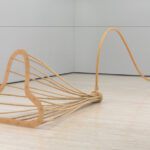
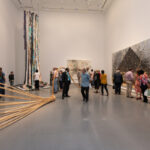
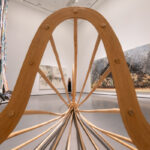
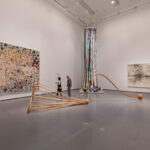
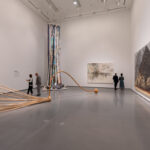
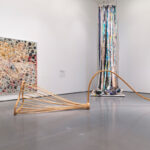
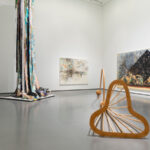
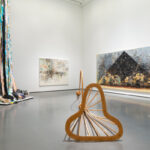
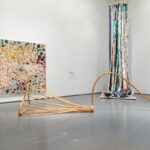
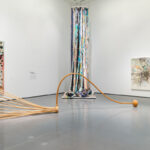
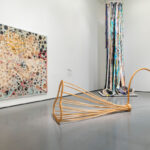
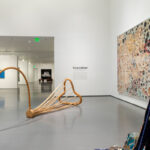
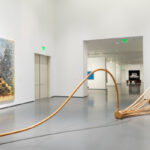
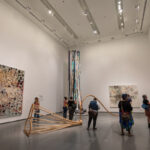
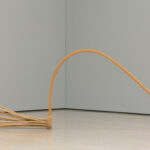
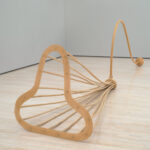
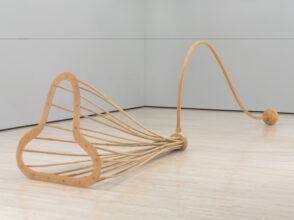
This monumental sculpture is also porous: we can see through to its interior. Martin Puryear constructed its curving forms by hand, joining four functional kinds of wood: rattan, the pliable palm stem grown in Southeast Asia; ponderosa pine, a versatile softwood native to the American West; ash, an exceptionally bendable wood grown across the eastern United States; and cypress, a durable wood native to the American Southeast. Together, the four woods make up an abstract pair of shapes—a swooping line and a basket-like enclosure—whose relationship is a puzzle for the viewer’s imagination.
Puryear has said, “The strongest work for me embodies contradiction, which allows for emotional tension and the ability to contain opposed ideas.”
The Baltimore Museum of Art by purchase, 1990; McIntosh/Drysdale by purchase, 1989(?); Margo Leavin Gallery, Los Angeles; the artist.
"Martin Puryear," Margo Leavin Gallery, Los Angeles, 4/15-5/20/1989.
Kellie Jones, "Martin Puryear, 20th International Sao Paulo Bienal 1989," 10/14-12/10/1989, p. 49, ill. on cover ['Untitled (1988)'].
Neal Benezra, "Martin Puryear," The Art Institute of Chicago, 11/9/1991- 1/5/1992; p. 137, no. 39, ill. p. 51 and centerfold; circulated to Hirshhorn Museum and Sculpture Garden, Museum of Contemporary Art, Los Angeles, Philadelphia Museum of Art. "Martin Puryear: Recent Sculptures," Virginia Museum of Art, Richmond, March 6, 2001 - May 27, 2001; Miami Art Museum, June 22, 2001 - August 6, 2001; Berkeley Art Museum, September 12, 2001 - December 30, 2001.
Emily Hall, ed., "Martin Puryear", The Museum of Modern Art, New York, 11/4/2007 - 1/14/2008.
Kellie Jones, "Martin Puryear, 20th International Sao Paulo Bienal 1989," 10/14-12/10/1989, p. 49, ill. on cover ['Untitled (1988)'].
Neal Benezra, "Martin Puryear," The Art Institute of Chicago, 11/9/1991- 1/5/1992; p. 137, no. 39, ill. p. 51 and centerfold; circulated to Hirshhorn Museum and Sculpture Garden, Museum of Contemporary Art, Los Angeles, Philadelphia Museum of Art. "Martin Puryear: Recent Sculptures," Virginia Museum of Art, Richmond, March 6, 2001 - May 27, 2001; Miami Art Museum, June 22, 2001 - August 6, 2001; Berkeley Art Museum, September 12, 2001 - December 30, 2001.
Emily Hall, ed., "Martin Puryear", The Museum of Modern Art, New York, 11/4/2007 - 1/14/2008.
Nancy Princenthal, 'Martin Puryear,' "American Craft," Feb.-Mar. 1992, pp. 34, 36, 66, ill. p. 36.


Explore the Collection Further