David Goldblatt
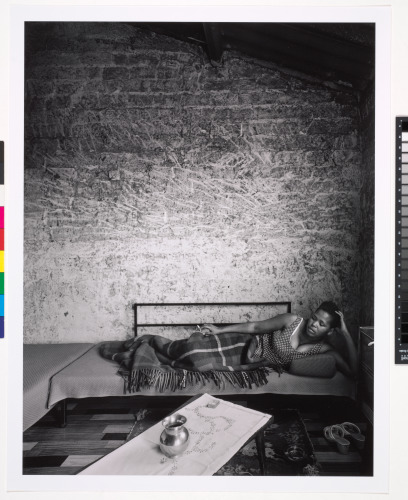
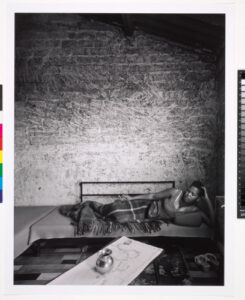
Margaret Mcingana, who later became famous as the singer Margaret Singana, Zola, Soweto, October 1970
1969
Scroll
David Goldblatt
Margaret Mcingana, who later became famous as the singer Margaret Singana, Zola, Soweto, October 1970
1969
Physical Qualities
Gelatin silver print, Sheet: 495 x 386 mm. (19 1/2 x 15 3/16 in.)
Image: 465 x 362 mm. (18 5/16 x 14 1/4 in.)
Credit Line
Gift of Joanne Gold and Andrew Stern
Object Number
2015.101
David Goldblatt never arranges his subjects nor their surroundings, thus this beautifully composed photograph of a woman in her well-appointed Soweto home, complete with eloquently textured walls, was casually taken during conversation. In 1968, Goldblatt began developing photo essays for Optima, a magazine published by Anglo American for its shareholders. This mining giant accepted his proposal to study Soweto, home to many black miners in apartheid’s segregated society. Goldblatt suggested Optima hire Peter Magubane (b. 1932) for the work, but he was at the time detained in jail for photographing police violence of the kind seen in Gavin Jantjes’ work to your left, so Goldblatt undertook the assignment. This photograph was an early study for
a larger essay printed in 1972.
Pictured here is Margaret Singana (1938–2000), a one-time domestic worker for a Johannesburg family whose prize winning voice later brought fame and the nickname “Lady Africa.” Still singing with a theater chorus in 1970, soon she was recording with The Symbols, cast in musicals touring internationally, and topping record charts in Europe and the United States. Her career waned in the 1980s as anti-apartheid divestment strategies gained sway and the United Nations Special Committee Against Apartheid imposed a cultural boycott.
The Baltimore Museum of Art by gift, 2015; Joanne Gold and Andrew Stern, Baltimore
Shifting Views: People & Politics in Contemporary African Art
Inscribed: lower right verso in graphite: "David Goldblatt / 1970"