
Mortuary Retinue
567-633
Scroll
Mortuary Retinue
567-633
Physical Qualities
Earthenware with transparent glaze over white slip, 33 cm. OH
Credit Line
Gift of George and Julianne Alderman, Baltimore
Object Number
1998.618.1-39
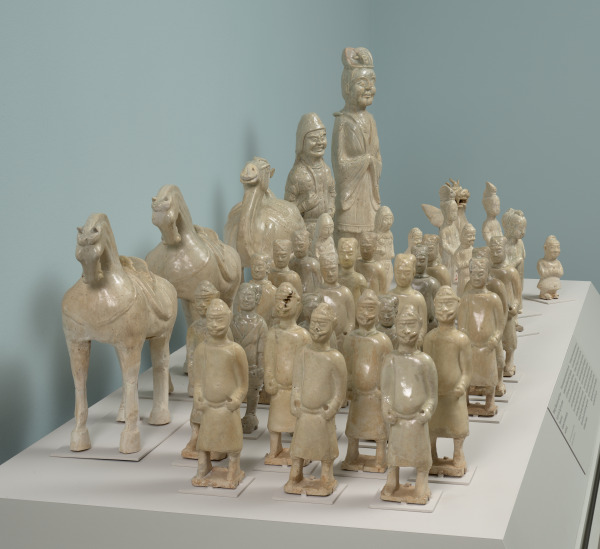
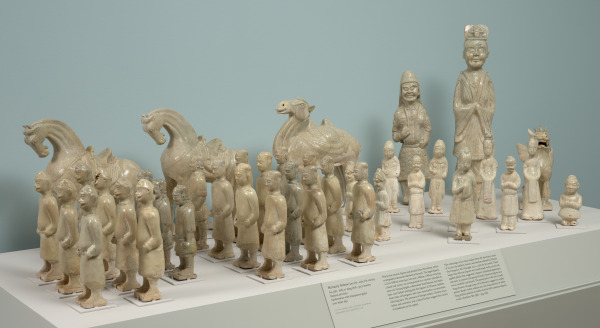
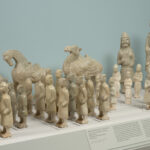
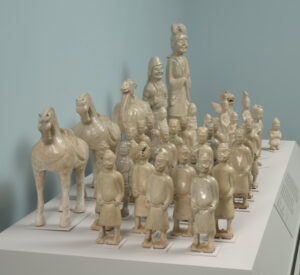
Thirty-nine ceramic figures and animals form this retinue, which accompanied a deceased individual to his tomb. The largest figures, a Civil Official wearing a hat and a Military Official wearing a hood and armor, are accompanied by a creature intended to avert evil. Varying heights, rudimentary facial features, hair styles, hats, and clothes distinguish the figures of Chinese soldiers from those of foreigners, who have moustaches, or minorities with long hair. The presence of foreign traders, Chinese court ladies and courtiers, and a dwarf further suggest the variety of inhabitants in the capital.
This entourage is far more modest than the mortuary army of 10,000 clay soldiers, horses, and chariots ordered by China’s First Emperor, Shi Huangdi, (221–206) for his tomb. Those larger than life-size figures were mold-made with carved and applied details that suggested a figure’s individual appearance and rank. In contrast, this group of small, columnar figures was not as carefully customized. The group dates to the Sui or early Tang dynasty, though some of its features suggest an earlier period. Ranks of foot soldiers are not characteristic of either Tang military practice or tombs, but the stiff, columnar figures recall a Northern Wei (386–534) style.
The Baltimore Museum of Art by gift, 1998; George and Julianne Alderman, Baltimore; Michael Teller, Williamsburg, Virginia (acquired by dealer after 1990)
Annette L. Juliano, Bronze, Clay and Stone Chinese Art in the C. C. Wang Family Collection, published by Hsi An T'ang, 1988, unpaginated, nos. 41-48; note comparative excavated examples in the appendix for nos. 42, 46, 48 from the tomb of Zhang Shigui dated 657 in Liquan county, Shaanxi province.