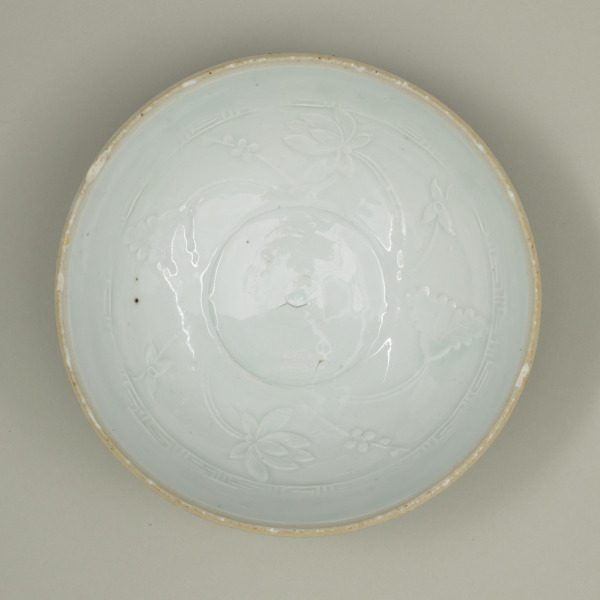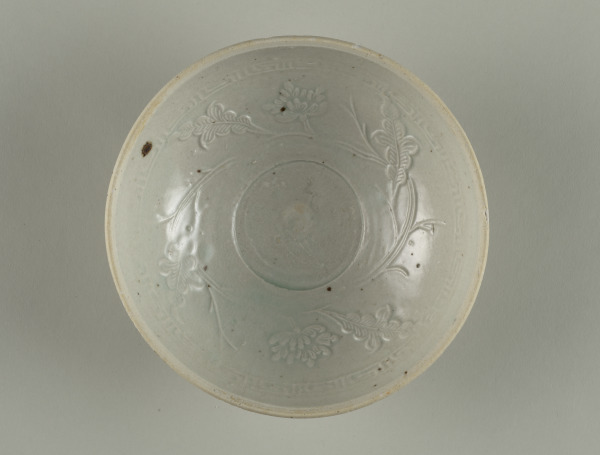
Mughal-Style Bowl Decorated with Lotus Scroll
1766-1910
Scroll
Mughal-Style Bowl Decorated with Lotus Scroll
1766-1910
Physical Qualities
Nephrite, 5 1/16 in. Diam. (12.8 cm.)
Credit Line
The Mary Frick Jacobs Collection
Object Number
1938.809
Jade carving in India reached its height during the Mughal Empire (1526-1857). Under the Qianlong Emperor (1736-1795), China took control over Central Asia's Khotan region (now Xinjiang Province). The region was the main source of nephrite jade for local artisans as well as those Mughal India and Qing dynasty (1644-1911) China. The 1756 gift of a jade bowl to the Chinese emperor prompted his demand for more jade objects, together with raw stone and artisans. Imperial workshops were instrcuted to copy the style of jades produced in northern India and Khotan. Palace records from 1762 listed Muslim jade carvers who produced decorative and utilitarian items. This boel could be a late 18th-century original or an early 20th-century copy.
The Baltimore Museum of Art by bequest, 1938; Mary Frick Jacobs
[Asian Refresh]
Asian Gallery Rotations 2023
Asian Rotations 2024
Asian Rotations 2025
Terese Tse Bartholomew, "Non-Chinese Jades: Islamic and Mughal Works," in Michael Knight et al, "Later Chinese jades: Ming dynasty to early twentieth century from the Asian Art Museum of San Francisco," SF: Asian Art Museum, 2007, pp. 315-319, nos. 381, 384, 385, with listing of known artists' names and glossary.
 On View at the BMA