Teotihuacan
Mural Fragment with Priest
Teotihuacan, 500-550
Scroll
Teotihuacan
Mural Fragment with Priest
Teotihuacan, 500-550
Physical Qualities
Earthen aggregate, lime plaster, and mineral pigments, 21 3/4 x 32 5/16 in. (55.2 x 82 cm.)
Credit Line
Purchased as the gift of the Henfield Foundation, New York, and Purchase Fund
Object Number
1962.42
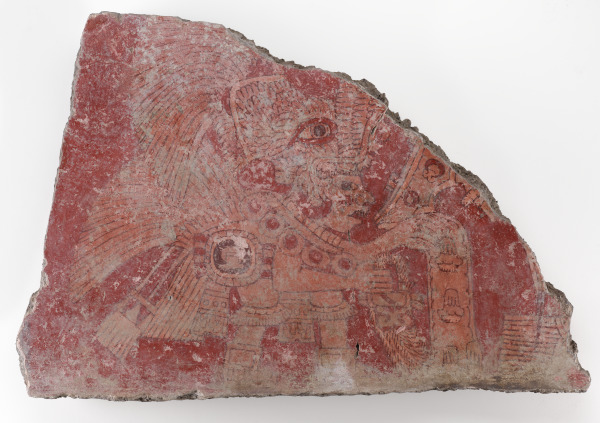
Here, a priest holds an incense bag and scatters seeds while chanting or singing. He wears many symbols of his power and prestige, from his quetzal feather headdress to the large jade beads hung around his neck. Both quetzal feathers and uncarved jade were symbolic of nature’s fertility and were prized for their vibrant colors. These luxury goods came to Teotihuacan, in central Mexico, from Guatemala and are evidence of the complex and wide-reaching trade networks that blanketed the Americas in the first millennia CE.
This mural fragment comes from what was once the most densely populated city of the Americas, Teotihuacan. The city boasted between 100,000–200,000 inhabitants at its height (500–550 CE) and attracted people from various cultural groups across Mesoamerica.
The Baltimore Museum of Art by purchase, 1962; John Stokes, Jr., Glencoe, Maryland
Ancient Americas Gallery Rotations 2021
Ancient Americas Gallery Rotations 2022
Ancient Americas Gallery Rotations 2023
Ancient Americas Rotations 2024
 On View at the BMA