Sakai Doitsu
New Year’s Game Paddle Decorated with Longevity Symbols
1866-1932
Scroll
Sakai Doitsu
New Year’s Game Paddle Decorated with Longevity Symbols
1866-1932
Physical Qualities
Ink, mineral and metallic pigments on wood, silk cord, 21 7/16 × 8 1/16 × 13/16 in. (54.5 × 20.5 × 2.1 cm.)
Credit Line
Julius Levy Memorial Fund
Object Number
2019.17
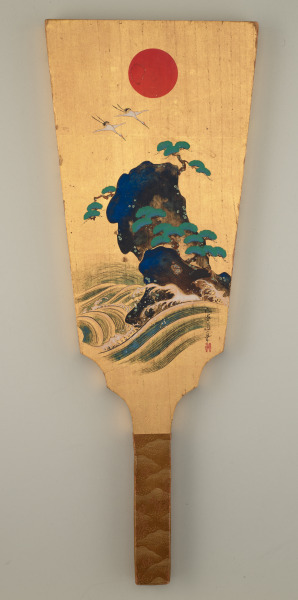
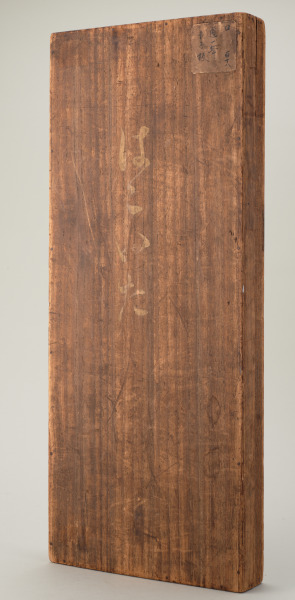
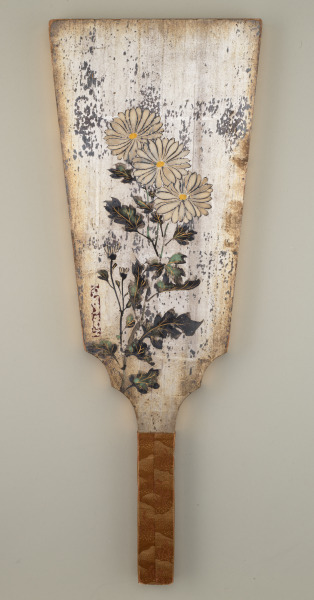
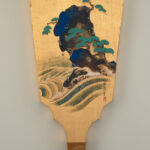
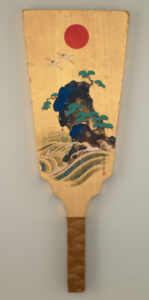
This New Year's gift communicates a wish for longevity. The painting depicts Mount Horai, the island home of Chinese immortals. Pine trees cling to the mountain's edge, an ancient tortoise climbs up its side, and two cranes fly down from above. The work is painted on a panel shaped like a hanetsuki game paddle.
Similar to badminton without a net, hanetsuki is played with a wooden paddle and feathered shuttlecock. The popular Japanese New Year game can be played by one person alone keeping the shuttlecock airborne or two people batting it back and forth. The longer the shuttlecock remains aloft, the better protected the players will be against mosquitoes in the new year.
The Baltimore Museum of Art by purchase, 2019; Kaikodo, New York
[Asian Refresh]
Asian Gallery Rotations 2023
Asian Rotations 2024
Asian Rotations 2025
"Parallel Lives," NY: Kaikodo, 15 March-18 May 2018, no. 25.
Stewart Culin, "The Japanese Game of Battledore and Shuttlecock," The Brooklyn Museum Quarterly, Vol. 12, No. 3 (JULY, 1925), pp. 139-150 [Stable URL: https://www.jstor.org/stable/26460114]
Inscribed: Signed: "Uge Dōitsu hitu”「雨華道一 筆」 ”Painted by Dōitsu called Uge.” Seal: Uge 「雨華」 Seal on the reverse: Uge Dōitsu「雨華道一」
 On View at the BMA