Nimsuzani or Djoinamaz
1900-1932
Scroll
Nimsuzani or Djoinamaz
1900-1932
Physical Qualities
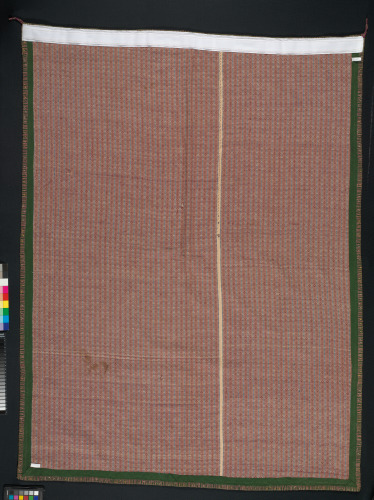
Silk ground, silk and cotton embroidery threads, cotton backing, 55 1/2 x 42 1/4 in. (141 x 107.4 cm.)
Credit Line
Gift of Jerry Maizlish, Sparks, Maryland
Object Number
1991.447
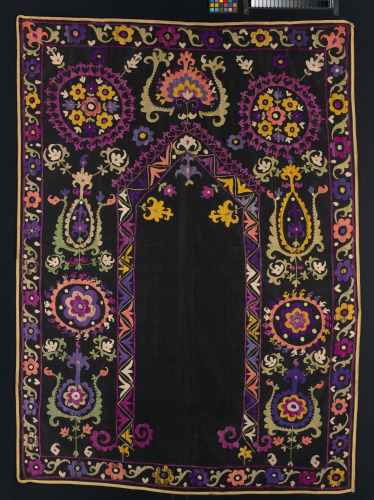
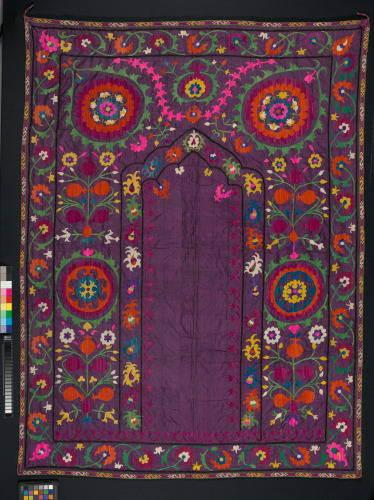
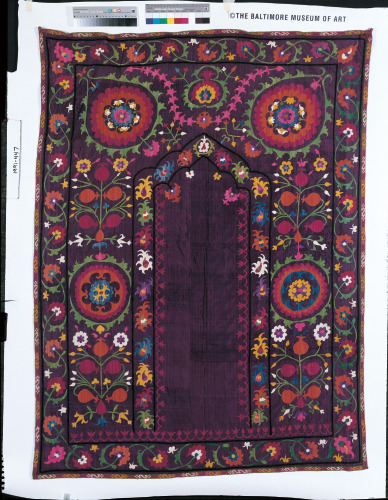
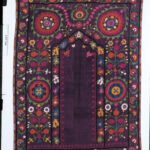
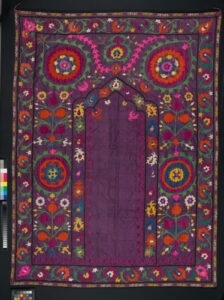
Bursting with floral designs, this Central Asian textile was probably
part of a dowry. A bride brings many textiles to her new home,
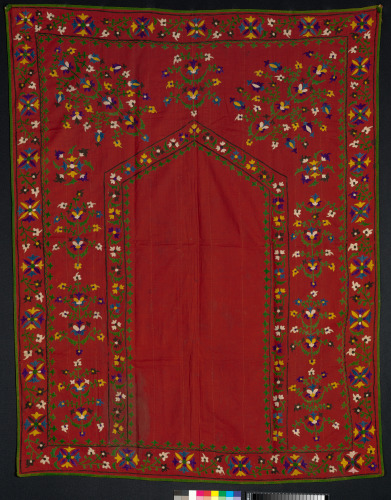
and one of them is often a small prayer mat (djoinamaz). The void
in its center takes the shape of a mihrab, a niche found within
the walls of mosques. The mihrab indicates the direction of Mecca,
towards which devout Muslims pray five times a day.
The prayer mat is both a religious threshold, connecting secular
and spiritual worlds, and a physical threshold, separating private
and communal spaces in the home. It also stands as a social
threshold, marking a young woman’s transition from her childhood
home to the home of her husband.
What in your home connects you to another place?
GO
The sounds you are hearing were recorded
in the place where this artwork was made.
Recorded fall, 2006, Shoberghan, Afghanistan.
Label Text from "Embroidered Treasures: Textiles from Central Asia," November 13, 2011 - July 8, 2012.
The ever present influence of Islam in Central Asian countries is reflected in this embroidery, which could serve as a prayer mat (djoinamaz). The void in the center of this textile, created by the absence of stitched designs, takes the shape of an architectural motif, the mihrab, which is a pointed archway or niche found within the walls of mosques. The mihrab indicates the direction of Mecca, towards which devout Muslims pray five times a day. In keeping with Muslim practice, the motifs decorating this embroidery are floral rather than figural. The four tree-of-life patterns at each side of the mihrab are laden with pomegranates. In Central Asia, pomegranates are symbolic of fertility due to the fruit’s many seeds. Since this textile was almost certainly part of a young woman’s dowry, the abundance of pomegranates could suggest the bride’s hopes and prayers for a fruitful union as she moves into her new home with her husband.
[PHOTO] Mihrab from Tilla Kari Madrasa (Islamic school) in Samarkand, Uzbekistan., 1646–1660. Source: ARTstor. Islamic Art and Architecture Collection. Sheila Blair, Jonathan Bloom, and Walter Denny. 1983. Photo credit: Walter B. Denny
The Baltimore Museum of Art by gift, ex. collection Gerald Maizlish, by purchase ex. unknown collection, by purchase c.1973 in Afghanistan
Embroidered Treasures: Textiles from Central Asia
Imagining Home
Elizabeth E. Bacon, Central Asians Under Russian Rule, Ithaca, N.Y.: Cornell University Press, 1980, reprint of 1966 ed., p. 15, pp. 17-19, map 2 facing p. 18, p. 25, p. 110.
Sheila Paine, Embroidered Textiles, Traditional Patterns from Five Continents, New York: Rizzoli, 1990, p. 26, pp. 108-109.
Pamela Clabburn, The Needleworker's Dictionary, New York: William Morrow & Co., 1976, p. 33.
Y. Levinsteyn, 'Unravelling Central Asian Embroidery,' Hali Magazine, Vol. 4, No. 2, 1981, pp. 152-153.
Thomas Knorr and David Lindahl, Uzbek: The Textiles and Life of the Nomadic and Sedentary Uzbeks of Central Asia, Basel, Switzerland: Zhinden Druck und Verlag AG, 1975.
Cathryn M. Cootner, 'Gardens of Paradise,' and David Shaffer, 'History and Technique,' in 'Suzani,' Hali Magazine (April/May/June 1986), pp. 44-51.
Tent & Town: Rugs & Embroideries from Central Asia: The H. McCoy Jones Collection, San Francisco: The Fine Arts Museum of San Francisco M. H. DeYoung Memorial Museum, Nov. 1982 - Feb. 1983.
Michael Franses and Robert Pinner, 'Large Medallion Suzani from South-- West Uzbekistan, Hali Magazine, Vol. 1, No. 2 (Summer 1978), pp. 128-133.
Clabburn, Pamela, and Helene Rosenstiel. "Bokhara." In The needleworker's dictionary. New York: Morrow, 1976.
'Marketplace,' in Hali, Issue 3 (Jan/Feb/Mar 1987).
Sotheby's: Fine Oriental and European Carpets 27 Sept. 2000: 16.
Sheila Paine, Embroidered Textiles, Traditional Patterns from Five Continents, New York: Rizzoli, 1990, p. 26, pp. 108-109.
Pamela Clabburn, The Needleworker's Dictionary, New York: William Morrow & Co., 1976, p. 33.
Y. Levinsteyn, 'Unravelling Central Asian Embroidery,' Hali Magazine, Vol. 4, No. 2, 1981, pp. 152-153.
Thomas Knorr and David Lindahl, Uzbek: The Textiles and Life of the Nomadic and Sedentary Uzbeks of Central Asia, Basel, Switzerland: Zhinden Druck und Verlag AG, 1975.
Cathryn M. Cootner, 'Gardens of Paradise,' and David Shaffer, 'History and Technique,' in 'Suzani,' Hali Magazine (April/May/June 1986), pp. 44-51.
Tent & Town: Rugs & Embroideries from Central Asia: The H. McCoy Jones Collection, San Francisco: The Fine Arts Museum of San Francisco M. H. DeYoung Memorial Museum, Nov. 1982 - Feb. 1983.
Michael Franses and Robert Pinner, 'Large Medallion Suzani from South-- West Uzbekistan, Hali Magazine, Vol. 1, No. 2 (Summer 1978), pp. 128-133.
Clabburn, Pamela, and Helene Rosenstiel. "Bokhara." In The needleworker's dictionary. New York: Morrow, 1976.
'Marketplace,' in Hali, Issue 3 (Jan/Feb/Mar 1987).
Sotheby's: Fine Oriental and European Carpets 27 Sept. 2000: 16.
Inscribed: None.