Elizabeth Barbara Garrett
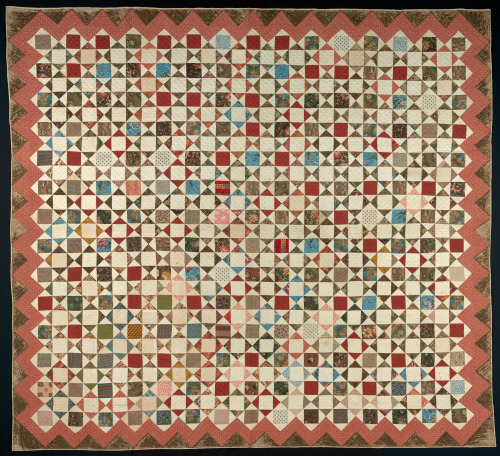
“Nine Patch Variation” with Squares on Point in Grid Quilt
1835
Scroll
Elizabeth Barbara Garrett
“Nine Patch Variation” with Squares on Point in Grid Quilt
1835
Physical Qualities
Cotton, 102 x 111 in. (259.1 x 281.9 cm.)
Credit Line
Gift of Mrs. Robert Garrett, New York
Object Number
2015.126
Nine-patch quilt with blocks set on point within a grid created by sashing. The nine-patch blocks are made from 9 fabric patches, each 1-3/8" square, producing a 4-1/2" square block that alternates with printed and unprinted white patches. The printed textiles include a great variety of patterns - some block prints, roller prints and probably block and roller prints, mill prints, and neats (small monochrome prints). Some dark grounded florals generally in good condition, are included, with some very unusual patterns and some printed in more than one colorway. The sashing is approximately 1-3/4" wide and is also composed of various fabrics. At the left a blue-green/lime-green print with yellow and beige floral motifs is used. In the center and to the upper right a 1-9/16" monochromatic brown/dark brown floral print with border line at the edges is used. At the lower right a lt. brown ground print with small red flowers forms a 1-3/4" sashing. The body of the quilt contains 576 nine-patch blocks arranged in 24 rows and 24 columns with half motifs at each side. This includes 5,184 individual blocks.
The quilt is bordered on three sides with a printed chintz. This 2-3/4" wide border is created by piecing narrow sections of a single "border print" designed with a wide row of flowers and an inner row of geometric motifs. The direction of the print changes at specific intervals at the lower sides and at the bottom center. The corners of the border are mitred.
The reverse of the quilt is pieced of white cotton and the binding is applied back to front allowing 1/2" to show on both top and back. The quilting is done in straight lines using white cotton thread, and the whole is quilted in 7-8 stiches per inch (top only) or 14-16 stitches per inch (counting both top and bottom).
The Baltimore Museum of Art by gift, 2015; Edith and James Garrett, Baltimore
Dunton Papers, Volume VI, pp. 66-67.
William Rush Dunton Papers, Vol. VI, pp. 66-69; The Baltimore Museum of Art. (includes photos and descriptions of this and another Elizabeth Barbara White quilts, initialed and dated.)
Antique collectors. Baltimore: Its History and Its People, pp. 455-458.
"Gives Statue of Lee: Mrs. Elizabeth B. White Wills Property for Shaft in Park./Southern Colleges Benefit," The [Baltimore] Sun (1837-1986): Nov17, 1917; Proquest Historical Newspapers, p. 12.
Katharine B. Dehler, "Mt. Vernon Place at the Turn of the Century: A Vignette of the Garrett Family," Maryland Historical Magazine, Fall, 1974, pp. 279-292.
See William Rush Dunton, Old Quilts, privately published, Catonsville, 1946, pp. 231-2 for information on the Elizabeth Stouffer quilts made by E.B.G.'s mother prior to her marriage, as well as similar quilt made by her aunt.
Bide, Martin. "Secrets of the Printer's Palette," in Down by the Old Mill Stream: Quilts in Rhode Island, Linda Welters & Margaret T. Ordonez (eds.), Kent, Ohio: Kent State University Press, 2000, pp.83-97.
Antique collectors. Baltimore: Its History and Its People, pp. 455-458.
"Gives Statue of Lee: Mrs. Elizabeth B. White Wills Property for Shaft in Park./Southern Colleges Benefit," The [Baltimore] Sun (1837-1986): Nov17, 1917; Proquest Historical Newspapers, p. 12.
Katharine B. Dehler, "Mt. Vernon Place at the Turn of the Century: A Vignette of the Garrett Family," Maryland Historical Magazine, Fall, 1974, pp. 279-292.
See William Rush Dunton, Old Quilts, privately published, Catonsville, 1946, pp. 231-2 for information on the Elizabeth Stouffer quilts made by E.B.G.'s mother prior to her marriage, as well as similar quilt made by her aunt.
Bide, Martin. "Secrets of the Printer's Palette," in Down by the Old Mill Stream: Quilts in Rhode Island, Linda Welters & Margaret T. Ordonez (eds.), Kent, Ohio: Kent State University Press, 2000, pp.83-97.
Inscribed: Embroidered in cross stitches at center top on reverse: EB*G/.1836./2