Henri Matisse
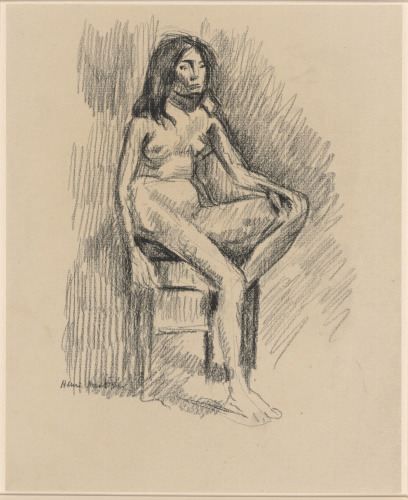
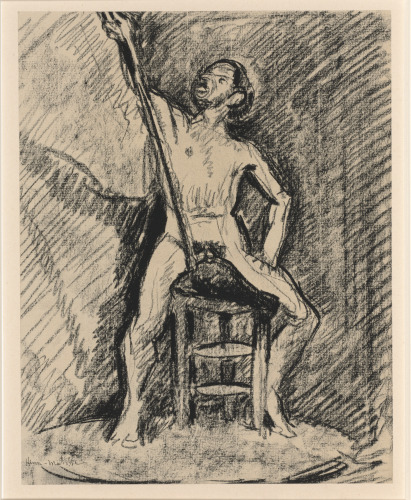
Nude Male Model Seated on a Stool
1892-1902
Scroll
Henri Matisse
Nude Male Model Seated on a Stool
1892-1902
Physical Qualities
Black crayon on paper, Sheet: 264 × 207 mm. (10 3/8 × 8 1/8 in.)
Mat: 20 × 16 in. (50.8 × 40.6 cm.)
Credit Line
The Cone Collection, formed by Dr. Claribel Cone and Miss Etta Cone of Baltimore, Maryland
Object Number
1950.12.53
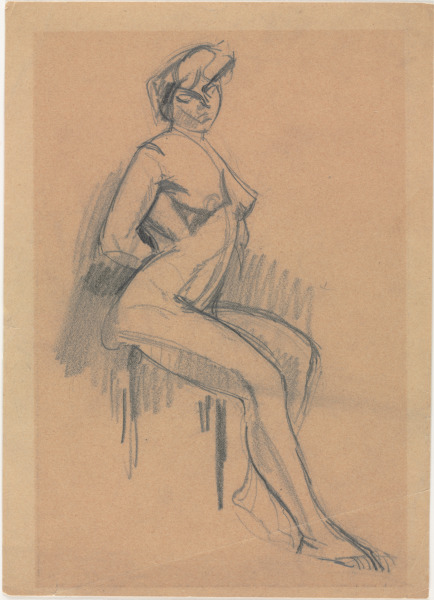
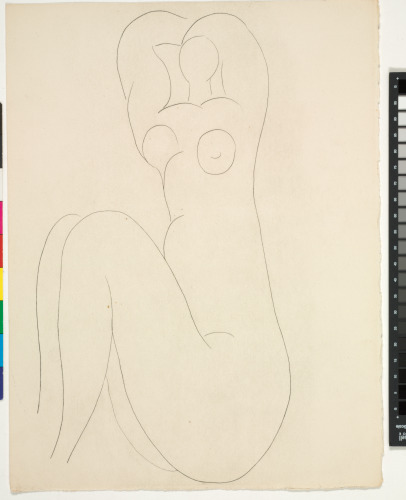
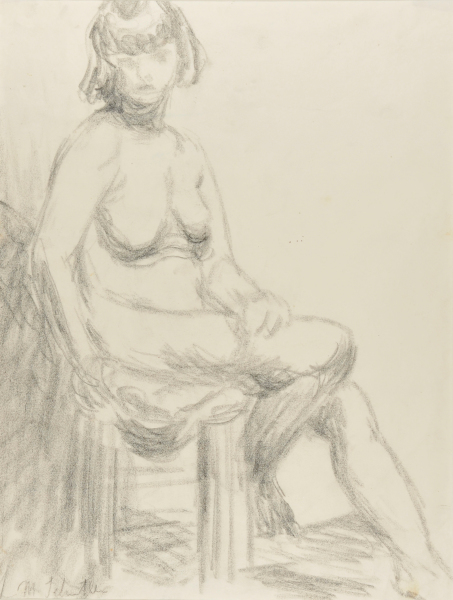
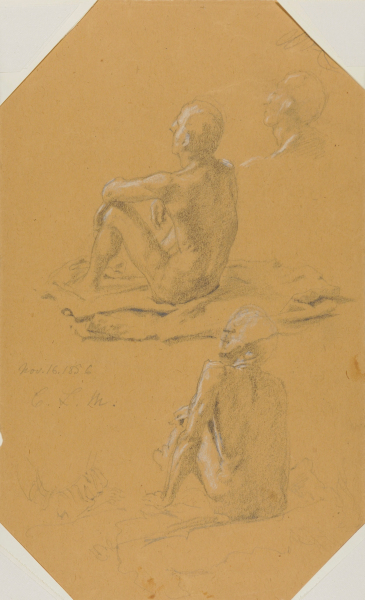
Unlike more typical "academy" studies, here Matisse used drawing as a means of exploration, rather than as an academic practice intended to perfect technical skill. This drawing probably comes from a period shortly after Matisse studied at the Ecole des Beaux-Arts when he continued to meet with artist friends to draw from the model. At the Ecole, Matisse studied with Gustave Moreau (1826-1898), a teacher who encouraged self-expression. One of Matisse's colleagues in Moreau's studio, the painter George Rouault (1871-1958) said of Moreau, "He taught us to discipline our will without any preconceived method; to have respect for a certain interior vision." Matisse is less concerned with modeling volume and form than he is occupied with the articulation of the figural pose, the linear rhythm of the limbs, and the figure's structural balance.
This drawing probably comes from a period shortly after Matisse studied at the Ecole des Beaux-Arts when he and his artist friends met to draw from the model. At the Ecole, Matisse studied under Gustave Moreau (1826–1898), a teacher who encouraged self-expression. Here Matisse is using drawing as a means of exploration, rather than as an
academic exercise intended to perfect technical skill. He is less concerned with modeling volume and form and more attentive to the articulation of the figural pose, the linear rhythm of the limbs, and the figure’s structural balance.
The Baltimore Museum of Art by bequest, 1949; Etta Cone, Baltimore; purchased from the Galerie Rosengart, Lucerne, 1934; Rosengart acquired it from Prof. Braune, Stuttgart, 1929 (see Angela Rosengart's letter).
Matisse: Painter as Sculptor
A Modern Influence: Henri Matisse, Etta Cone, and Baltimore
Senzoku, Nobuyuki, ed. Matisse and Modern Masters from the Cone Collection of the Baltimore Museum of Art = Kon korekushon ten. [Tokyo]: "Kon Korekushon" Ten Katarogu Iinkai, 1996, page 99, no. 44.
Fisher, Jay McKean, et al. The Essence of Line: French drawings from Ingres to Degas. University Park, PA: Pennsylvania State University Press, 2005. p. 47, ill.
Kosinski, Dorothy, Jay McKean Fisher, and Steven Nash. Matisse: Painter as Sculptor. Baltimore, MD: Baltimore Museum of Art; Dallas, TX: Dallas Museum of Art: Nasher Sculpture Center; New Haven: Yale University Press, 2007, page 31, fig. 29.
Cozzi, Leslie and Katherine Rothkopf (eds). "A Modern Influence: Henri Matisse, Etta Cone, and Baltimore." Baltimore: The Baltimore Museum of Art, 2021. ill.
Markings: Watermark: "Abbey Mills/ Greenfield" surmounted by a crown