Seto kiln
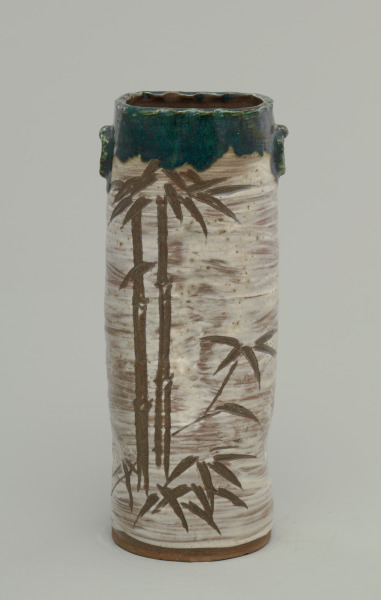
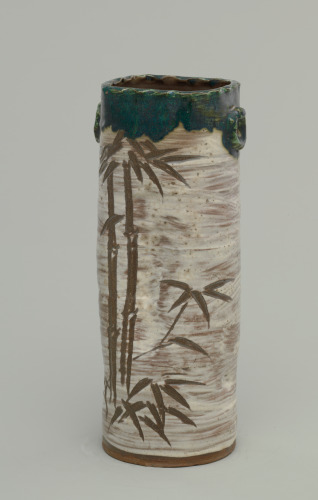
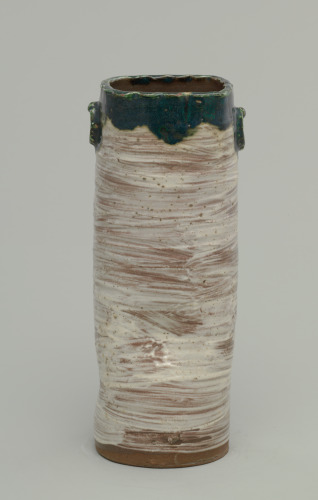
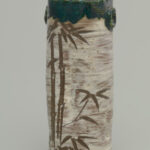
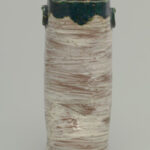
Oribe-Style Tall Vase with Bamboo Decoration
1879
Scroll
Seto kiln
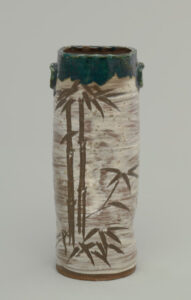
Oribe-Style Tall Vase with Bamboo Decoration
1879
Physical Qualities
Earthenware with white slip and blue-green and transparent glazes, 30.4 H x 12.7 W x 10.5 D cm.
Credit Line
Gift of Helen Mary Overstreet, Cockeysville, Maryland
Object Number
2005.97
Oribe pottery is known for its dark green copper glaze, white slip, and clear overglaze, often applied to irregular molded forms. The vase is round at its foot, square at its mouth, and has two indentations on opposite sides of the body. Named for the tea master Furuta Oribe (1544–1615), Oribe ware was first produced by Japan’s Mino kilns. The ware enjoyed an unexplained
revival in popularity in the 19th century, which continues today.
The Baltimore Museum of Art by gift 2005; Miss Helen Mary Overstreet by gift; Draza Kline by purchase, Nikko, Japan, April 1966
Across East Asia: China's Cultural & Artistic Legacy
Asian Gallery Rotations 2021
Asian Gallery Rotations 2022
Asian Gallery Rotations 2023
Hugo Munsterberg, "The Arts of Japan," Rutland, Vt.: Charles E. Tuttle Co., 1957, p. 139 .
H. Batterson Boger, "The Traditional Arts of Japan," Garden City, NY: Doubleday & Co. Inc., 1964, p. 235.
Hazel H. Gorham, "Japanese and Oriental Ceramics," Rutland, Vt.: Charles E. Tuttle Co., 1971, pp. 34-38.
H. Batterson Boger, "The Traditional Arts of Japan," Garden City, NY: Doubleday & Co. Inc., 1964, p. 235.
Hazel H. Gorham, "Japanese and Oriental Ceramics," Rutland, Vt.: Charles E. Tuttle Co., 1971, pp. 34-38.