Uvean
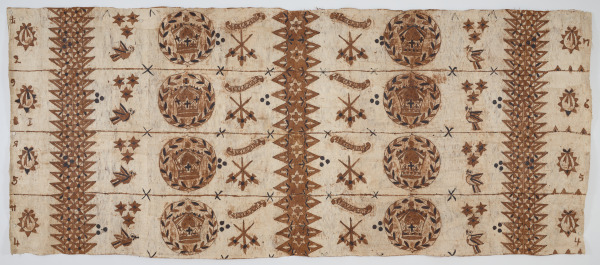
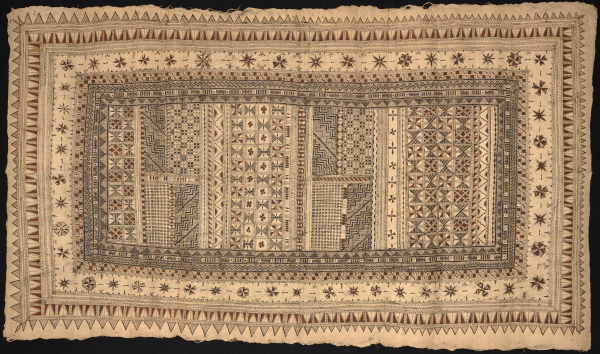
Painted Bark Cloth (Siapo)
Wallis and Futuna Islands, 1939-1941
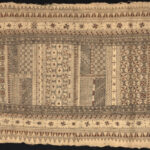
Scroll
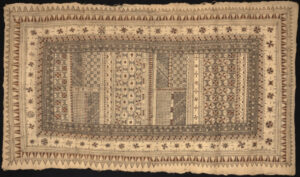
Uvean
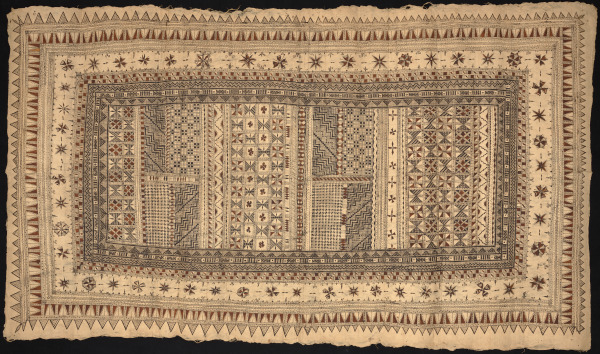
Painted Bark Cloth (Siapo)
Wallis and Futuna Islands, 1939-1941
Physical Qualities
Bark cloth, pigment, 90 9/16 x 52 5/8 in. (230 x 133.7 cm.)
Credit Line
Gift of James J.O. Anderson, Baltimore
Object Number
1988.162
Both of these works were given as gifts to Major James J.O. Anderson, a U.S. Marine stationed on Savai’i Island in the nation of Samoa during World War II. Anderson’s job was, in part, to establish meaningful relationships with the political leaders (faipule) of the Samoan and Samoan-adjacent islands. The existence of these works speaks to his success in that endeavor. Both represent long-standing artistic forms associated with leadership in this region, and both were given to Anderson by the leaders of islands in the Samoan region.
The bowl (tanoa fai’ava) was given to him as a personal gift upon his departure from Savai’i Islands in 1942, and the painted barkcloth (siapo) was presented to him by a leader on nearby Wallis Island as “a gift to the American people.” The lack of wear on both artworks suggest they were made specifically for Anderson.
The Baltimore Museum of Art by gift 1988; James J.O. Anderson, by gift, in Wallis Island 1942.
Oceanic Gallery Rotations 2021
Oceanic Gallery Rotations 2022
Oceanic Gallery Rotations 2023
Kevin Tervala, "Oceanic Art at The Baltimore Museum of Art," Tribal Arts Magazine 104 (Summer 2022): 106-113. Illustrated on pg. 107.