

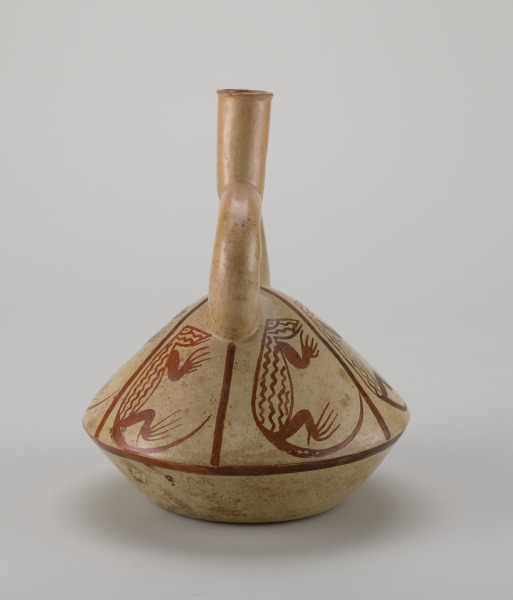
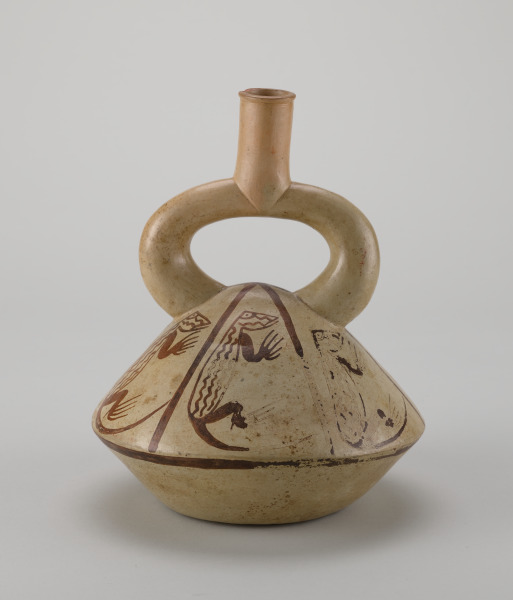
Moche
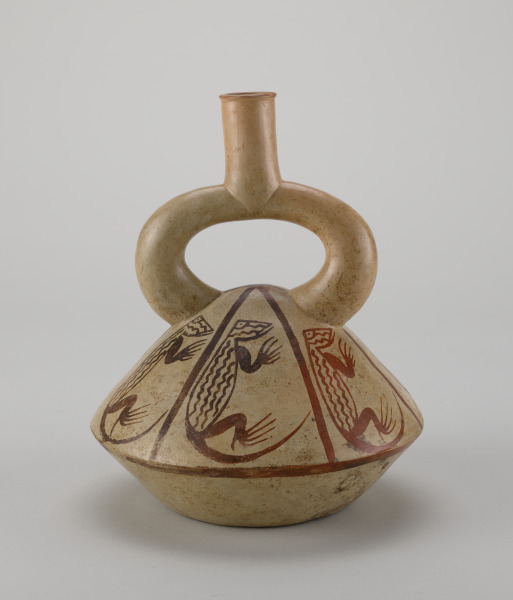
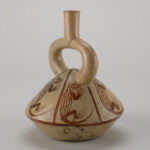
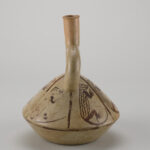
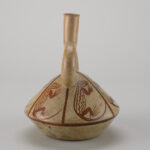
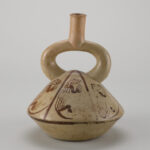
Painted bottle
Moche, 100-800
Scroll
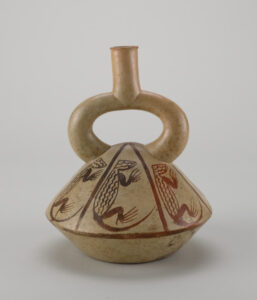
Moche
Painted bottle
Moche, 100-800
Physical Qualities
Earthenware, slip, 8 1/4 × 6 1/4 in. (21 × 15.9 cm.)
Credit Line
Gift of Dr. George G. Graham, Alexander S. Graham, and Carol Lee Graham
Object Number
2003.177
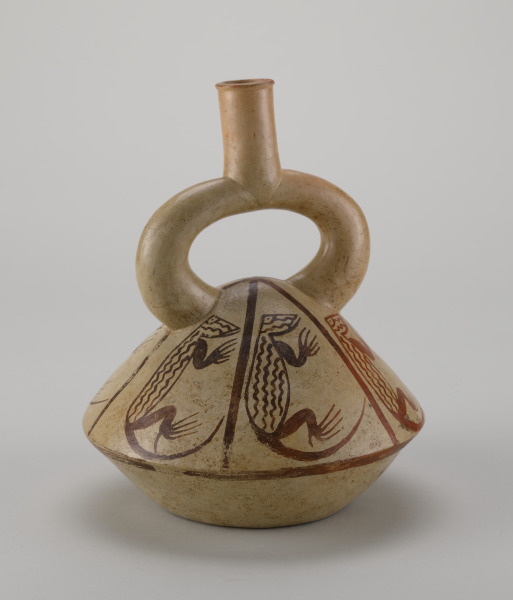
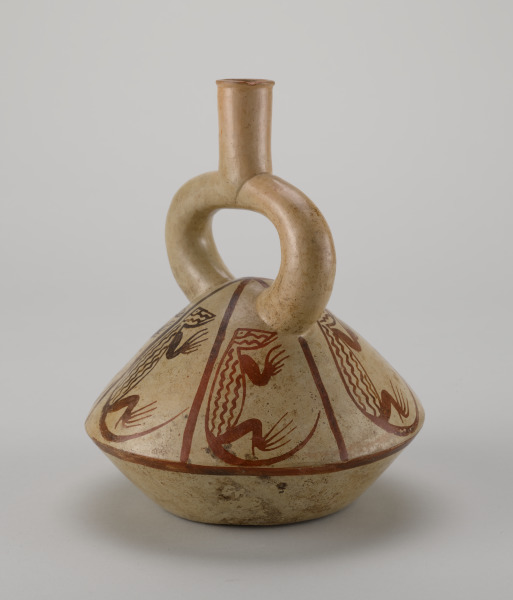
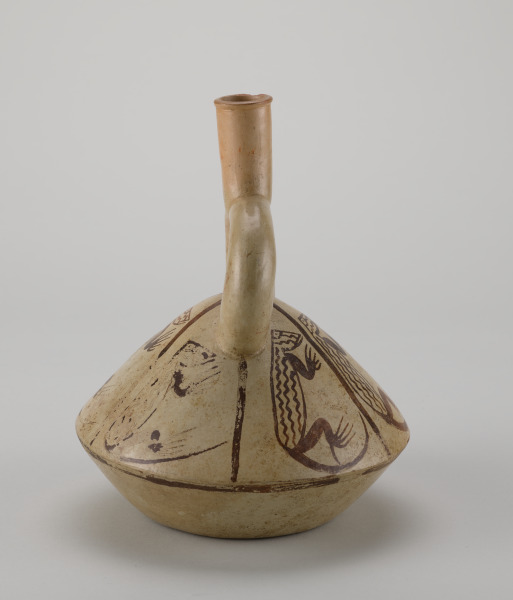
All of the ceramic vessels seen above are “stirrup spout” bottles, named for their resemblance to horse stirrups. They were made by Moche people, prolific ceramicists who thrived on the northern coast of Peru from around 100–900 CE.
Moche ceramic production constantly evolved, as you can see from left to right. The decoration of the earliest vessel here reveals lizards executed with thicker lines. In later periods, painted decorations became more refined with thinner and crisper geometric lines, like the painting on the portrait head bottle. Look for differences in the vessel’s form, color, decoration, and spout shape.
Stirrup spout vessels were produced by other cultures living in the Andes from the second millennium BCE until the early colonial period. The Moche people revived the form pioneered by cultures that preceded them by centuries, including the Chavín and Cupisnique people. While the exact purpose of this shape in Moche culture is unknown, it may have served as a handle for carrying, prevented the evaporation of liquids held within, or had some symbolic significance that is lost to us.
Group label for 2003.177, 1996.147, and 1989.57.
Ancient Americas Gallery Rotations 2021
Ancient Americas Gallery Rotations 2022
Ancient Americas Gallery Rotations 2023
Ancient Americas Rotations 2024