Robin Rhode and Niels Borch Jensen
Pan’s Opticon Studies, No. 2
2008
Scroll
Physical Qualities
Photogravure, Sheet: 562 x 773 mm. (22 1/8 x 30 7/16 in.)
Plate: 489 x 732 mm. (19 1/4 x 28 13/16 in.)
Credit Line
Roger M. Dalsheimer Photograph Acquisitions Endowment
Object Number
2010.3.2
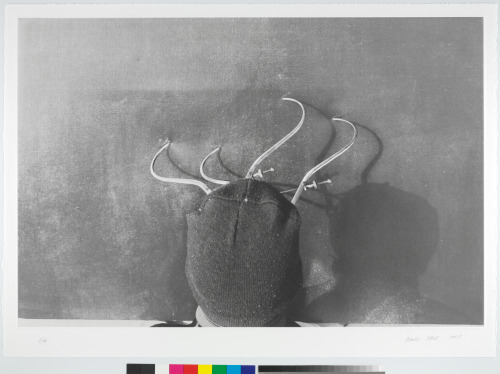
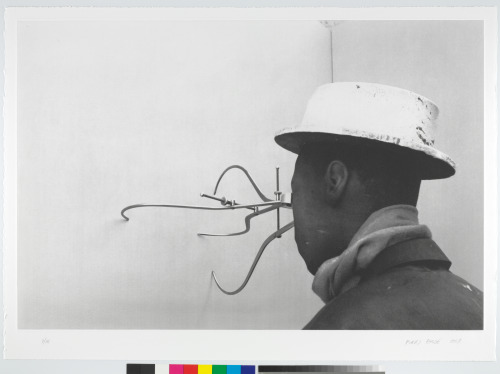
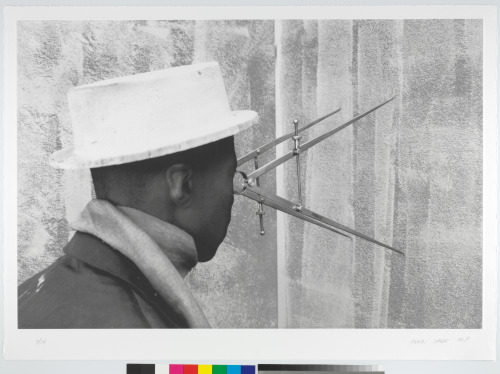
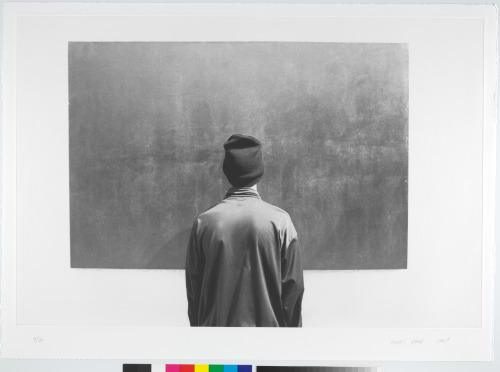
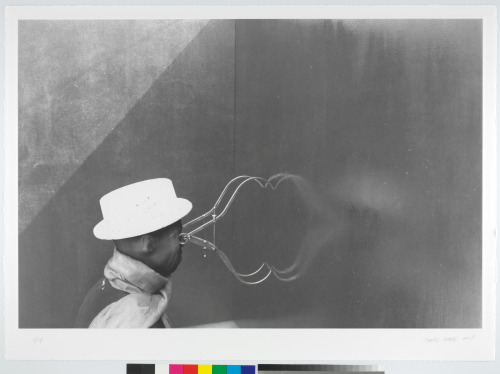
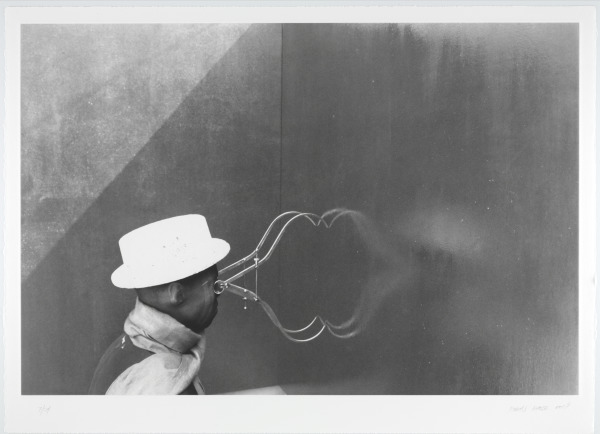
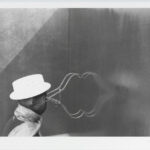
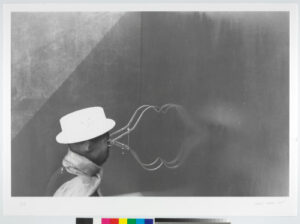
The title of this series calls up the panopticon, an eighteenth century penitentiary design that stationed guards in a central tower encircled by floor upon floor of prison cells. This enabled 24 hour surveillance of inmates. Ever since Michel Foucault published “Discipline and Punish: The Birth of the Prison” (1975), artists and scholars have evoked the design as emblematic of a state’s desire to control individuals. Rhode alters the term “panopticon” to make it possessive. In doing so he cleverly inverts authority so that the people represented here control the power to see.
Their eyes are equipped with calipers that measure the amount of light emitted onto surfaces. As instruments that measure the distance between two sides of an object, pseudoscientists used them in the 19th century to measure skull size and facial features of select people, including prisoners. The vagaries (and vulgarities) of faulty racial experiments are tested by Rhodes’ two figures. One in bowler hat, scarf and jacket endures the strain of a nylon stocking over his head; a man of the 1950s, a period of rampant racial surveillance, he is as constrained as the apparatus he maneuvers. His counterpart wears contemporary dress. Of our time, he skeptically regards controlling measures from a distance or probes the pain they produced by pressing in.
The Baltimore Museum of Art by purchase, 2010; Niels Borch Jensen, Berlin
Seeing Now: Photography Since 1960
Shifting Views: People & Politics in Contemporary African Art
Inscribed: lower left in graphite: "7/24"; lower right in graphite: "ROBIN RHODE 2009."
Markings: WM: Somerset