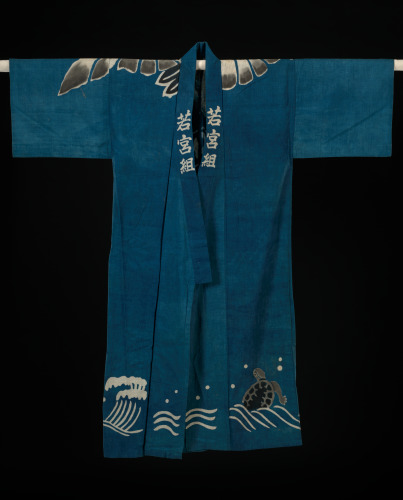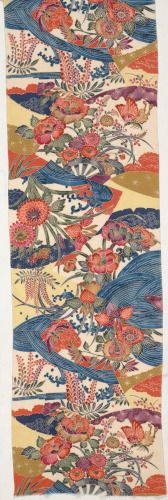
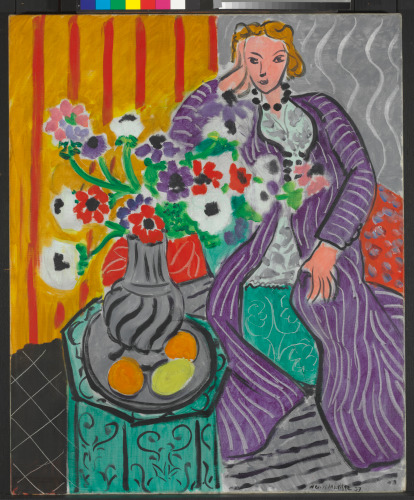

Paper Wrappers (tatoshi) for Kimono and Accessories
2009
Paper Wrappers (tatoshi) for Kimono and Accessories
2009
Inscribed: Printed/written on Tatoshi within the printed box on inner flap: "Note for the products that has gold and silver foil and moth repellent. It is essential for preservation of kimono to use moth repellent; however, you cannot use two types of moth repellent at the same time. It must not be directly put on kimono otherwise it can change especially the color of white kimono or one with gold and silver foil. You must wrap it with thin paper. ◎ You cannot use it with perfume or plastic bag. ◎ Exposing gold and silver foil with high-temperature ironing can damage it.◎ Exposing gold and silver foil with sulfer can damage it. ◎ Perspiration and humidity are source[s] of color change." (Translations by Yuta Hayashi, Japanese international student at Lawrence University, Appleton, Wisconsin between 2015-2017 (class of 2019) [Note from translator: The last portion is very hard to describe. You see the character 虫干 and it is a specific word for drying but its a traditional Japanese way of taking care of kimono and clothes in general. It concerns the way they are to be ventilated to prevent things from getting moldy and bugs. Japanese do this in a sunny summer or a dry fall season. It says "Please do 虫干." Last sentence or phrase appears to address the purchaser, because at the edge it says 様 which is a honorific title."] 3a: Additional writing in black ink added to printed tatoshi: "Charles" [refers to purchaser Charles Newhall III]