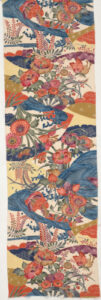

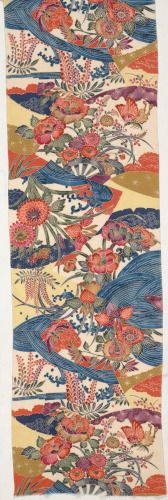
Partial Length of Kimono Silk, Kyo-bingata (Kyoto Bingata) - Image 1
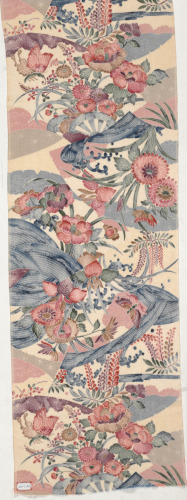
Partial Length of Kimono Silk, Kyo-bingata (Kyoto Bingata) - Image 2

Partial Length of Kimono Silk, Kyo-bingata (Kyoto Bingata)

1899-1949

Thumbnail 1
Thumbnail 2
Scroll

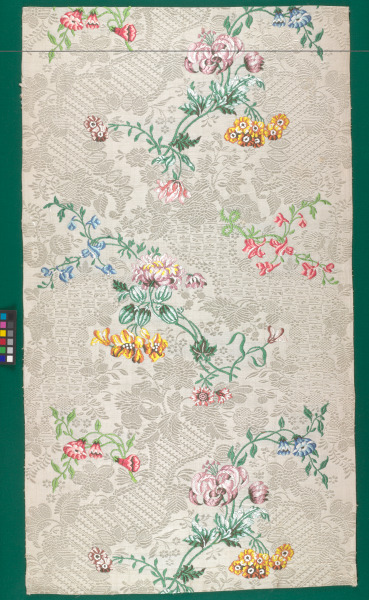
Partial Length of Kimono Silk, Kyo-bingata (Kyoto Bingata)

1899-1949

Physical Qualities Silk, 63 1/2 × 13 3/4 in. (161.3 × 34.9 cm.)
Credit Line Jeffrey Krauss Collection of Japanese Textiles
Object Number 2017.423
Length of Kyo-bingata or bingata made in Kyoto (not Okinawa). . High quality chirimen (crepe) silk length taken from a disassembled kimono. Stencil dyed in patterns of overlapping fan leafs with floral designs. The dye penetration is not as much as in Okinawan bingata and the hand brush shading used by Okinawan artisans is absent in this example. Okinawan Bingata colors are used for a contrasting effect and are often muddier than the colors used in Kyo-bingata. Japanese after war used materials to make new garment …out of kimono. Until war kimono constructed to be able to reposition panels when they were worn to in order to save the panel and extend life.
The Baltimore Museum of Art by gift, 2017; Jeff Krauss, Potomac, MD

Explore the Collection Further

Scalamandré
Length of Red Ground Silk with Tree of Life Motif
1984–2014
Anna Maria Garthwaite and Daniel Vautier
Length of Brocaded Silk Tobine
1748
Kara Walker and Ann Demeulemeester
Adjustable Hem Balloon Skirt with Kara Walker Silhouette Silk Print
2006
Carel van Mallery, Jan van der Straet, and others
The Reeling of Silk
1589–1599
Carel van Mallery, Jan van der Straet, and others
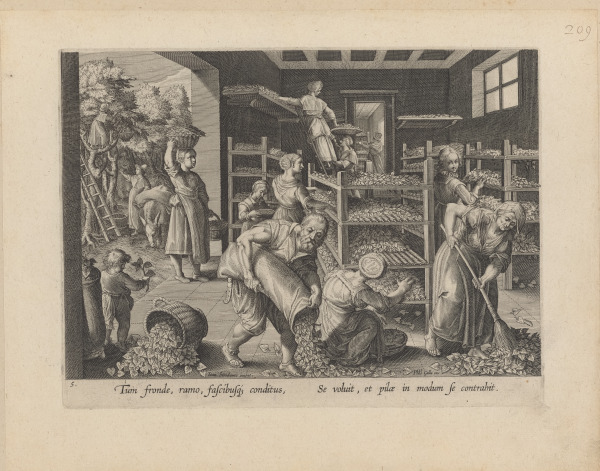
The Gathering of Mulberry Leaves and the Feeding of the Silkworms
1589–1599
Carel van Mallery, Jan van der Straet, and others
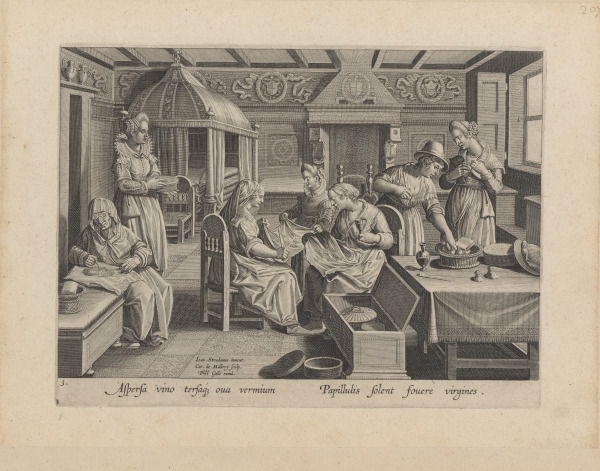
The Silkworm Eggs Spread Out on Shelves
1589–1599
Carel van Mallery, Jan van der Straet, and others
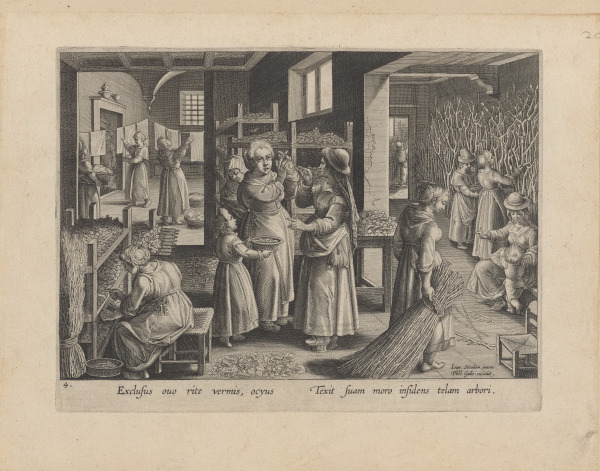
The Incubation of the Silkworm Eggs
1589–1599
Carel van Mallery, Jan van der Straet, and others
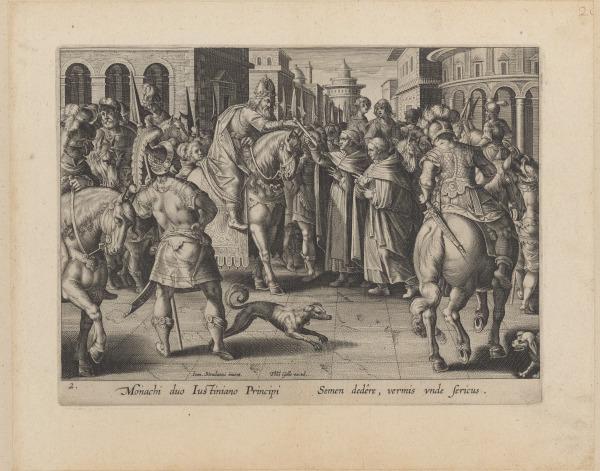
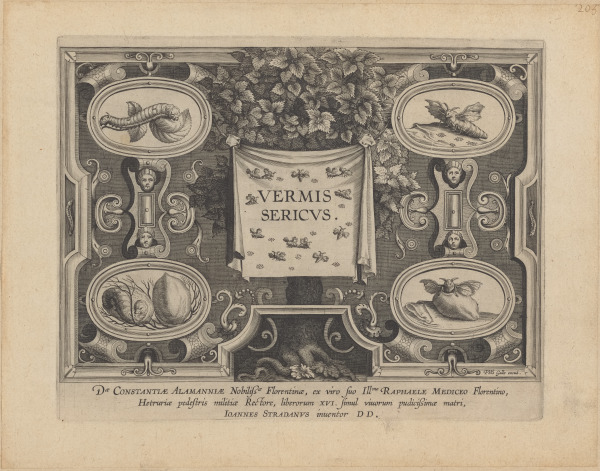
Vermis Sericus (The Introduction of the Silkworm and the Production of Silk in Europe)
1589–1599
Carel van Mallery, Jan van der Straet, and others
Vermis Sericus (The Introduction of the Silkworm and the Production of Silk in Europe)
1589–1599
Naoki Honjo
Tokyo, Japan (Ikebukuro Station)
2004
Yoshinori Mizutani
Tokyo Parrots 008
2012
Carel van Mallery, Jan van der Straet, and others
Vermis Sericus (The Introduction of the Silkworm and the Production of Silk in Europe)
1589–1599