Manning, Bowman & Co.
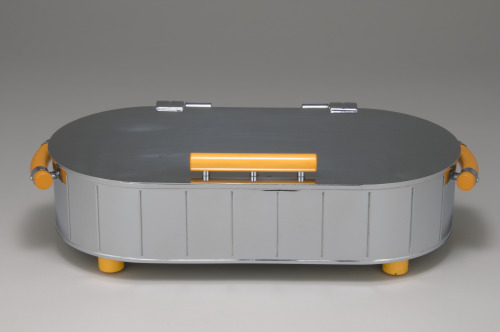
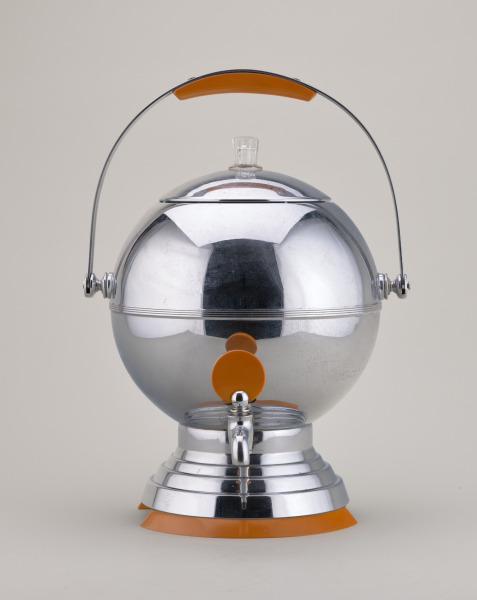
“Party Urn” Percolator
1936
Scroll
Manning, Bowman & Co.
“Party Urn” Percolator
1936
Physical Qualities
Chrome plate, copper, bakelite, glass, Party urn: 14 1/8 x 11 1/8 x 10 1/2 in. (35.9 x 28.3 x 26.7 cm) Lid: 5 1/2 x 5 1/2 x 2 1/2 in. (14 x 14 x 6.4 cm) Filter basket: 4 3/4 x 4 3/4 x 2 3/4 in. (12.1 x 12.1 x 7 cm) Filter: 4 7/8 x 4 7/8 x 1/8 in. (12.4 x 12.4 x 0.3 cm) Central tube: 9 3/8 x 1 1/8 x 1 1/8 in. (23.8 x 2.9 x 2.9 cm) Electrical cord: 36 x 1 x 3/4 in. (91.4 x 2.5 x 1.9 cm)
Credit Line
Gift of David and Cecily Dunham Harvey, New York
Object Number
2012.224
Electricity for the home was a relatively new luxury when the Manning-Bowman Company started making streamlined electric serving utensils that expressed modernity. Shiny chrome plating was a popular decorative embellishment on motorcars of the period, and molded Bakelite was one of the first plastics made from synthetic components. A nonconductive and heat-resistant material, Bakelite found application in electrical insulators, radio and telephone casings, and, as here, kitchenware. The percolator was actually invented in the 18th century, long before household electricity was available. Electroplating with chrome was developed by 1848, but it wasn’t until 1924 that improvements in the process led to its widespread use.
The Baltimore Museum of Art by gift, 2012; Mr. and Mrs. David Harvey, New York
AMW Reinstallation 2014
American Wing Rotations 2020
American Wing Rotations 2021
American Wing Rotations 2022
Markings: Marked underneath base "PAT. NO'S. 1551504-1475334/MANNING-BOWMAN & CO./MERIDEN, CONN. U.S.A./...SERIAL NO./3-49"