
Igbo
Personal Altar (Ikenga)
Igbo, 1933-1966
Scroll

Igbo
Personal Altar (Ikenga)
Igbo, 1933-1966
Physical Qualities
Wood, 11 7/16 x 4 1/8 in. (29.1 x 10.5 cm.)
Credit Line
Gift of Alan Wurtzburger
Object Number
1954.145.51a
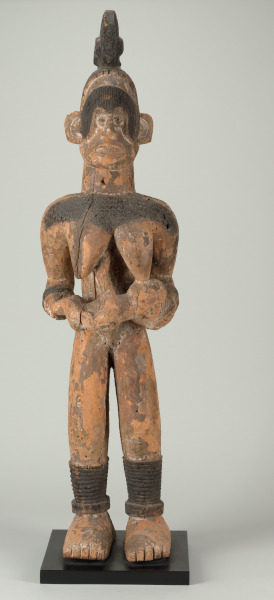
With his hands, a man raises his hoe, wields a weapon, exchanges money and builds a house. Among Igbo men, this power of the hand to enable success has been recognized and honored with sculptural shrines, ikenga. This streamlined ikenga incorporates two principle forms: horns at the top, and a stool for the base. Each is a metaphor for two highly valued masculine qualities: strength and status. Horns conjure the aggressive, "go-getter" quality of animals like the ram, while stools are used exclusively by men who have achieved a high rank. With these two icons, this shrine embodies both gratitude for what has been accomplished and a prayer for ongoing success.
Glaze, Anita J. and Alfred L. Scheinberg, Discoveries: African Art from the Smiley Collection, [Urbana-Champaign]: Krannert Art Museum, University of Illinois at Urbana-Champaign, 1989, p 45.