
Nasca
Polychrome Bowl
325-450
Scroll

Nasca
Polychrome Bowl
325-450
Physical Qualities
Earthenware, polychrome slip paint, 4 × 5 1/4 in. (10.2 × 13.3 cm.)
Credit Line
Gift of A. Lyndon Bell and Family
Object Number
2016.201
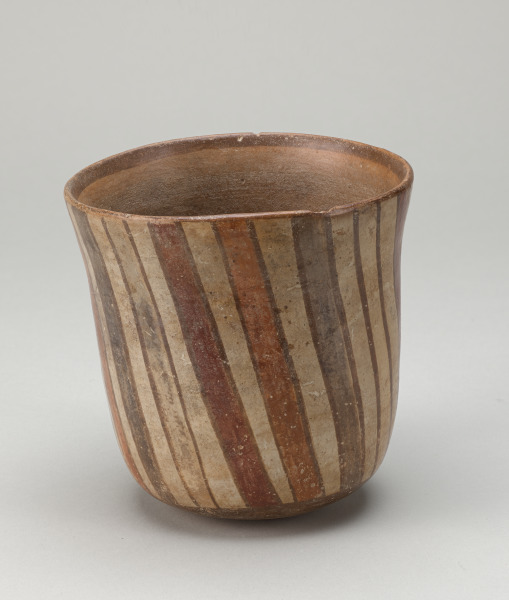
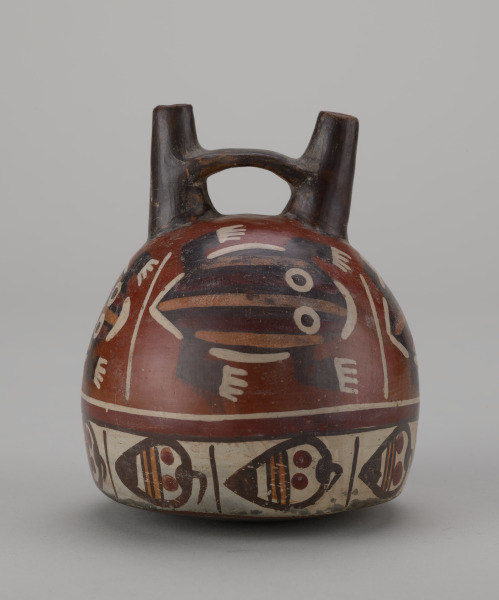
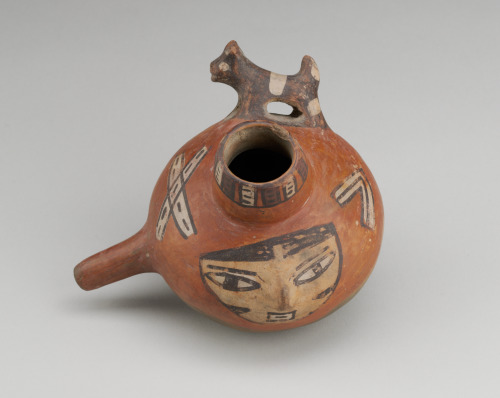
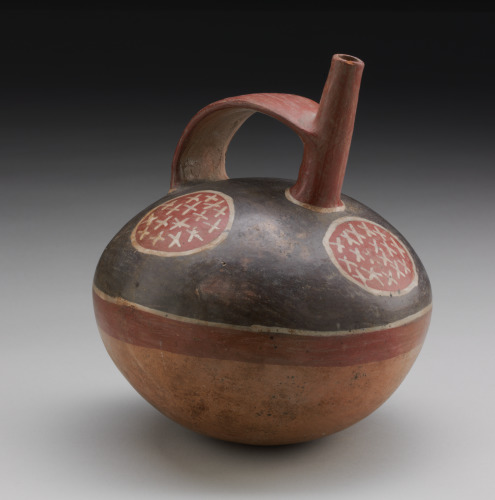
Nasca artists are universally recognized for polychrome painted ceramics that take the form of containers, figures, musical instruments, effigies, miniatures, and architectural models. The ceramics are hand-formed and painted in a varied palette of clay-rich slip paints. Themes vary from the representational to the abstract. On this bowl, five colors are used to create a horizontal panel, outlined in white, which contains a series of undulating, double-headed serpents whose tongues are extended. The entire vessel is slip painted in red and finely burnished. It is light in weight. The bowl shape and painting style indicate the style category of “Nasca 4” which dates roughly to the fifth century (see Kroeber and Collier 1998: 139, fig. 199; Proulx 2006: 159). - Lisa DeLeonardis, June 2016
The Baltimore Museum of Art, by gift, 2016; Kelley Bell, by descent from Carl T. Bell, 2013-2016; 2016; Carl T. Bell, by descent from A. Lyndon Bell, 1981-2013; A. Lyndon Bell, by purchase, May 1959-1981
Kroeber, Alfred L., and Donald Collier, “The Archaeology and Pottery of Nazca, Peru: Alfred L. Kroeber’s 1926 Expedition,” edited by Patrick H. Carmichael, Walnut Creek, CA: Sage, 1998.
Proulx, Donald A., “A Sourcebook of Nasca Ceramic Iconography: Reading A Culture Through Its Art,” Iowa City: University of Iowa Press, 2006.
Proulx, Donald A., “A Sourcebook of Nasca Ceramic Iconography: Reading A Culture Through Its Art,” Iowa City: University of Iowa Press, 2006.