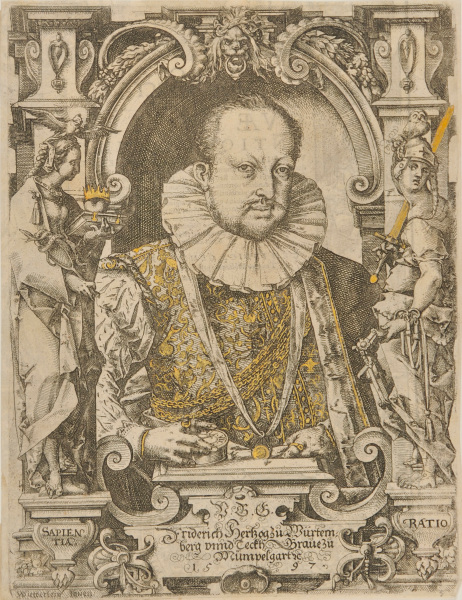
Wendelin Dietterlin
Portrait of Friedrich I, Duke of Württemberg
1596
Scroll
Wendelin Dietterlin
Portrait of Friedrich I, Duke of Württemberg
1596
Physical Qualities
Engraving, handcolored with gold, with woodcut on verso, Sheet: 210 × 160 mm. (8 1/4 × 6 5/16 in.)
Credit Line
Garrett Collection
Object Number
1984.81.4463
Frontispiece to Biblia Sacra (?) The verso states that this illustrated Bible was printed in Tübingen, a city in what was then the Duchy of Württemberg. The portrait on the recto depicts the Duke of Württemberg, hence if this is a case of the recto being printed on recycled paper (the verso) there is at least a geographical connection between the recto and verso (possibly the same publisher?). Hollstein also catalogues the print as recto engraving of Friedrich verso Biblia Sacra, however, so it is likely that this is not a case of recycled paper, but was originally a mix of engraving and woodcut in the same book. Friedrich I of Württemberg (19 August 1557, in Montbéliard – 29 January 1608, in Stuttgart) was the son of George of Mömpelgard and his wife Barbara of Hesse, daughter of Philip I, Landgrave of Hesse. Several references are made to him in Shakespeare's The Merry Wives of Windsor, in which a series of anti-German jokes start with a horse theft, several references are made to German travelers in England and to a German duke who is not expected to come to Windsor. Frederick of Mömpelgard was heir apparent to the dukedom of Württemberg when he visited Windsor and other English cities in 1592. He developed a desire to be made a Knight of the Garter and solicited Queen Elizabeth for the honor repeatedly. After he had inherited the dukedom and become more prominent in affairs, she admitted him to the order.
Inscribed: Recto: in plate: in cartouche below portrait: “Friderich Herzog Würtem / berg [indecipherable] zu / Mömpelgard / 1597”; on either side of cartouche: “Sapientia / Ratio”; lower left corner: “Dietterlein invent.”
Markings: CM: Claghorn