
Libbey Glass Company
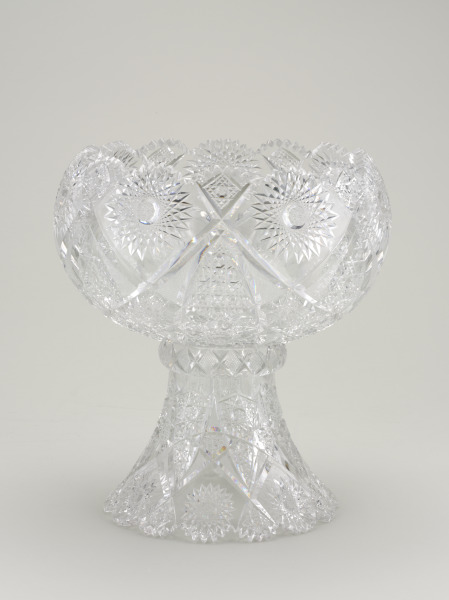
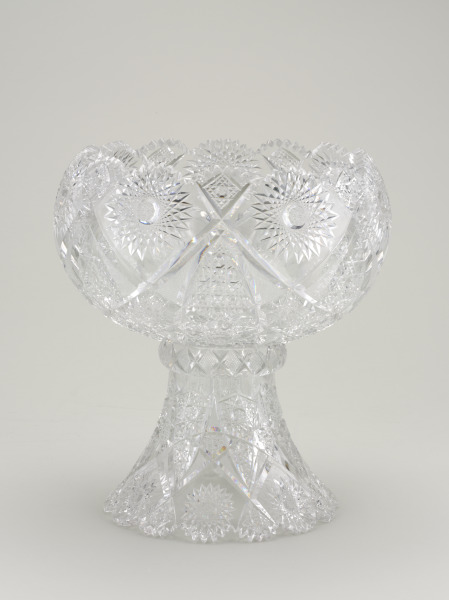
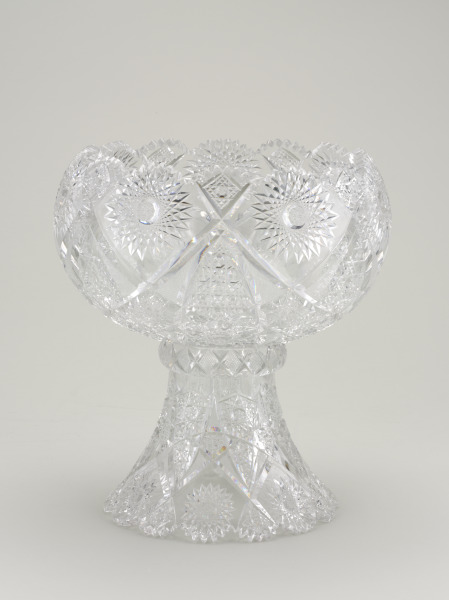
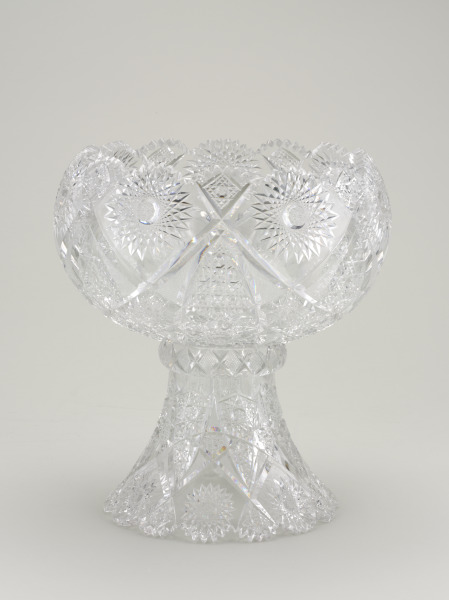
Punch Bowl on Stand
1894-1904
Scroll
Libbey Glass Company
Punch Bowl on Stand
1894-1904
Physical Qualities
Lead glass, Overall: 15 5/8 × 14 3/4 × 14 3/4 in. (39.7 × 37.5 × 37.5 cm.)
Credit Line
Bequest of Barbara Edwards O'Brien
Object Number
1984.206
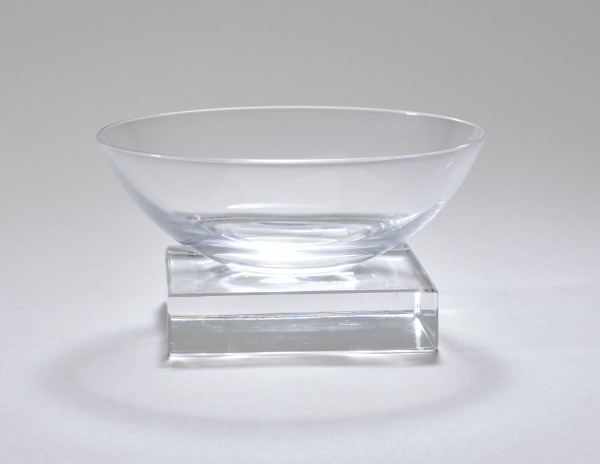
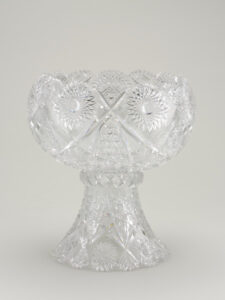
This two-part punch bowl and stand is a sparkling display piece used for special occasions. Inside the translucent upper basin, alcoholic punch in shades such as pink, green, and yellow would illuminate the cut stars and stripes, spreading colorful, glittering hues across a dining table. The sharp surface texture was made using a cut-glass technique—known as “Brilliant Cut”—perfected in American factories in the late 19th century.
Headquartered in Toledo, Ohio, Libbey made some of the most spectacular examples of American “Brilliant Cut” glass using the region’s rich natural resources. The firm’s first major success was at the 1893 Columbia Exposition, where they set up a working glass factory within the exhibition pavilion.--Brittany Luberda 7/2021
To make cut glass, artisans hold smooth glass shapes called “blanks” against various rotating metal or stone wheels. The practice of glass cutting spread slowly from ancient Egypt through the Mediterranean, finally reaching England in the early 18th century. In the 1770s, the first American cut glass was produced by Henry Stiegel, a German-born glassmaker working in Mannheim, Pennsylvania. “Brilliant” cut glass, made in intricate patterns after the 1876 American Centennial, relied on high grade silica to improved glass-making formulas. The use of natural gas rather than coal offered greater process control, while electricity eliminated clumsy steam-driven cutting wheels. The glass industry in the United States retained an international flavor – many of the most skillful American cutters were European born. Headquartered in Toledo, Ohio, Libbey made some of the most spectacular examples.
Baltimore Museum of Art by bequest, 1984; Barbara Edwards O'Brien
AMW Reinstallation 2014
American Wing Rotations 2020
American Wing Rotations 2021
American Wing Rotations 2022
American Wing Rotations 2023
American Wing Rotations 2024
American Wing Rotations 2025
 On View at the BMA