
Edward Berge
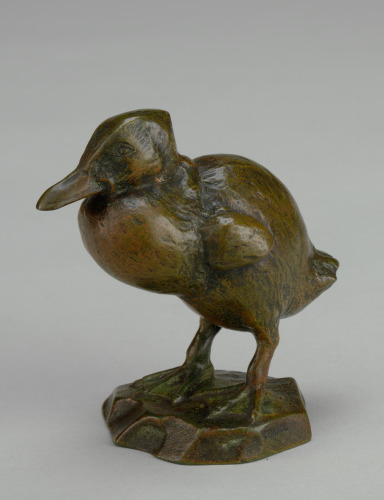
Putto with Duck
1895-1923
Scroll

Edward Berge
Putto with Duck
1895-1923
Physical Qualities
Bronze, 10 1/2 x 8 1/4 x 7 1/2 in. (26.7 x 21 x 19.1 cm)
Credit Line
The Cone Collection, formed by Dr. Claribel Cone and Miss Etta Cone of Baltimore, Maryland
Object Number
1950.391
After studying at the Rinehart School of Sculpture of The Maryland Institute College of Art, Edward Berge, a native Baltimorean, went to Paris to continue his artistic education at the Acadèmie Julian; he also studied with noted sculptors, Charles Verlet (1857 – 1923) and Auguste Rodin (1840 – 1917). An accomplished sculptor by the time of his return to Baltimore, his work was exhibited in several major exhibitions which took place in the first years of the 20th century including the Louisiana Purchase Exposition, St. Louis, 1904 and the Panama-Pacific International Exposition, San Francisco, 1915. In both, he was awarded medals for his sculpture and of the five works he sent to San Francisco, his bronze entitled Wildflower (1909) was voted the most popular in the show.
Berge’s sculpture fall into two groups, those which he referred to as “Ideals” and commissioned works. The former were ornamental pieces for gardens and parks for which his young children frequently posed. Among his commissioned pieces on public display in Baltimore are General Armistead, who defended Baltimore in the War of 1812 and long time mayor of the city, Ferdinand C. Latrobe. Berge also executed the George A. Lucas monument in Greenmount Cemetery.
The Baltimore Museum of Art by bequest, 1949; Etta Cone, Baltimore.
Etta Cone, "The Cone Collection of Baltimore Maryland," (Baltimore: Etta Cone publisher, 1934) 23.
Inscribed: Signed on base at front: "Berge"
Markings: Foundry mark, cold stamped individual letters: "B. Zoppo Foundry N. Y."