
Isaac Moillon, Unidentified Parisian Manufacturer, and others
Queen Dido’s Banquet in Honor of Aeneas
1653-1674
Scroll

- Designer: Isaac Moillon
- Workshop or: Unidentified Parisian Manufacturer
- Workshop: Aubusson (Manufacture Royale d’Aubusson, after 1665)
Queen Dido’s Banquet in Honor of Aeneas
1653-1674
Physical Qualities
Wool, silk, linen lining, 134 × 188 in. (340.4 × 477.5 cm.)
Credit Line
Gift of the Hearst Foundation
Object Number
1954.29
The Scene
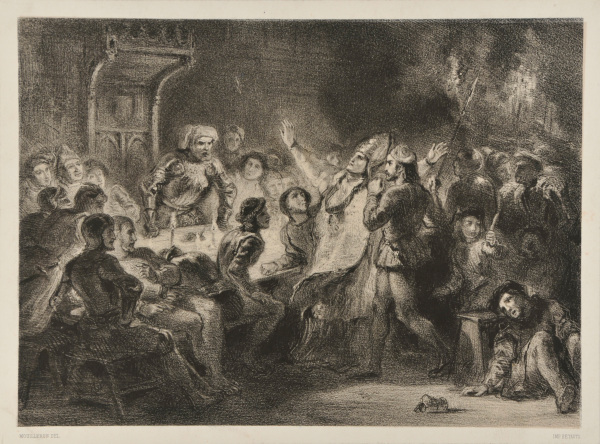
Dido, the courageous founding Queen of Carthage in northern Africa, hosts a feast to celebrate the Trojan warrior Aeneas, who shipwrecked on her shores. Surrounded by guests and enslaved attendants in a palace filled with gold, silver, and luxurious textiles, Dido listens to Aeneas recount his fight against the Greeks at the Battle of Troy. As told in Virgil’s epic poem The Aeneid (written 29–19 BCE), during this banquet Dido and Aeneas are enchanted by devious gods and fall passionately in love, which tragically ends with Dido taking her life after Aeneas leaves for Italy.
Virgil’s Aeneid is about Aeneas’ journey from Troy to conquer Italy, joined by fellow Trojan refugees. Scenes from the poem are found throughout European art history, often when leaders model their rule on the Roman Empire. While the original owner of this French tapestry is still to be discovered, the border’s crown and dolphins (often a symbol of the Dauphin, or son of the King), suggest this was made for the court of Louis XIV (reigned 1643–1715).
Weaving a Tapestry
Isaac Moillon, royal tapestry designer to King Louis XIV of France, designed nine scenes from the story of Dido and Aeneas, which were woven in workshops in France and Brussels. Moillon began by painting a scene, which was then copied into a cartoon: a full-scale, reverse drawing of a design. In a tapestry workshop, the cartoon was placed below a loom. For this tapestry, weavers then wove dyed wool and silk threads, called weft, over undyed wool base threads, called warp. The colorful weft completely covered the warp to create intricate, vibrant imagery. For a tapestry of this scale, the process would have taken about eight months if five weavers worked simultaneously.
Conservation Close-Up
Over the last 350 years, this tapestry’s natural dyes faded from exposure to light. To reveal the original coloration, Baltimore-based textile conservator Louise Wheatley carefully detached the linen lining on a lower corner of the tapestry to reveal the back side (see image). The intense colors of these threads are closer to what viewers saw in the 17th century. Conservation staff at the Baltimore Museum of Art then took fiber samples from the newly exposed threads and examined them under a microscope, confirming the materials used for the warp and weft. Knowing the material composition of the tapestry allows conservators to determine its treatment and future care.
Middle Eastern Queens by European Artists
The tapestry and the paintings around this room show two queens from the Middle East represented by European artists. Dido, from the Roman mythology The Aeneid, was born in present-day Lebanon and established a kingdom on the coast of northern Africa. Mary or the Madonna, celebrated as the queen mother of Jesus, the son of God in the Christian religious tradition, was a poor woman from present-day Israel. Both women are depicted with the skin tone and clothing of wealthy European women from the Renaissance instead of Middle Eastern figures from early millennia. This practice of recasting prestigious people of Middle Eastern or African descent as white, also known as whitewashing, reveals a pervasive Eurocentric worldview and a desire to see white Europeans in positions of power throughout history.
The Baltimore Museum of Art by gift, 1954; William Randolph Hearst Foundation, New York, NY by transfer, 1951-54; William Randolph Hearst, New York, NY and San Simeon, CA by purchase, 1927; Edson Bradley sale, American Art Association, November 11, 1927, cat. 372; Edson Bradley, New York, NY and Newport, RI
Jacobs Wing Rotations 2022
Jacobs Wing Rotations 2023
Workshop or
Unidentified Parisian Manufacturer
1789-12-31 19:03:58–1789-12-31 19:03:58
Explore the Collection Further