
José Clemente Orozco, George Charles Miller, and others
Rear Guard
1928
Scroll

- Artist: José Clemente Orozco
- Printer: George Charles Miller
- Publisher: The Weyhe Gallery
Rear Guard
1928
Physical Qualities
Crayon and tusche lithograph, Sheet: 392 x 540 mm. (15 7/16 x 21 1/4 in.)
Image: 353 × 472 mm. (13 7/8 × 18 9/16 in.)
Credit Line
Gift of Blanche Adler
Object Number
1929.17.21.64
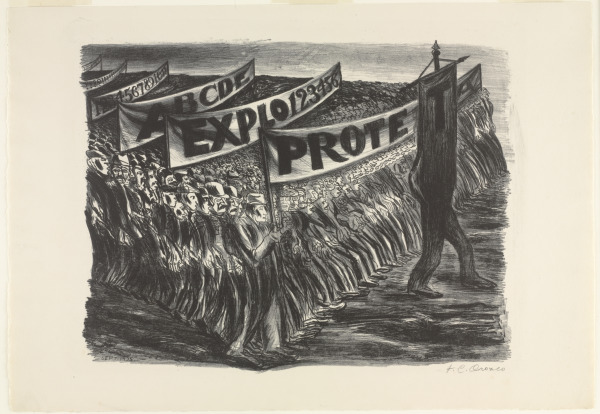
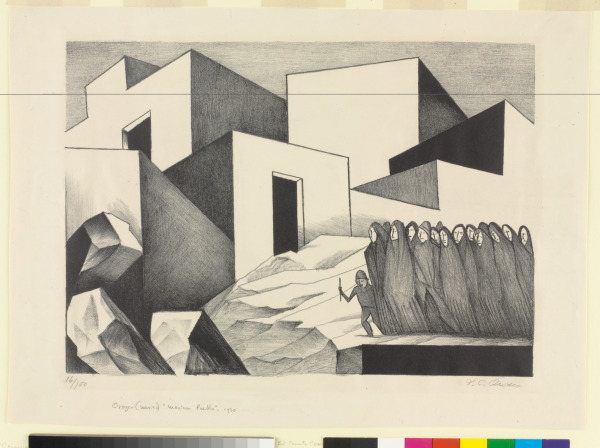
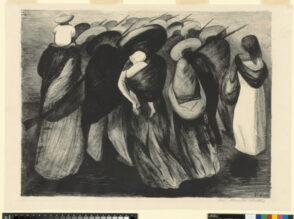
"Rear Guard" relates loosely to Orozco’s 1926 series of drawings that consider the effects of war on the lives of ordinary people. Here the composition is filled by a large group of anonymous soldiers marching into the distance, their weariness suggested by the bent angles of their sombreros. At the back of the group are a young girl and three women wearing dresses, two of whom carry young children. (One woman reaches back to caress the infant’s foot, adding a human touch to this melancholy scene.) These figures refer to the large number of women and children who were displaced by the upheavals of the Mexican Revolution. The women may also be "soldaderas", camp followers who accompanied traveling soldiers and carried out a range of responsibilities. These women often were soldiers’ companions (and bore their children), procured and cooked food, and tended to the injured, and some occasionally smuggled ammunition
or engaged in combat.
The Baltimore Museum of Art by gift, 1929; Blanche Adler, Baltimore
BMA, "Art and Revolution Installation #1," September 30 - October 30, 1988.
Rena Hoisington, BMA, "Crossing Borders: Mexican Modernist Prints," November 19, 2017 - March 11, 2017.
Rena Hoisington, BMA, "Crossing Borders: Mexican Modernist Prints," November 19, 2017 - March 11, 2017.
Hilton, Ronald, ed. "Handbook of Hispanic Source Materials and Research Organizations in the United States." Toronto, Canada: The University of Toronto Press, 1942, p. 186.
Inscribed: Signed l/r on stone, J.C.O.; below in pencil, José Clemente Orozco.


Publisher
The Weyhe Gallery
2000–2000
Gallery founded by Erhard Weyhe (American, born Germany, 1882-1972)
Carl Director of Weyhe's art gallery was Carl Zigrosser (1891-1975)
Meet The Weyhe Gallery
Carl Director of Weyhe's art gallery was Carl Zigrosser (1891-1975)