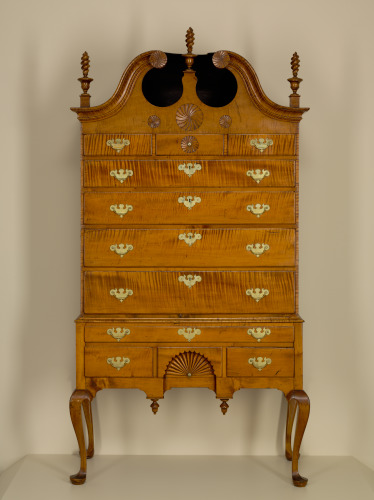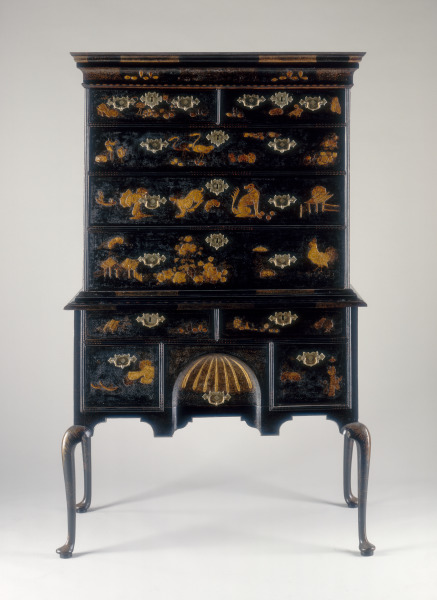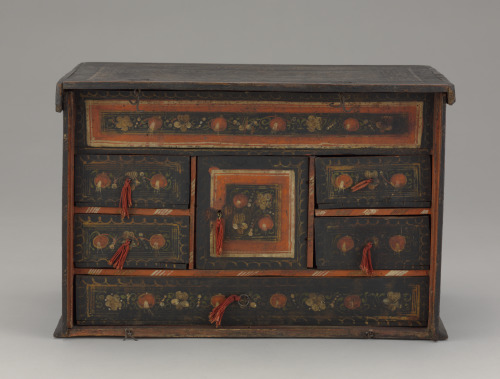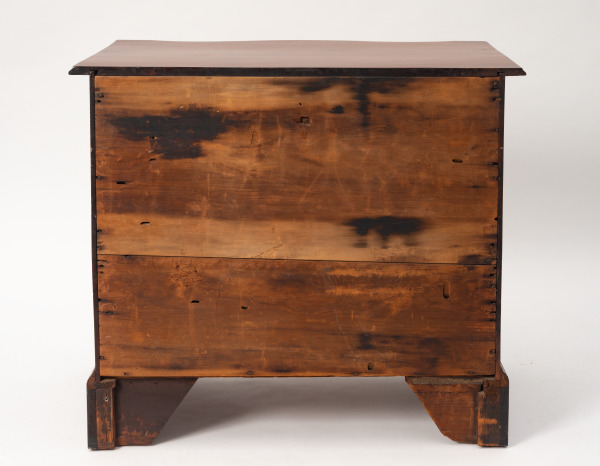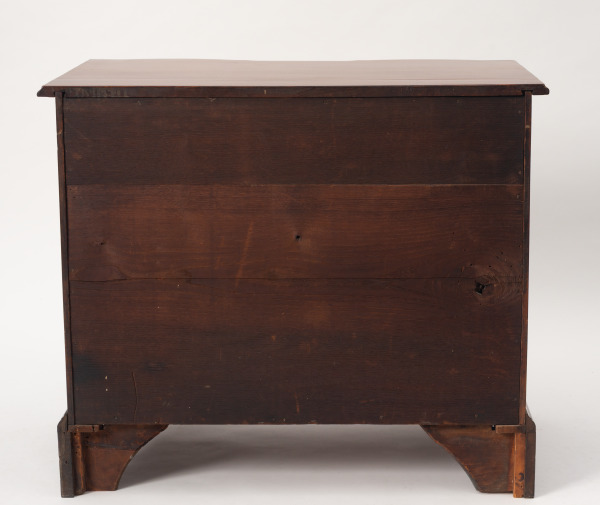

Reverse Serpentine Chest of Drawers
1774-1784
Scroll
Reverse Serpentine Chest of Drawers
1774-1784
Physical Qualities
Walnut; original brasses, replaced locks, 34 1/8 x 38 7/8 x 22 in. (86.7 x 98.7 x 55.9 cm.)
Credit Line
Dorothy McIlvain Scott Collection
Object Number
2012.290
Walnut was considered a somewhat exotic wood so far north as Massachusetts, where it is too cold to grow for the production of fine lumber. This chest was probably created out of walnut brought up from Virginia. The serpentine form, also called an “oxbow,” is well composed with a strong original central drop at the very bottom and tall claw feet that give the piece an assured stance. It was made in either Boston or Salem, both centers for the production of fine colonial furniture.
The Baltimore Museum of Art by bequest, 2012; Dorothy McIlvain Scott, Baltimore
Extended Loans IN
AMW Reinstallation 2014
American Wing Rotations 2020
American Wing Rotations 2021
American Wing Rotations 2022
American Wing Rotations 2023
American Wing Rotations 2024
American Wing Rotations 2025
Elder III, William Voss and Jayne E. Stokes. American Furniture 1680-1880: From the Collection of the Baltimore Museum of Art. Baltimore: Museum of Art, 1987, p.94-95, ill. 67.
 On View at the BMA