
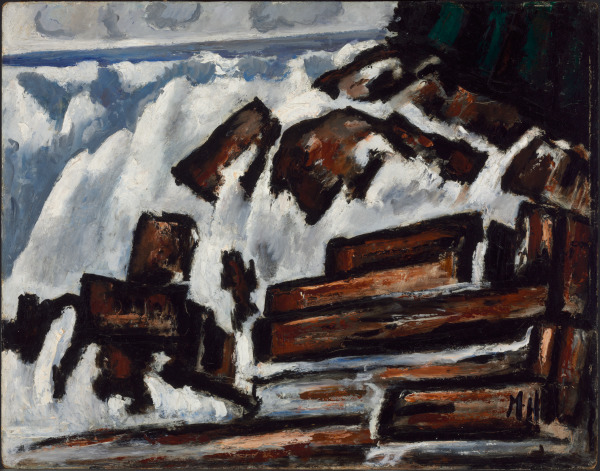
Marsden Hartley
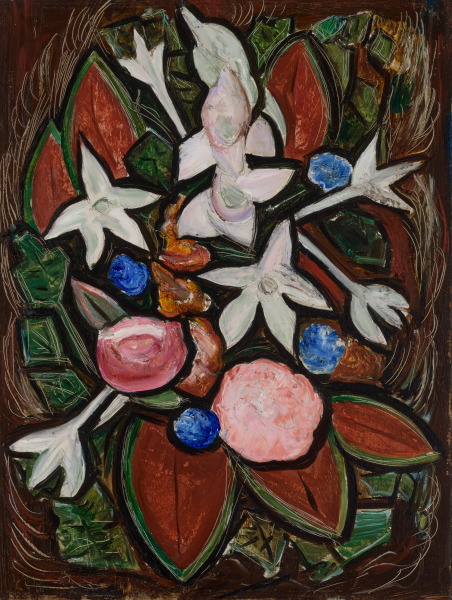
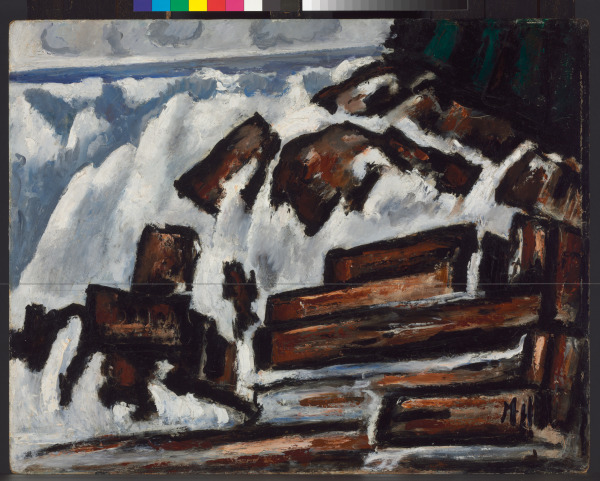
Rising Wave, Indian Point, Georgetown, Maine
1936-1937
Scroll
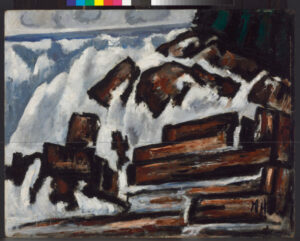
Marsden Hartley
Rising Wave, Indian Point, Georgetown, Maine
1936-1937
Physical Qualities
Oil on paperboard, Framed: 32 x 38 x 3 3/8 in. (81.3 x 96.5 x 8.6 cm) Sight: 21 1/2 x 27 3/8 in. (54.6 x 69.5 cm)
Credit Line
Edward Joseph Gallagher III Memorial Collection
Object Number
1958.41
Here, Marsden Hartley rendered coastal waves crashing against sea boulders. The scene evokes the name of the Penobscot tribe, which can translate to “where the white rocks open out” in the Abenaki language spoken by Indigenous people in Quebec and northeastern New England. Indian Point is the tip of a peninsula marking the entrance to the Sagadahoc Bay near Georgetown, Maine. This region, which has more than 80 miles of shoreline, was the territory of the Penobscot people, who lived along the Penobscot River to the north. Though decimated by war and by illnesses introduced by European colonizers, and forced to give up most of their land by the 1830s, the Penobscot Nation today protects and manages 90,000 acres of trust land in Maine.
Link Benesch Reinstall (Spring 2008)
Maine Moderns: The Stieglitz Circle in Seguinland
Nature and Spirit: Marsden Hartley's Mysticism
Expressions of Nature: Early 20th Century Landscapes
Adelyn Breeskin: Curating a Legacy
American Wing Rotations 2023
American Wing Rotations 2024
American Wing Rotations 2025
Baltimore Museum of Art. The Edward Joseph Gallagher III Memorial Collection. [Baltimore, MD]: Baltimore Museum of Art, [1964], page 25.
Libby Bischof and Susan Danly, "Maine Moderns: Art in Seguinland, 1900-1940," New Haven and London: Yale University Press, 2011, ill. p. 89 (pl. 9).
Inscribed: FACE: LR, 'M.H.'. VERSO: (label), 'Rising Wave/Indian Point/Georgetown (sic)/Maine; 1937-38/Marsden Hartley' (in artist's hand)
 On View at the BMA