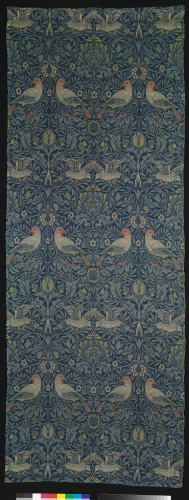
William Morris and Morris & Company
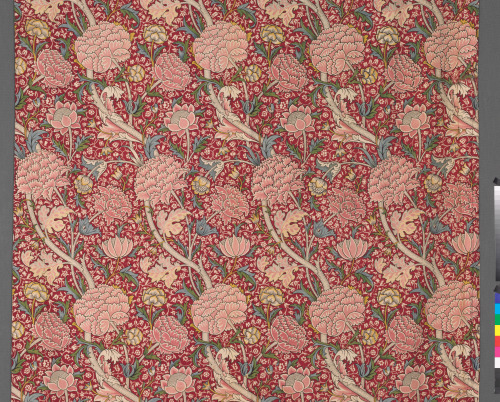
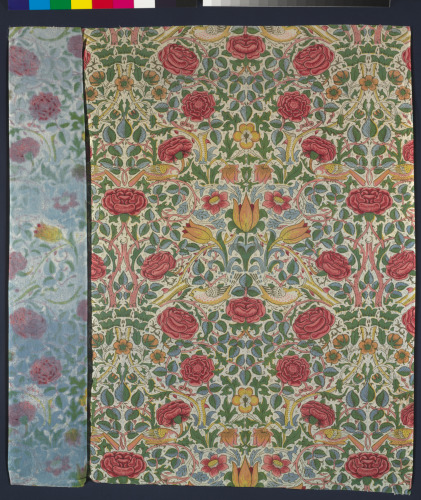
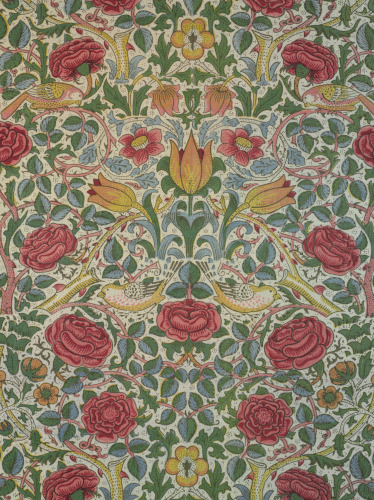
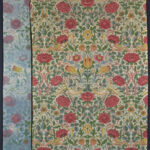
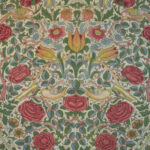
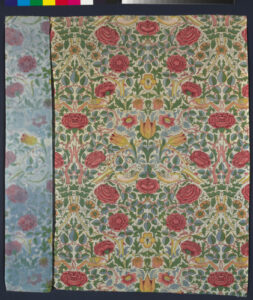
Rose
1882
Scroll
Physical Qualities
Cotton, 35 x 64 3/4 in. (89 x 164.5 cm.)
Credit Line
Gift of Dena S. Katzenberg, Baltimore, MD.
Object Number
1993.487
Perhaps the most amazing of the indigo discharge designs, 'Rose' was intended to have a white ground. This required that the whole cloth be dyed blue, then discharged or bleached out (with blocks cut in the negative of the design) in all areas except for those intended to be blue or green. The cloth was then cleared by a soap or bran bath, dried, block printed with a mordant for yellow, submerged in a dye bath of weld, cleared again, block printed with a mordant for madder, and submerged in a madder vat to produce red and other colors. Evidence of the use of the indigo discharge technique can be seen on the reverse of this fabric, which remains blue in many areas that are white on the face since the bleaching agent did not permeate through to the back of the cloth. The selvage is also blue since it was not necessary to bleach out an area that would not be printed.
Baltimore Museum of Art by gift, 1993; Dena S. Katzenberg Baltimore, MD.
William Morris: The Reactionary Revolutionary
Engaging the Elements: Poetry in Nature
Baltimore Museum of Art, 'BMA Today July / August 2003,' p. 8, ill.
Baltimore Museum of Art, 'BMA Today': March / April 2003 p.8, ill.
Andre, Linda, and Jessica Skwire Routhier, eds. The Baltimore Museum of Art: Celebrating A Museum. Baltimore, Maryland: Baltimore Museum of Art, 2014. pg.57
Linda Parry (ed.), William Morris, London: Philip Wilson Publishers in Association with The Victoria and Albert Museum, 1996, pp. 266-267, cat. M.69, illus. Linda Parry, William Morris Textiles, New York: The Viking Press, 1983, p. 38, pp. 49-54, and p. 156, fig. 53. Otto Charles Thieme, Avant Garde by the Yard: Cutting Edge Textile Design, 1880-1930, Cincinnati: Cincinnati Art Museum, 1996, pp. 4-13 (general), p. 10, pl. 10; p. 11 ('Rose'). Norah C. Gillow, William Morris: Designs and Patterns, New York: Crescent Books/Bracken Books, 1988, pl. 22. Hazel Clark, Textile Printing; Aylesbury, Bucks, U.K.: Shire Publications; 1985, p. 15 (info. on indigo-discharge). Christie's, London, 5 February, 1992, lot 105.
Inscribed: None.
 On View at the BMA