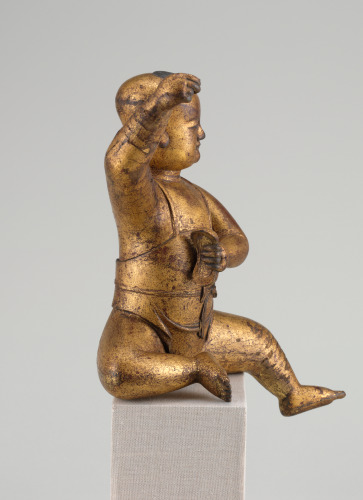
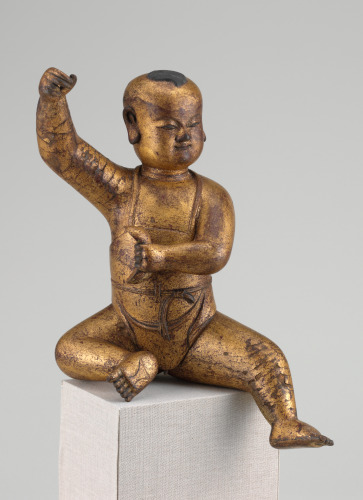
Seated Boy as Kui Xing
1400-1599
Scroll
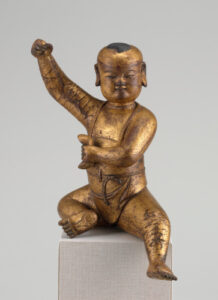
Seated Boy as Kui Xing
1400-1599
Physical Qualities
Gilt and lacquer on wood, 15 × 11 5/8 in. (38.1 × 29.5 cm.)
Credit Line
Julius Levy Memorial Fund
Object Number
2017.224
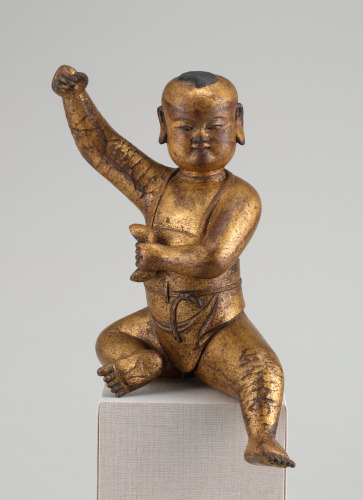
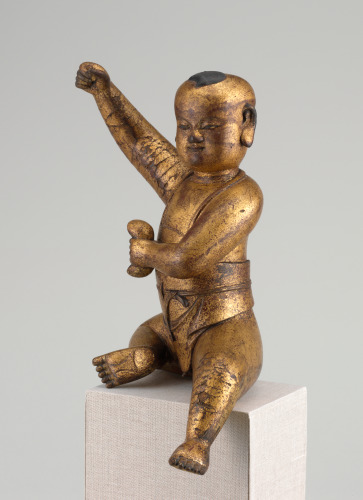
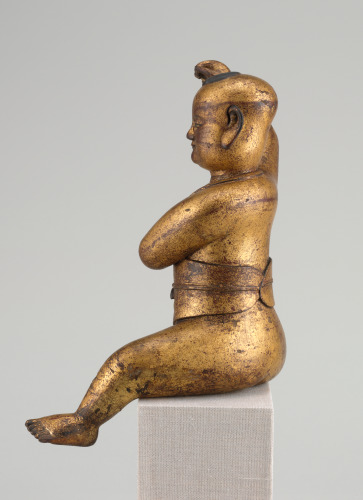
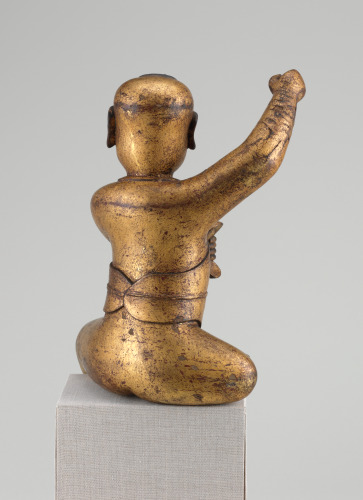
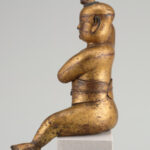
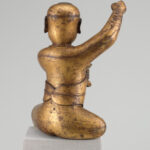
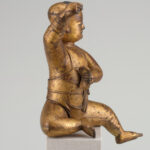
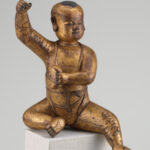
The figure of a boy references three different practices at once: Daoism, Confucianism, and Buddhism. His raised right hand would have held a brush (now missing), a gesture associated with Kui Xing, China’s Daoist deity connected to success in Imperial examinations. The crescentshaped gold bar in his left hand symbolizes the wealth available to the few candidates able to pass those tests. The baby figure represents an object of prayers and veneration to the Buddhist bodhisattva, Guanyin, for the birth of a son. Finally, the boy himself symbolizes Chinese Confucian ideals, because only a son could maintain the family’s ancestral connection through the observance of annual rites as well as maintain or advance their social position by securing an official post in the Imperial bureaucracy.
The Baltimore Museum of Art by purchase, 2017; Kaikodo, New York; European private collection
Asian Gallery Rotation
Asian Gallery Rotations 2021
[Asian Refresh]
Asian Gallery Rotations 2022
Asian Gallery Rotations 2023
Asian Rotations 2024
Asian Rotations 2025
Hucker, Charles O. (1985), A dictionary of official titles in Imperial China, Stanford University Press, pp. 106–107, 536, ISBN 0-8047-1193-3
 On View at the BMA