Louise B. Wheatley
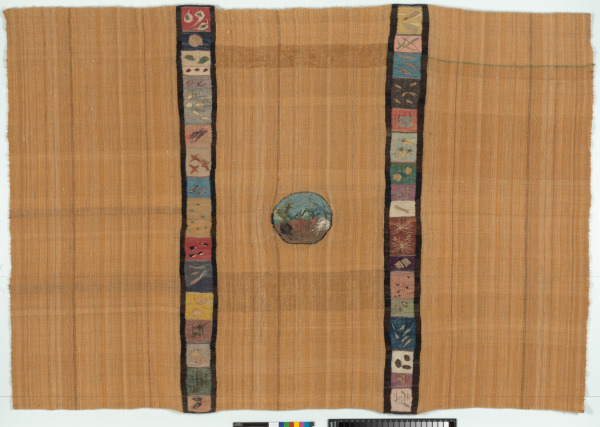
Seed Manta
1998
Scroll
Louise B. Wheatley
Seed Manta
1998
Physical Qualities
Wool, linen, silk, cotton, cashmere, musk ox down, hemp, alpaca hair, llama hair, ramie, cat hair, synthetic copper thread, 32-1/4 x 46 in. (81.9 x 116.9 cm.)
Credit Line
Lilian Sarah Greif Bequest Fund
Object Number
1999.162
The plain-woven panels and tapestry-woven ornament of Seed Manta recall the stripes or clavi and roundels woven into Coptic tunics. Wheatley’s subject, like those of many Coptic weavers before her, celebrates nature and the fertility of the Earth. Thirty-four different seeds or seed groupings are depicted within the tapestry strips of this blanket, including flower seeds, rice, grain, sunflower seeds, and others, which ”sit in...groups of preordained possibility,” the artist explains, “awaiting the directive to unfold.” Meanwhile, within the central roundel various plants are “rooting into the soil and stretching up to the sky.” The subtle textures of Seed Manta result from Wheatley’s employment of numerous handspun fibers. The mottled ground with subtle shifts in color and the variety of hues within the decorative sections are produced by dyeing handspun yarns with natural (often homegrown) dyestuffs, such as lichen, madder, indigo, cochineal, logwood, weld, Queen Anne’s lace, coreopsis, sumac, and cutch. Together, they yield a multitude of hues in an infinite variety of shades and values.
Baltimore Museum of Art by purchase, 1999; Louise Wheatley (b. 1947), Manchester, NH.
Intimate Earth: The Art of Louise Wheatley
Timeless Weft: Ancient Tapestries and the Art of Louise B. Wheatley
Jones, Anita, "Louise Wheatley," in Intimate Earth: The Art of Louise Wheatley," James Archer Abbott (ed.), Baltimore: Evergreen Museum & Library, The Johns Hopkins University, 2011, pp. 7-8, illus. p. 6.