Unknown Artist
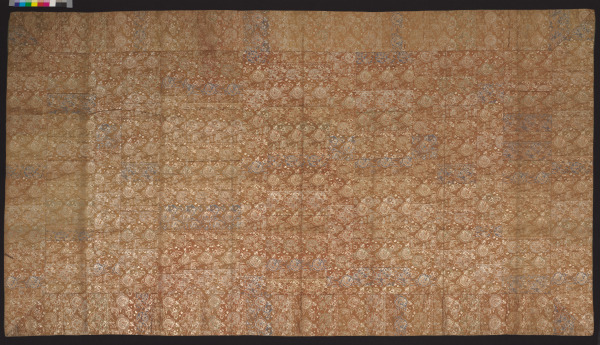
Seven Column Kesa with Peonies and Chrysanthemums
Buddhist, 1614-1867
Scroll
Unknown Artist
Seven Column Kesa with Peonies and Chrysanthemums
Buddhist, 1614-1867
Physical Qualities
Silk, gilded paper, 43-1/2 x 71-1/2 in.
Credit Line
Gift of Davy McCall, Chestertown, Maryland
Object Number
2002.588
A seven column kesa or Buddhist priest's robe composed of a fabric with a ground woven in beige main wefts, gilded paper strips, and multicolored supplementary silk wefts. The kesa features seven pieced vertical columns separated by narrower whole strips and surrounded by a wide border. There are no horizontal dividing strips. A wide border, mitered at the corners, surrounds the whole. These elements are composed of a fabric with a ground including flat gilded paper wefts and a pattern of peonies and chrysanthemums created with supplemental wefts in multiple colors including dark purple, medium violet/purple (faded to light violet-purple in some areas), medium blue, grey-blue (faded in some areas to light blue-green), dark coral, white, off-white, cream or light yellow, and light green. The floral designs appear to be placed on a diaper pattern composed of ancient hollyhock motif appearing at the interstices. Two squares representing the bodhisattva of Wisdom and Benevolence are found on either side of the center column, which represents Buddha (Sakyamuni). These and the squares in the four corners representing the four Heavenly Kings, who guard the four corners or four cardinal points of the Buddhist universe, are made of intense orange silk with flat gold leafed paper wefts woven in floral motifs (kinran). The kesa is lined in dark blue/purple silk. (A second stiff, blue, transparent lining placed over the first is a later conservation measure). A strap is found on the reverse beneath the added sheer lining and a blue cord tie is attached to the front at the upper left. The fabric composing the kesa is of a complex weave structure with very narrow violet warps, one set apparently interacting with the main wefts, which consist of bundles of three thick beige/brown threads, and others tying down the supplementary wefts, including the kinran, in a two-to-one twill. The squares of orange-red ground are woven in two/two twill with the gilded paper wefts bound in two to one twill.
The Baltimore Museum of Art by gift, 2002; Davy McCall, Chestertown, Maryland, purchased by the donor from the Imperial Hotel Antique Shop, Tokyo, Japan in 1945.
Kennedy, Alan. Japanese Costume: History and Tradition. Paris: Editions Adam Biro, 1990, pp. 121-150.
Kennedy, Alan. Manteau de nuages: kesa japonais XVIII-XIX siecles. Paris: Reunion des musees nationaux, 1991.
Till, Barry and Swart, Paula. 'Elegance and Spirituality of Japanese Kesa.' Arts of Asia (Vol. 27, No. 4), pp. 51-63.
Morse, Anne Nishimura and Morse, Samuel Crowell. Object as Insight: Japanese Buddhist Art & Ritual. N.Y.: Katonah Museum of Art, 1995, pp. 8-17, 60-63.
Yang, Sunny and Narasin, Rochelle M. Textile Art of Japan. Tokyo: Shufunotomo Co., Ltd., 1989, p.112.
Kennedy, Alan. Manteau de nuages: kesa japonais XVIII-XIX siecles. Paris: Reunion des musees nationaux, 1991.
Till, Barry and Swart, Paula. 'Elegance and Spirituality of Japanese Kesa.' Arts of Asia (Vol. 27, No. 4), pp. 51-63.
Morse, Anne Nishimura and Morse, Samuel Crowell. Object as Insight: Japanese Buddhist Art & Ritual. N.Y.: Katonah Museum of Art, 1995, pp. 8-17, 60-63.
Yang, Sunny and Narasin, Rochelle M. Textile Art of Japan. Tokyo: Shufunotomo Co., Ltd., 1989, p.112.
Inscribed: None
Maker
Unknown Artist
2000-01-01 00:00:00–2000-01-01 00:00:00