Wenceslaus Hollar
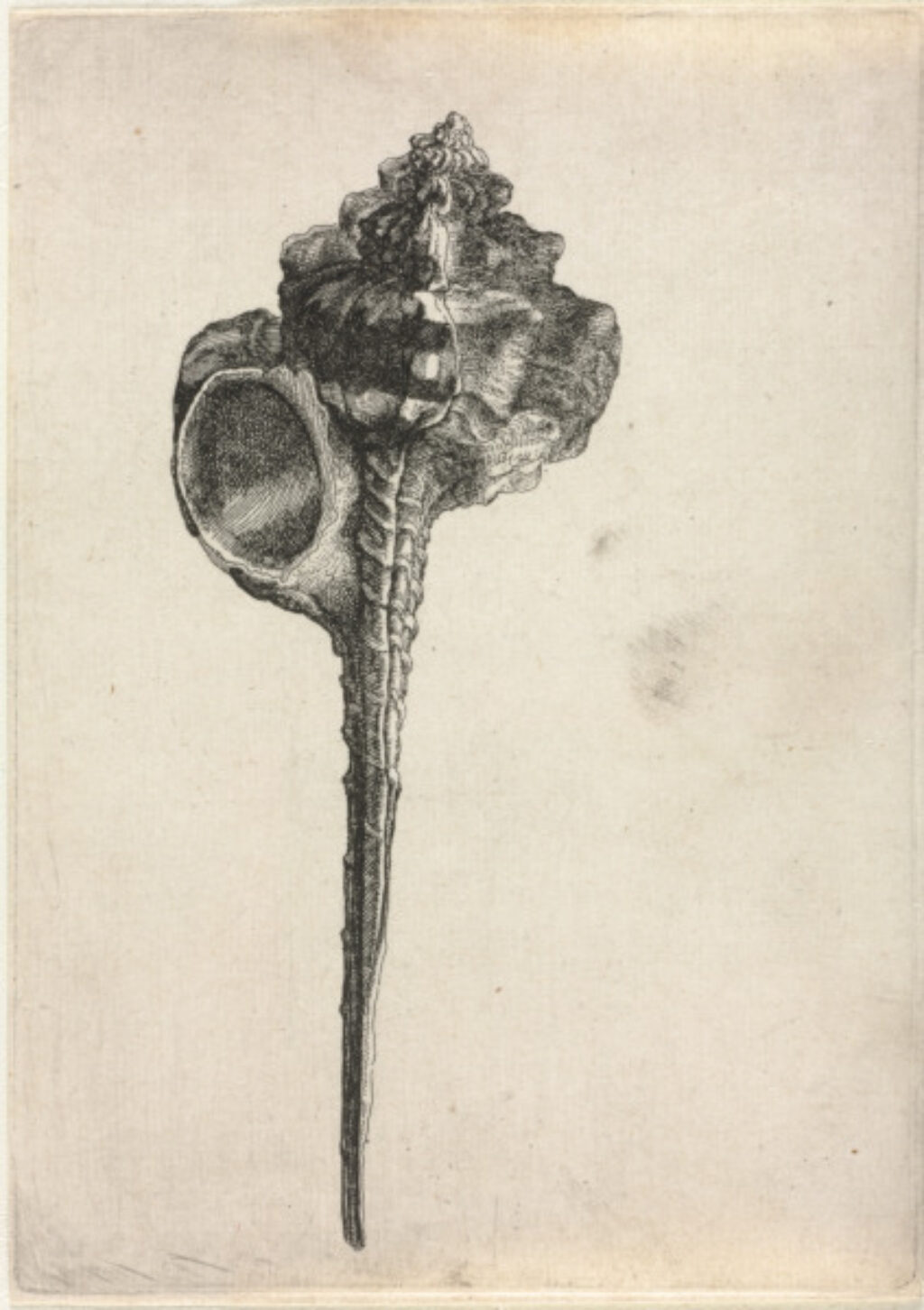
Snipeis Bill Murex (murex haustellum)
1640-1650
Scroll
Wenceslaus Hollar
Snipeis Bill Murex (murex haustellum)
1640-1650
Physical Qualities
Etching, Sheet: 100 x 139 mm. (3 15/16 x 5 1/2 in.)
Plate: 98 x 137 mm. (3 7/8 x 5 3/8 in.)
Credit Line
John Dorsey and Robert W. Armacost Bequest Funds, and purchased as the gift of the Print, Drawing & Photograph Society
Object Number
2011.120
Murex haustellum belongs to an untitled series of 38 shells, all of which are presented in the same, simple fashion. By isolating the shells against a plain background, Wenceslaus Hollar draws the viewer’s attention to their intrinsic beauty, focusing on their distinctive silhouettes and textures. The absence of text distinguishes Hollar’s shell etchings from illustrative scientific prints of the time that provided the Latin name of each specimen, if not sometimes other relevant information.
Although the murex haustellum is readily available today, it was a rarity in the seventeenth century. Brought to Europe via maritime trade, such shells were collected as exotic objects and scientific curiosities, and would be displayed among similar items in the compendium of knowledge known as a wunderkammer (room of wonder).
The Baltimore Museum of Art by purchase, 2011; Susan Schulman Printseller, NY
Watershed: Transforming the Landscape in Early Modern Dutch Art


Explore the Collection Further