Shaoxing or Ningbo kilns
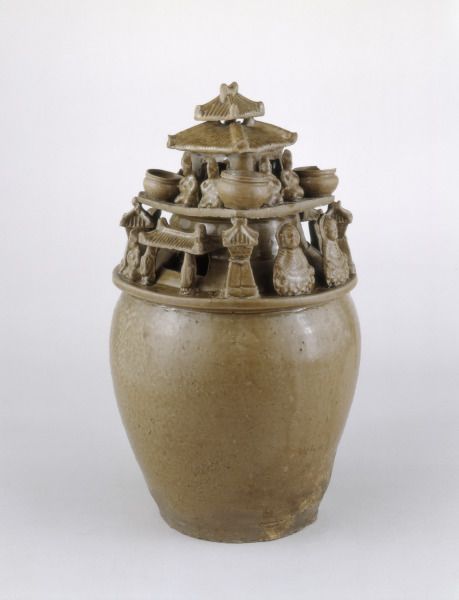
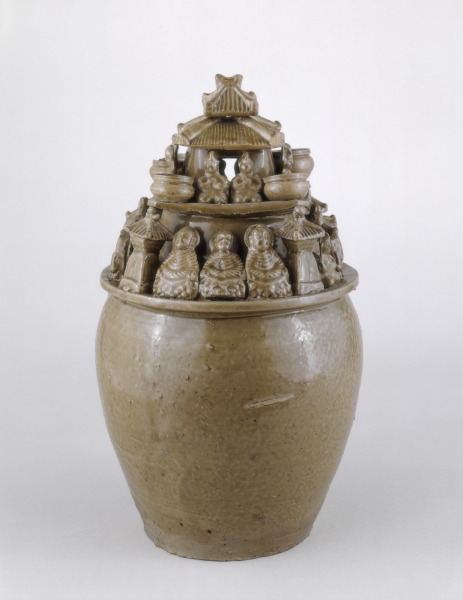
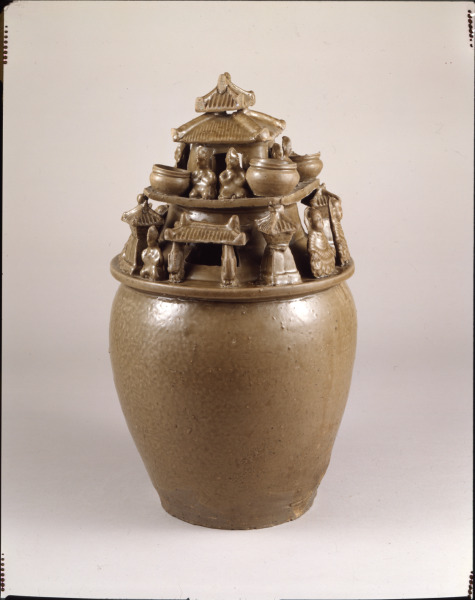
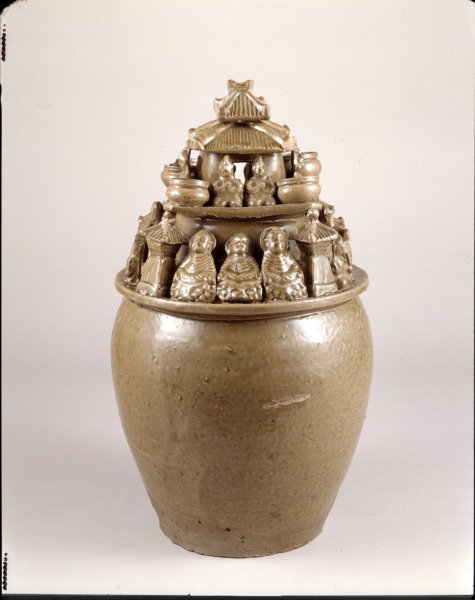
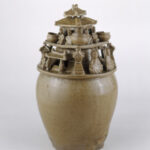
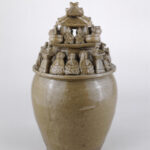
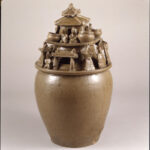
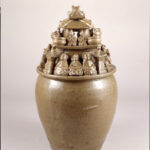
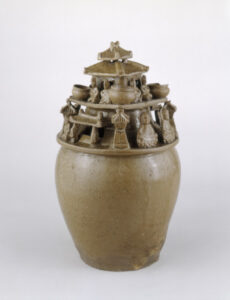
Soul Urn Decorated with Seated Buddha Figures
265-300
Scroll
Shaoxing or Ningbo kilns
Soul Urn Decorated with Seated Buddha Figures
265-300
Physical Qualities
Stoneware with olive-green glaze, 17 H x 9 3/4 Diam. in. (43.2 x 24.8 cm.)
Credit Line
Purchase with exchange funds from Frank J. and Elizabeth L. Goodnow Collection
Object Number
1988.647
Buddhism spread from India to northwestern China during the 1st century, then outward from the centrally located city of Luoyang, which was China’s capital at the time. This vessel, made in a coastal southern province, places Buddha figures in a two-tiered Chinese setting. The absence of a removable lid reflects the vessel’s symbolic purpose. Four pairs of figures, separated by grain storage jars, kneel in devotion on the upper level. The lower has five seated Buddhas and two openings covered by a roof supported by dragon-form que gates. Que gates or pillars were used for palaces, city gates, entrance doors, and tombs. In Sichuan Province, the pillars signaled the soul’s entrance into the spirit world, but here they suggest passage to the Buddha’s paradise. The inclusion of the Buddha image on this funerary urn, together with Chinese devotees and architectural elements, demonstrates the geographic extent of the faith at the end of the 3rd century.
The Baltimore Museum of Art by purchase, 1988; J. J. Lally & Co., New York; Stanley and Adele Herzman, New York; Sotheby's, New York, 1985
Asian Reinstallation: Home, Temple, Tomb
Asian Gallery Rotations 2021
[Asian Refresh]
Asian Gallery Rotations 2022
Asian Gallery Rotations 2023
Asian Rotations 2024
Asian Rotations 2025
Frances Klapthor, Chinese Ceramics, Baltimore: BMA, 1993, no. 6, p. 16, ill. p. 17.
Wai-Kim Ho, 'Hun-p'ing Urn of the Soul,' Cleveland Museum of Art Bulletin, 28, Feb. 1961, 26-34.
Albert Dien, “Developments in Funerary Practices in the Six Dynasties Period: The Duisuguan or “Figured Jar” as a Case in Point,” in Wu Hung, ed., Between Han and Tang, vol. 2. 60-101.
Wu Hung, Buddhist Elements in Early Chinese Art (2nd and 3rd Centuries A.D.), Artibus Asiae, Vol. 47, No. 3/4 (1986), pp. 263-303+305-352
[Stable URL: http://www.jstor.org/stable/3249974]
Albert Dien, “Developments in Funerary Practices in the Six Dynasties Period: The Duisuguan or “Figured Jar” as a Case in Point,” in Wu Hung, ed., Between Han and Tang, vol. 2. 60-101.
Wu Hung, Buddhist Elements in Early Chinese Art (2nd and 3rd Centuries A.D.), Artibus Asiae, Vol. 47, No. 3/4 (1986), pp. 263-303+305-352
[Stable URL: http://www.jstor.org/stable/3249974]
 On View at the BMA


![LANDSCAPE WITH FIGURE SEATED ON A HILLSIDE [TOP]; LANDSCAPE WITH FIGURES NEAR A CROSS [BOTTOM]](https://artbmadevsite.org/wp-content/uploads/2026/02/96165_25714587.jpg)