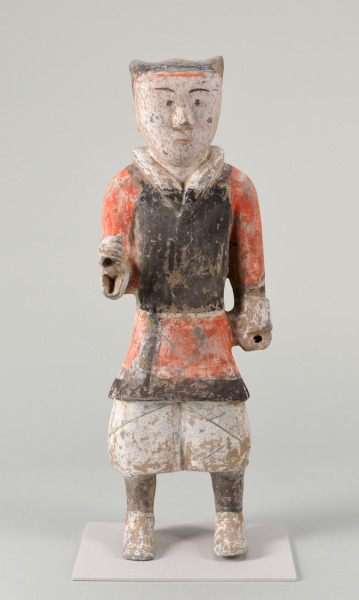

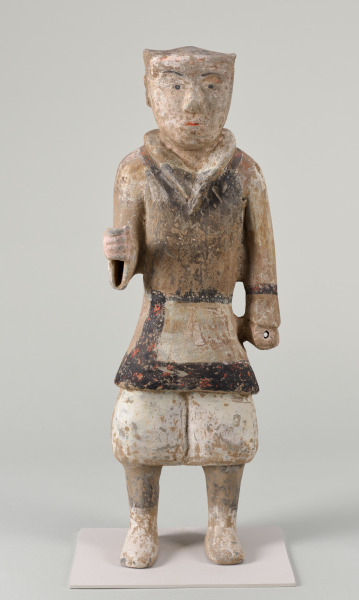
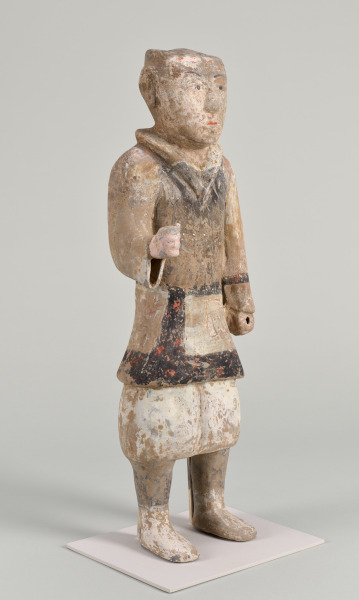
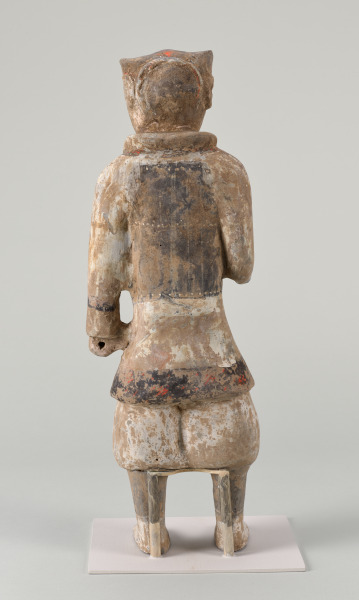
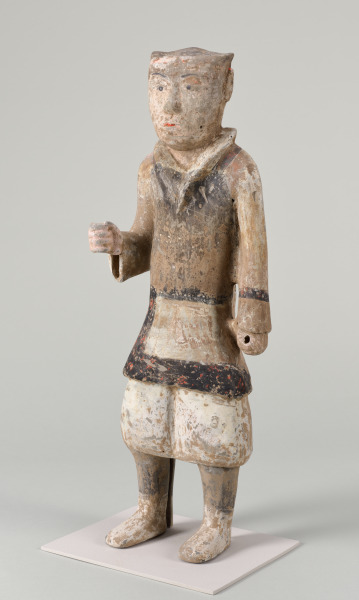
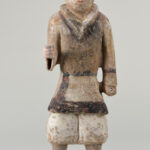
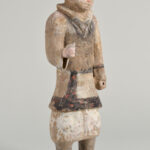
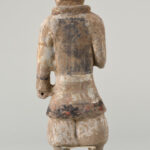
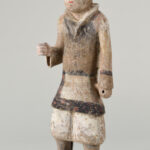
Standing Foot Soldier
167-134
Scroll
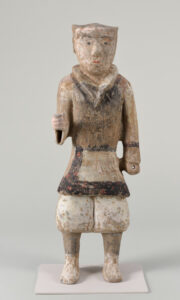
Standing Foot Soldier
167-134
Physical Qualities
Earthenware with unfired pigments, 18 3/4 x 6 1/2 x 4 3/8 in. (47.5 x 16.5 x 11 cm.)
Credit Line
Gift of George and Julianne Alderman, Baltimore
Object Number
2000.339
Warfare was nearly continuous throughout the Western Han dynasty
(206 bce–9 ce). Western Han armies were based on the model of
infantries accompanied by chariots and cavalry, which had been used
by the earlier Qin dynasty (221–206 bce). Following the example of the
First Qin Emperor, members of the Western Han elite were accompanied
in death by armies of sculpted soldiers, which not only indicated
the earthly status of the deceased, but also ensured the tombs’ ongoing
protection. The sculpted armies of the Western Han were smaller
in number and size than those of the earlier Qin dynasty. They were
also less detailed.
The Baltimore Museum of Art by gift, 2000; George and Julianne Alderman, Baltimore; Michael Teller, Williamsburg, Virginia (acquired after 1990)
Asian Reinstallation: Home, Temple, Tomb
Asian Gallery Rotations 2021
Asian Gallery Rotations 2022
Asian Gallery Rotations 2023
Danielle and Vadime Elisseeff, 'New Discroveries in China,' Fribourg: Office du Livre, 1983, no. 77, p. 121: group of mounted soldiers and foot soldier from Yangjiawan, Xianyang (Shaanxi province), discovered 1965 and dated to c. 179-141 BC. The Quest for Eternity, San Franciso: Chronicle Books/ Los Angeles County Museum of Art, 1987 (exhibition catalogue), pp. 17-52, 68-74, cat. nos. 11-14, 18-21, fig. 6, ill. Fine Asian Works of Art, Butterfields, San Francisco, Sale 71180, 6/27/2000, nos. 3412, 3414, ill. 3412, a group of 13 figures with an estimate of $12,000-$15,000, sold for $6,800 + 15% premium; 3414 with an estimate of $4,000-6,000 did not sell.