Kashan kilns
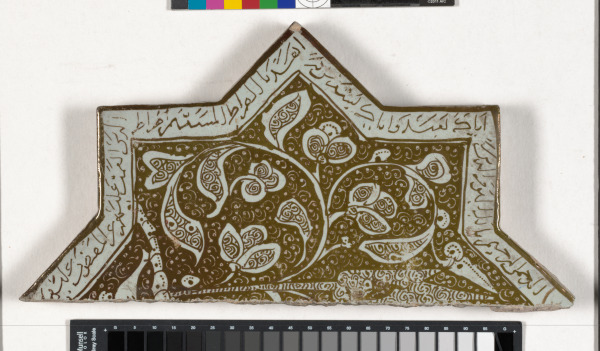
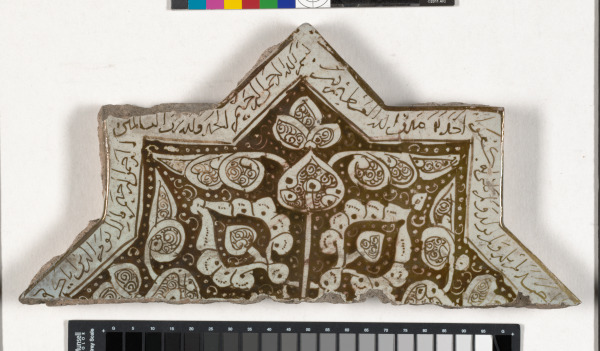
Star Tile from Imamzadeh Yahya Decorated with Leaves (fragment)
1259
Scroll
Kashan kilns
Star Tile from Imamzadeh Yahya Decorated with Leaves (fragment)
1259
Physical Qualities
Fritware with gold lustre decoration over white glaze, 12 1/4 x 6 1/8 in. (31.1 x 15.6 cm.)
Credit Line
Gift of Richard and Elizabeth S. Ettinghausen in Memory of Adelyn D. Breeskin
Object Number
2013.216
In a climate of tremendous prosperity in Iraq during the 9th and 10th
centuries, kilns at Basra used a technique invented by Egyptian and Syrian
glassmakers in the 8th century to produce an expensive, deluxe lusterware
pottery. The Iraqi potters added metallic oxide decoration, usually a
combination of copper and silver, to earthenware vessels that had already
been glazed and fired. A second firing resulted in the formation of a thin
metal film affixed to the glazed surface, which could then polished and
shined. Dr. Richard Ettinghausen was the first scholar to suggest that Basra
was an early center for the production of both ceramics and glass. Iran’s
Nishapur kilns copied the Basra innovation by creating an imitation luster
characterized by cross-hatching and small dots. Kilns at Kashan continued
to produce high quality luster-decorated tiles until the mid-14th century.
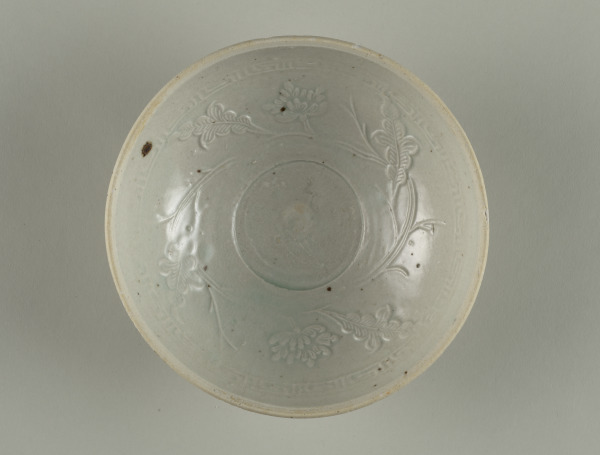
Bowl with Star Design, 10th century
Abbasid period (749–1055)
Basra, Iraq
Earthenware with yellow luster decoration on white glaze
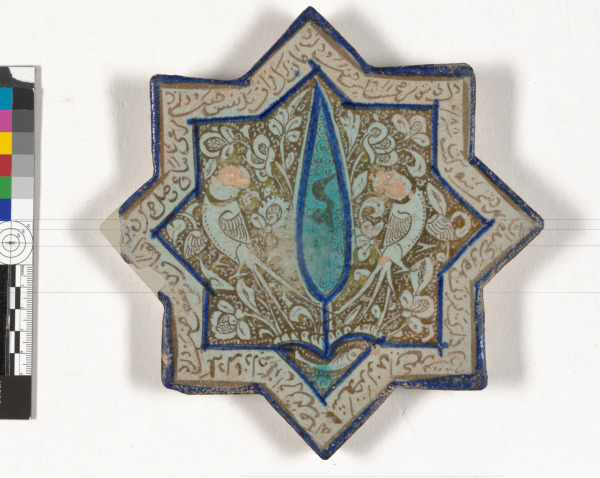
Tile Decorated with Leaves, late 13th century
Ilkhanid period (1256–1353)
Kashan, Iran
Fritware with luster glaze
Bowl with Design of Dots and Lines, 10th century
Abbasid dynasty (749–1055)
Nishapur, Iran
Earthenware with imitation yellow luster decoration on white glaze
BMA 2013.157, 2013.216, and 2013.158
The Baltimore Museum of Art by gift, 2013 (on extended loan from 1957); Elizabeth Ettinghausen, Princeton, NJ; Richard S. Ettinghausen
Extended Loans IN
Art Across Asia: West Asian Connections
Anthony Welch, "Calligraphy in the Arts of the Muslim World," Austin: University of Texas Press (in cooperation with The Asia Society, NY), 1979, pp. 116-117.
"Epigraphy iii. Arabic inscriptions in Persia," "Encyclopaedia Iranica," 7/10/2017 [http://www.iranicaonline.org/articles/epigraphy-iii]
Bloom, Jonathan M.- Blair, Sheila S., The Grove Encyclopedia of Islamic Art and Architecture Volume 2, New York, 2009.
Dieulafoy, Jane, La Perse, la Chaldée et la Susiane, Hachette, Paris, 1887.
Hutt, Antony, Islamic architecture Iran 1, London: Scorpion Publications Limited, 1977.
Wilber, Donald N. , The Architecture of Islamic Iran, Greenwood Press, New York, 1969.
"Epigraphy iii. Arabic inscriptions in Persia," "Encyclopaedia Iranica," 7/10/2017 [http://www.iranicaonline.org/articles/epigraphy-iii]
Bloom, Jonathan M.- Blair, Sheila S., The Grove Encyclopedia of Islamic Art and Architecture Volume 2, New York, 2009.
Dieulafoy, Jane, La Perse, la Chaldée et la Susiane, Hachette, Paris, 1887.
Hutt, Antony, Islamic architecture Iran 1, London: Scorpion Publications Limited, 1977.
Wilber, Donald N. , The Architecture of Islamic Iran, Greenwood Press, New York, 1969.