Zizwezenyanga Qwabe, Zulu, born c. 1900, active South Africa 1920-1940 and Zulu
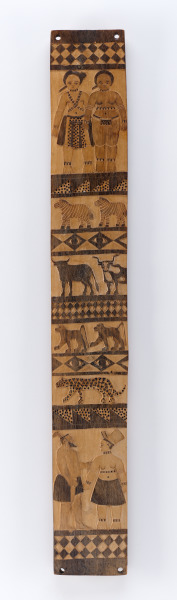
Storage-Rack Panels with Figures and Animals
1924-1949
Scroll
Storage-Rack Panels with Figures and Animals
1924-1949
Physical Qualities
Wood with burnt wood, 26 × 3 3/4 in. (66 × 9.5 cm.)
Credit Line
Gift of Dori and Daniel Rootenberg, New York, in Honor of Shannen Hill, Associate Curator of African Art, 2015-2017
Object Number
2017.223.2
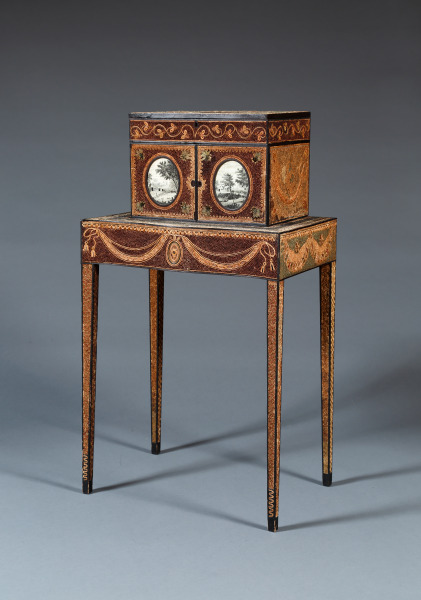
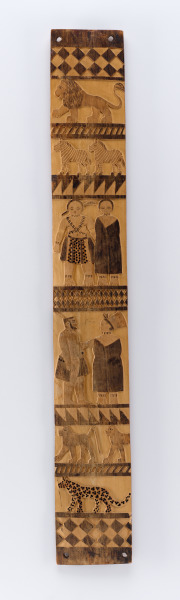
Here, two couples—one young, one old—are depicted among an array of animals native to southern Africa. Between the 1930s and 1950s, the Zulu carver Zizwezenyanga Qwabe established himself as one of the most sought-after artists in colonial South Africa. A master at pyrography, an artistic technique where designs are burned into wood with a hot tool, he became famous for idealized scenes of pre-colonial Zulu life.
Qwabe’s work was popular among both Black South Africans and Europeans. For Black South Africans suffering under the oppressive Apartheid regime, a political system of oppressive racial segregation and discrimination that benefited white citizens, scenes like this were a reminder of better days. White patrons viewed works like these as souvenirs.
The Baltimore Museum of Art by gift, 2017; Jacaranda Tribal, New York; Bourne End auction house, U.K., 2006; Private Collection, U.K.
African Gallery Rotations 2021
African Gallery Rotations 2022
African Gallery Rotations 2023
African Wing Rotations 2024
African Wing Rotations 2025
Sandra Klopper, "Reinventing Zulu Tradition: The Modernism of Zizwezenyanga Qwabe's Figurative Relief Panels," in Mapping Modernisms: Art, Indigeneity, Colonialism, eds. Elizabeth Harney and Ruth B. Phillips, 33-61 (Durham, NC: Duke University Press, 2018.
Artist
Zizwezenyanga Qwabe, Zulu, born c. 1900, active South Africa 1920-1940
1899–1974
Died at some point in late 1960s/early 1970s
Meet Zizwezenyanga →
 On View at the BMA
Explore the Collection Further