Pablo Picasso
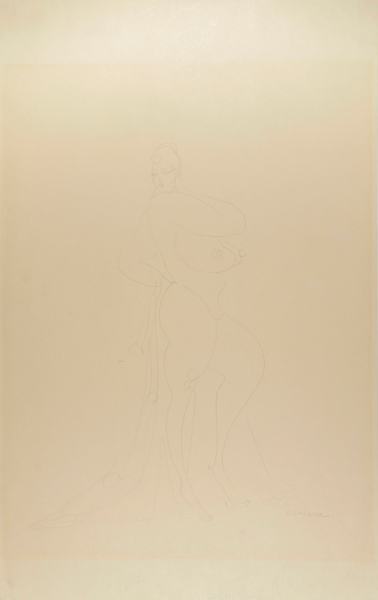
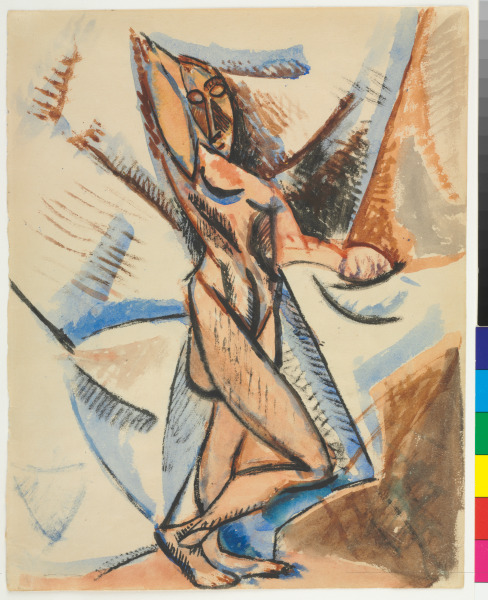
Study for “Nude with Drapery”
1906
Scroll
Pablo Picasso
Study for “Nude with Drapery”
1906
Physical Qualities
Watercolor and black conté crayon, Sheet: 309 × 243 mm. (12 3/16 × 9 9/16 in.)
Credit Line
The Cone Collection, formed by Dr. Claribel Cone and Miss Etta Cone of Baltimore, Maryland
Object Number
1950.278
During the summer of 1907, in the midst of the last revisions he would make to Les Demoiselles d'Avignon, Picasso produced a related painting that features one of the figures from the larger painting, Nude with Drapery, illustrated below. This watercolor comes from a sketch book acquired and dismantled by Leo Stein who also owned the painting. The artist's final adjustment to Les Demoiselles was the repainting of the heads of the two right figures. In a decision that would accentuate the radical modernism of this epic work, the faces were changed to emphazsize the bold and abstracted features of African masks. The same features were incorporated in his watercolor for Nude with Drapery and were undoubtedly inspired by his first visits to the ethnographic collection at the Trocadero Museum in Paris in June and July 1907. Rather than using a single type of African mask as his prototype, such as the Kota Religtuary Figure illustrated below, Picasso seems to have incorporated an amalgam of features from different masks. A visit to the galleries of African art on the lower floor of the Museum provides the opportunity to see a variety of African masks in addition to the Kota figure, including examples from the Luba and Dan peoples.
Picasso's radical composition where the diagonal fragmentation of the figure is so integrated into the background as to almost lose its independence, is said to be inspired by the legendary dances of the American performer, Loie Fuller. Picasso had seen her as Salome, a favorite subject for the artist, where 'Puller so expertly manipulated veils with canes that her figure seemed to disappear as it moved across a transparent stage lit from below by colored lights.
The Baltimore Museum of Art by bequest, 1949; Etta Cone, Baltimore, by purchase 1936; from Paul Rosenberg, Paris; Gertrude and Leo Stein until 1914
Picasso and Modern Art: Gifts to American Museums
Picasso, Braque and Early Film in Cubism
The Stein Family Collection
La Ofrenda
"Picasso: The Artist and His Muses"
Picasso and Primitive Art
Bearden/Picasso: Rhythms and Reverberations
"Cone Collection of Baltimore, Maryland," Baltimore: Etta Cone, 1934, pl. 64.
Christian Zervos, "Pablo Picasso, Vol. II," Paris: Editions Cahiers d'Art, 1942, no. 45.
Adelyn Breeskin, "Early Picasso Drawings in the Cone Collection,
Yale University Art Gallery. Pictures for a picture of Gertrude Stein as a collector and writer on art and artists : ǂb an exhibition: Yale University Art Gallery, February 11-March 11, 1951; the Baltimore Museum of Art, March 21 - Aril 21, 1951. [New Haven], [1951], cat. no. 30, (published as ‘Nu au bras leve’).
Pierre Daix and Georges Boudaille, "Picasso, the Blue and Rose Periods: A Catalogue Raisonné, 1900-1906," London: Evelyn, Adams and Mackay, 1967, XVI.12.
"The Cone Collection. " rev. ed., Baltimore: The Baltimore Museum of Art, 1967 no. 91, ill. p. 38.
Edward Burns, ed. "Gertrude Stein on Picasso," NY: Liveright/The Museum of Modern Art, 1970, ill. p. 133.
Victor I. Carlson, "Picasso: Drawings and Watercolors, 1899-1907 in the Collection of The Baltimore Museum of Art," Baltimore: The Baltimore Museum of Art, 1976, cat. 45.
Rubin, William, ed. Pablo Picasso, A Retrospective. New York: Museum of Modern Art, 1980, p. 103 ill.
Brenda Richardson, "Dr. Claribel & Miss Etta," Baltimore: The Baltimore Museum of Art, 1985, ill. p. 88.
National Gallery of Art, "Modern Art and America: Alfred Stieglitz and his New York Galleries," Boston, New York, and London: Bullfinch Press, 2000, p. 120, fig. 44.
Cowling, Elizabeth, Anne Baldassari, John Elderfield, et al. Matisse Picasso. Paris: Réunion des musées nationaux, 2002, figure 25, page 344.
Baltimore Museum of Art, "Newsletter of the Print and Drawing Society of the Baltimore Museum of Art," Volume XXI, No. 2, Fall 2003, p. 7, ill.
Helene Seckel, "Les Demoiselles D'Avignon," Paris: Musée Picasso, p.265, fig III.3.
Janet Bishop, Cécile Debray, and Rebecca Rabinow, eds., "The Steins Collect: Matisse, Picasso, and the Parisian Avant-Garde," San Francisco: The San Francisco Museum of Modern Art, 2011.
Levitov, Karen. Collecting Matisse and Modern Masters: The Cone Sisters of Baltimore. New York: The Jewish Museum; New Haven, CT; London: Yale University Press, 2011, page 24, fig. 11.
Fillion, Susan. Miss Etta and Dr. Claribel: Bringing Matisse to America. Boston: David R. Godine, 2011, page 41.
"The Baltimore Museum of Art: Celebrating a Museum," The Baltimore Museum of Art, 2014, p. 194-95.