Henri Matisse
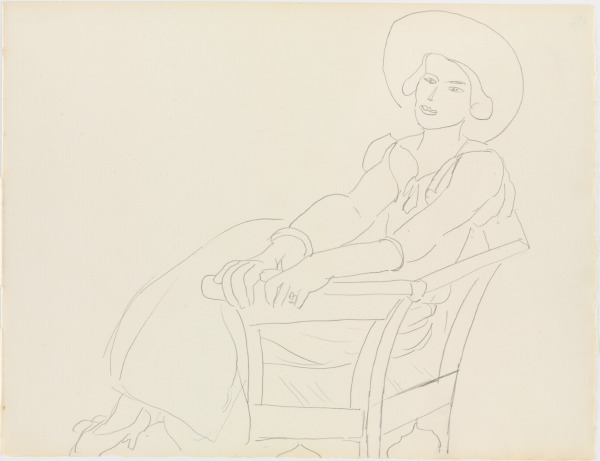
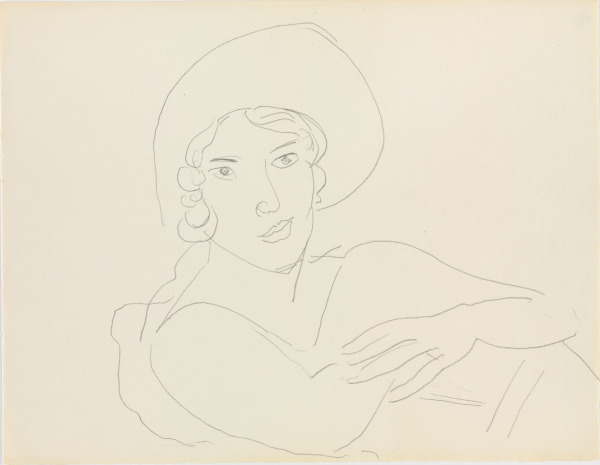
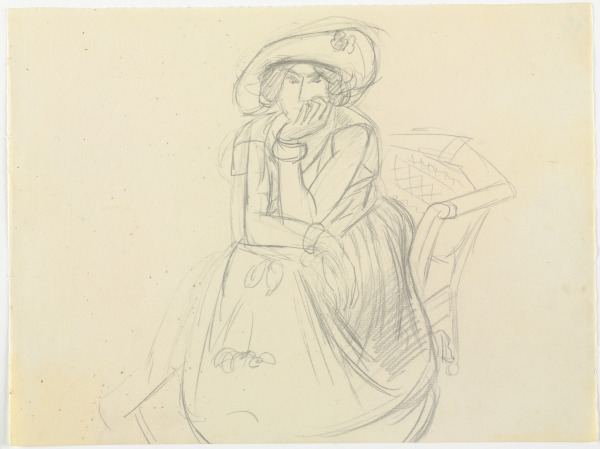
Study for “The Yellow Dress”
1923-1933
Scroll
Henri Matisse
Study for “The Yellow Dress”
1923-1933
Physical Qualities
Graphite on paper, Sheet: 235 × 317 mm. (9 1/4 × 12 1/2 in.)
Mat: 16 × 20 in. (40.6 × 50.8 cm.)
Credit Line
Marguerite Matisse Duthuit Collection
Object Number
2011.196
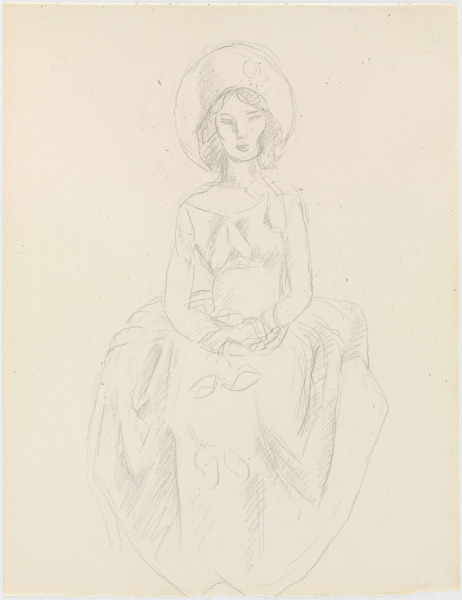
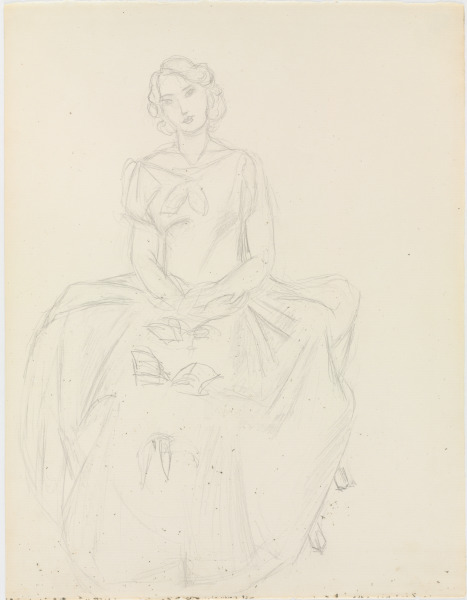
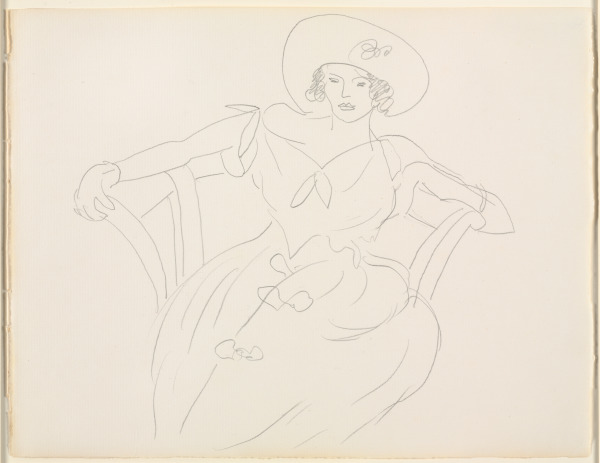
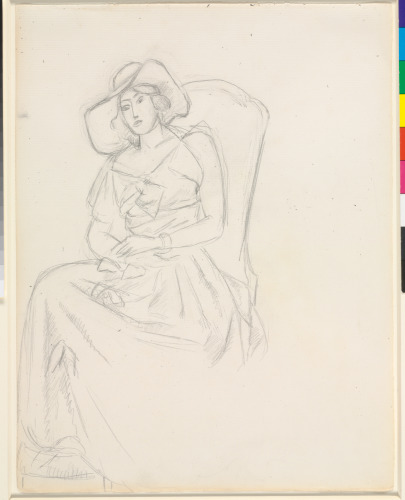
In the final group of studies, executed with notable hatch marks and erasures, the artist is less concerned with capturing the character of the model than with situating the model firmly in three-dimensional space. In the final image of the group, Matisse has arrived at the full-length, frontal pose in the finished painting.
The drawings for "The Yellow Dress" are especially noteworthy because they illustrate Matisse’s preference for drawing in series during the 1930s. By closely following the variations in these drawings, a viewer might enjoy an experience not unlike joining Matisse in his studio as the artist works tirelessly with the model. It was through this careful process that he could achieve familiarity with his subject and that familiarity, once attained, opened Matisse to new ways of seeing.
A horizontally oriented drawing to the far left of this wall, provides a link to Matisse’s paintings of the late 1920s, excellent examples of which can be found in the adjacent galleries. As such, this drawing provides a point of departure towards something new. We see an interior with Lisette in the background, surrounded by prominent interior details such as shutters, an elaborate chair, and decorative screen.
Five of the drawings (on the wall and in a nearby case) drawn in outline with graphite pencil, form a series of selected close-up views of Lisette, always including the prop of the distinct curving chair. The position of the model’s head and torso changes from slight profile to full face, accompanied by the changing positions of the arms. These variations reflect different attitudes from casual and personal, to more formal, as the artist and model collaborate to explore possibilities. Considering the number of torso and head studies of Lisette, it would be easy to assume that the primary purpose was portraiture when in fact what is most important is the positioning of Lisette’s figure seated in the chair. It is this singular concentration on the figure that would enlarge as the painting progressed which achieved for Matisse the compositional structure and monumentality
that he sought to bring to his art.
Three drawings bring concentrated emphasis to the position of the figure as central to the composition. One shows Lisette slumping in a high-back chair, looking absently to the left, while in another closely related sketch she leans forward in the chair, looking straight ahead, supporting her head with her arm. But, in the third drawing of this group, Matisse arrives at what is closest to the final position that Lisette will take in the painting. The figure is drawn mid-ground in the center of the sheet of paper. She sits up straight, her dress encompassing the rounded curve of the chair with arms drawn symmetrically to her body, hands nestled in her lap. Her head is held vertically, as she looks straight ahead with little hint of expression. Adding a touch of naturalness, the ribbons of the dress fall casually and a sleeve slips slightly off her right shoulder. Lisette’s figure seems to grow like a flower from a pot. The drawings for "The Yellow Dress" were formerly in the collection of Matisse’s daughter, Marguerite Duthuit and were donated in 2008–2011. This is the first time they have been exhibited together.
Follow these directions and you will be able to complete your journey from Matisse’s drawings to his actual painting of "The Yellow Dress." (Look to the left, walk through the center doorway of this gallery, then look again to the left through the door where you will see the painting, on a separate wall,in the distant gallery). When you arrive, and can look closely at the painting, you will see that the process of study and revision that begins with the drawings continues on canvas. There is no clear point where drawing ends and painting begins. For Matisse, the possibility of seeing anew is always
in the present.
The Baltimore Museum of Art by gift, 2011; Barbara Duthuit, France
Matisse, Life in Color: Masterworks From The Baltimore Museum of Art
New Arrivals: Matisse Prints & Drawings
A Modern Influence: Henri Matisse, Etta Cone, and Baltimore
Cozzi, Leslie and Katherine Rothkopf (eds). "A Modern Influence: Henri Matisse, Etta Cone, and Baltimore." Baltimore: The Baltimore Museum of Art, 2021. ill.
Markings: WM: MBM